Let me be honest with you for a second.
When I first started looking into tech careers seriously, I was drowning in contradictory advice. One article said “learn Python, you’ll be set for life.” Another said “AI is going to eat all the coding jobs anyway.” A LinkedIn post from some guy with 40,000 followers said “just get an AWS certification and you’re golden.”
The reality? It’s messier and more interesting than any of those takes.
The IT industry is not dying. But it is splitting. Some roles are shrinking — basic IT support, traditional data entry work, and certain junior developer positions are either being automated or outsourced at a rapid pace. At the same time, a separate set of IT careers is growing at a speed that companies genuinely can’t hire for fast enough.
The Bureau of Labor Statistics projects IT employment will grow by 11% between 2023 and 2033 — more than double the average growth rate across all occupations. That growth, though, is not spread evenly. It is concentrated in specific roles tied to AI, cloud infrastructure, cybersecurity, and data.
This article is not a generic list of “cool tech jobs.” It’s a practical breakdown of the IT roles that are seeing real, documented demand in 2025 and into 2030 — along with what they actually pay, what skills they need, and how realistic they are for someone starting from different points.
Let’s get into it.
Why the “Future of IT Jobs” Conversation is Different Now
A few years ago, this was a simpler conversation. Companies were digitizing rapidly and almost any IT skill — networking, basic web development, database administration — had decent demand.
That’s changed. The reason is AI.
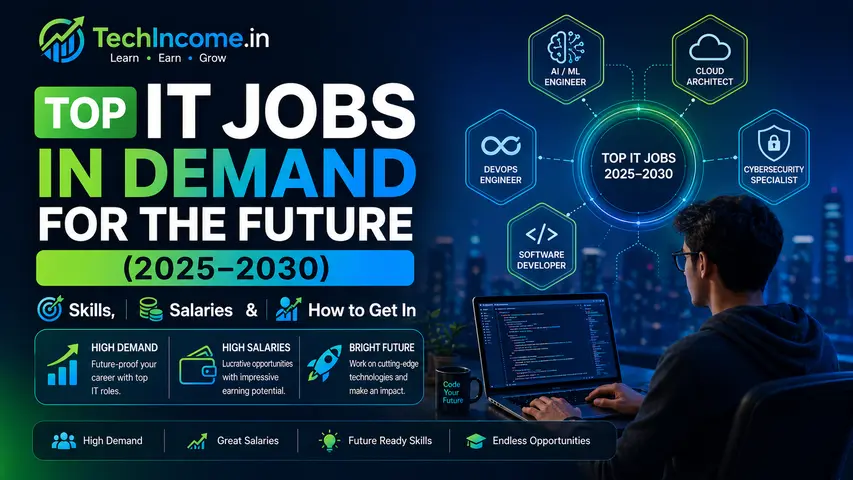
Not because AI is replacing all tech workers (it isn’t), but because AI has fundamentally altered what companies need from their tech teams. According to Robert Half’s 2026 IT Salary Report, the top priorities that business leaders are hiring for right now are: AI and machine learning (45%), IT operations and infrastructure (36%), IT governance and compliance (25%), cloud architecture (24%), and data engineering (22%).
Notice what’s missing from that list. Basic software support. Generic web development. Junior QA roles.
Companies still need humans in tech — but they need humans who can do what AI cannot, or who can guide and manage the AI systems that are being rolled out everywhere. That’s the key lens through which you should look at every job on this list.
1. AI/ML Engineer — The Hottest Role Right Now
If there is one job title that has gone from “niche” to “desperately needed” in the shortest time, it is the AI/ML Engineer.
These professionals design, build, and maintain the machine learning systems that companies are now integrating into almost every product and process. That means working with large language models, training custom ML pipelines, building recommendation engines, and increasingly — making sure the AI systems a company deploys actually behave reliably in production environments.
Why the demand is real: Mid-level AI engineers are seeing salary growth of 9.2% year-over-year, which is the fastest growth rate of any tech specialisation right now. Average salaries in the US sit around $167,000 annually for experienced professionals, with senior roles going significantly higher.
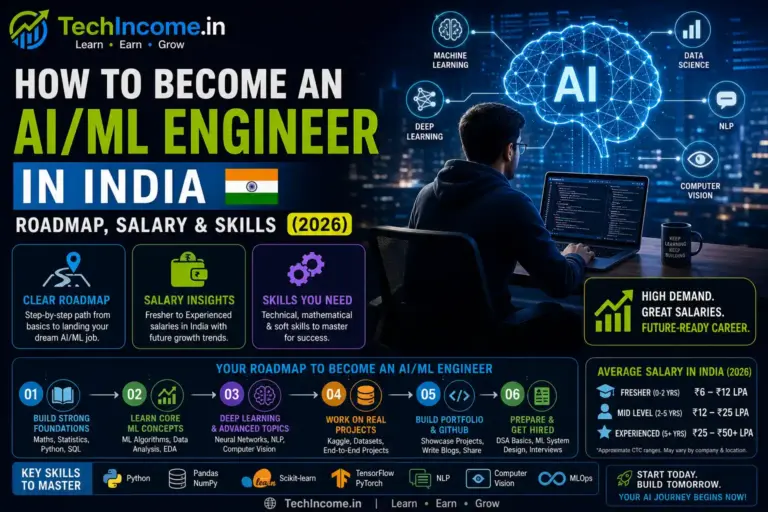
What you actually need: Python is non-negotiable. Beyond that, you’ll want experience with frameworks like TensorFlow or PyTorch, familiarity with cloud-based ML services (AWS SageMaker, Google Vertex AI, Azure ML), and increasingly — knowledge of how to fine-tune and deploy large language models. A solid understanding of mathematics (linear algebra, statistics, calculus) matters more than most bootcamps will tell you.
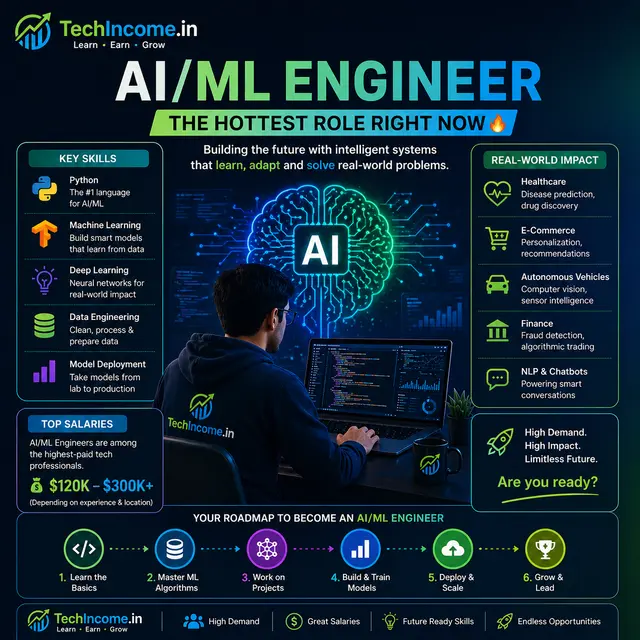
India-specific context: Indian companies and MNCs are aggressively hiring for AI/ML roles in Bangalore, Hyderabad, and Pune. Freshers with strong ML fundamentals and a GitHub portfolio are landing roles between ₹8–15 LPA. Mid-level engineers with 3–4 years of experience are routinely pulling ₹20–40 LPA.
2. Cloud Architect — The Backbone of Everything Digital
Almost every major organization in the world is in the middle of moving its infrastructure to the cloud. Some are mid-migration. Some are re-evaluating their cloud strategy entirely. Every single one of them needs someone who understands how to design, optimize, and secure cloud environments.
That someone is a Cloud Architect.
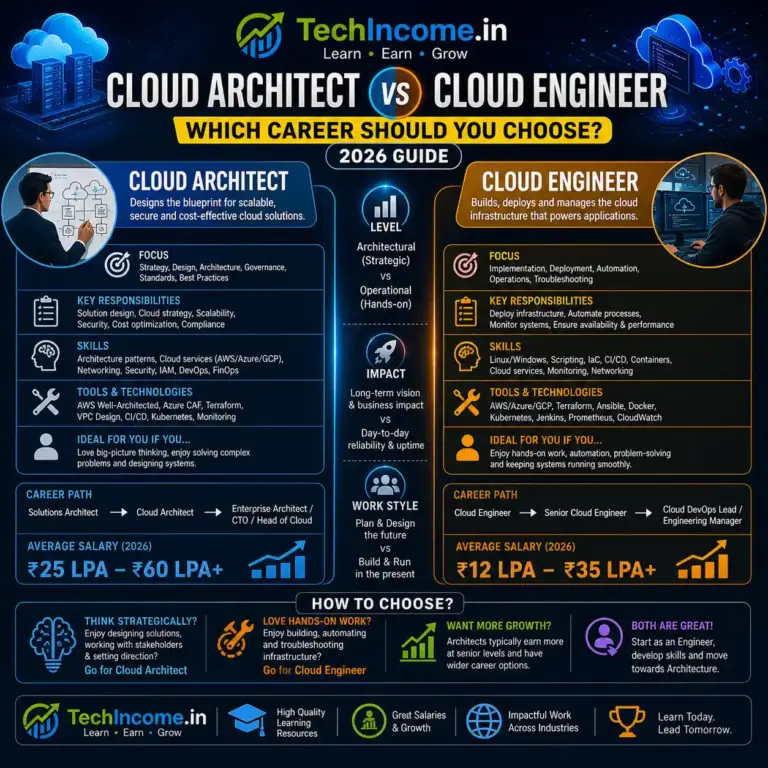
The role involves designing an organization’s entire cloud strategy — deciding which services go on AWS vs. Azure vs. Google Cloud, how data flows between systems, how costs are managed, and critically, how everything stays secure and available when something breaks (and something always breaks).
Why the demand is real: Cloud Architects in the US earn an average of $143,270 annually — and that’s the average, not the ceiling. As businesses double down on AI infrastructure (which is entirely cloud-dependent), the demand for architects who can design those environments is accelerating fast.
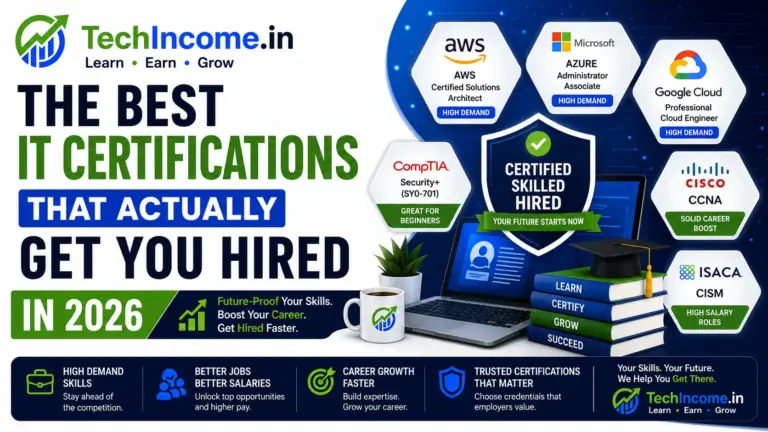
What you actually need: Start with a cloud certification — AWS Solutions Architect, Google Cloud Professional Architect, or Microsoft Azure Solutions Architect are the three most respected. Practical experience matters more than credentials here, though. Most Cloud Architects come from a background in systems administration, DevOps, or software engineering. You don’t become one straight out of college; you grow into it.
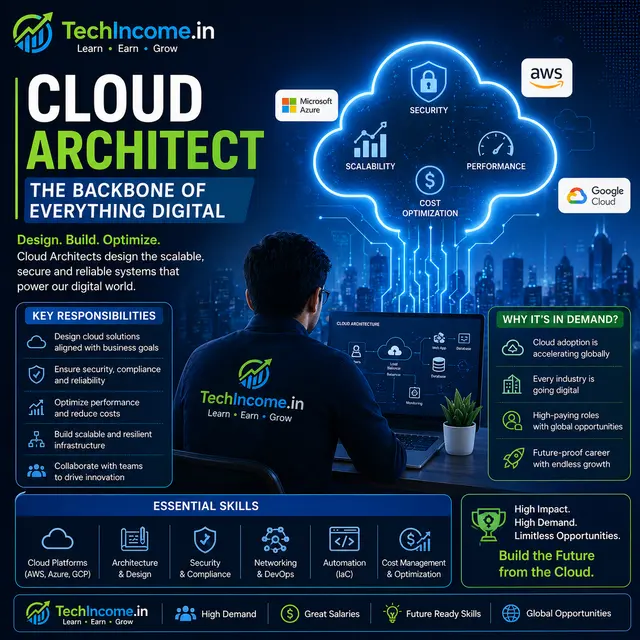
India-specific context: Cloud Architect roles are among the most actively recruited positions at Indian tech companies and at the India offices of global enterprises. Expect ₹18–45 LPA for experienced candidates, with significant variance depending on whether you’re multi-cloud certified or have AWS specialty certifications.
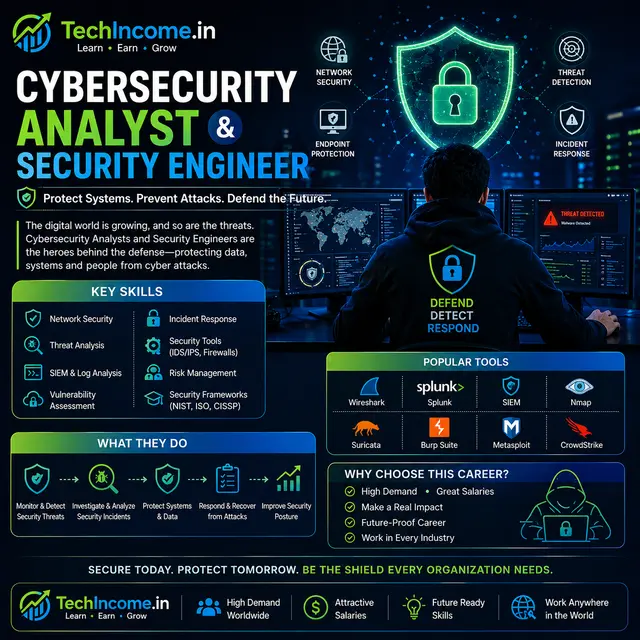
3. Cybersecurity Analyst and Security Engineer
Here is a number that should stop you for a moment: there is currently a global shortage of over 3 million cybersecurity professionals. Three million. And that gap is not closing — it is widening, because every new AI system, every new cloud deployment, every new connected device creates new attack surfaces that need to be defended.
Cybersecurity spans several sub-roles. At the entry level, you have Security Analysts who monitor systems, respond to threats, and investigate incidents. As you move up, roles like Security Engineer, Cloud Security Specialist, and eventually CISO (Chief Information Security Officer) open up. A CISO at a large enterprise in the US earns between $304,000 and $483,000 annually — making it one of the highest-paid positions in all of IT.
Why the demand is real: Employers rank security architect and security engineer among the most in-demand roles they cannot fill. 87% of companies say they offer higher salaries to candidates with specialized cybersecurity skills, and most organizations admit they don’t have the talent they need to protect their own infrastructure.
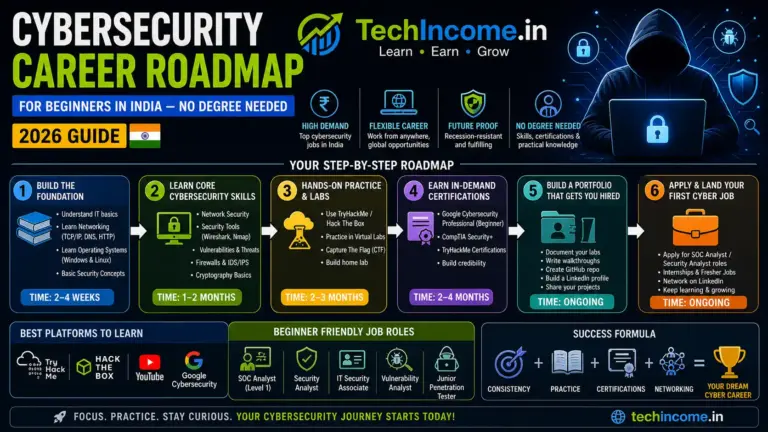
What you actually need: For entry-level roles, CompTIA Security+ is widely recognized as the first meaningful certification to pursue. From there, CEH (Certified Ethical Hacker), CISSP, and CISM open doors to senior positions. Gaining the CISSP or CISM certification typically boosts cybersecurity salaries by 20–30%. A background in networking (understanding how traffic flows, what firewalls do, how encryption works) is essential.
India-specific context: Every bank, every fintech startup, every government digital initiative in India is actively hiring cybersecurity professionals. This is one of the few IT roles where demand genuinely outpaces the available talent pool in India. Salaries range from ₹6–12 LPA at entry level to ₹25–60 LPA for senior security architects.
4. Data Scientist and Data Engineer
The phrase “data is the new oil” has been beaten to death, but the job market data confirms it’s not just a slogan. Data scientists with the ability to turn messy, complex datasets into business decisions are commanding serious compensation and holding serious influence inside organizations.
It’s worth distinguishing between two related but different roles here.
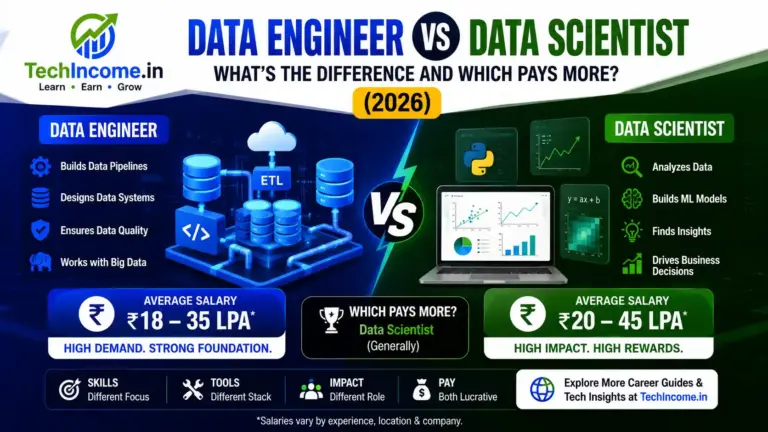
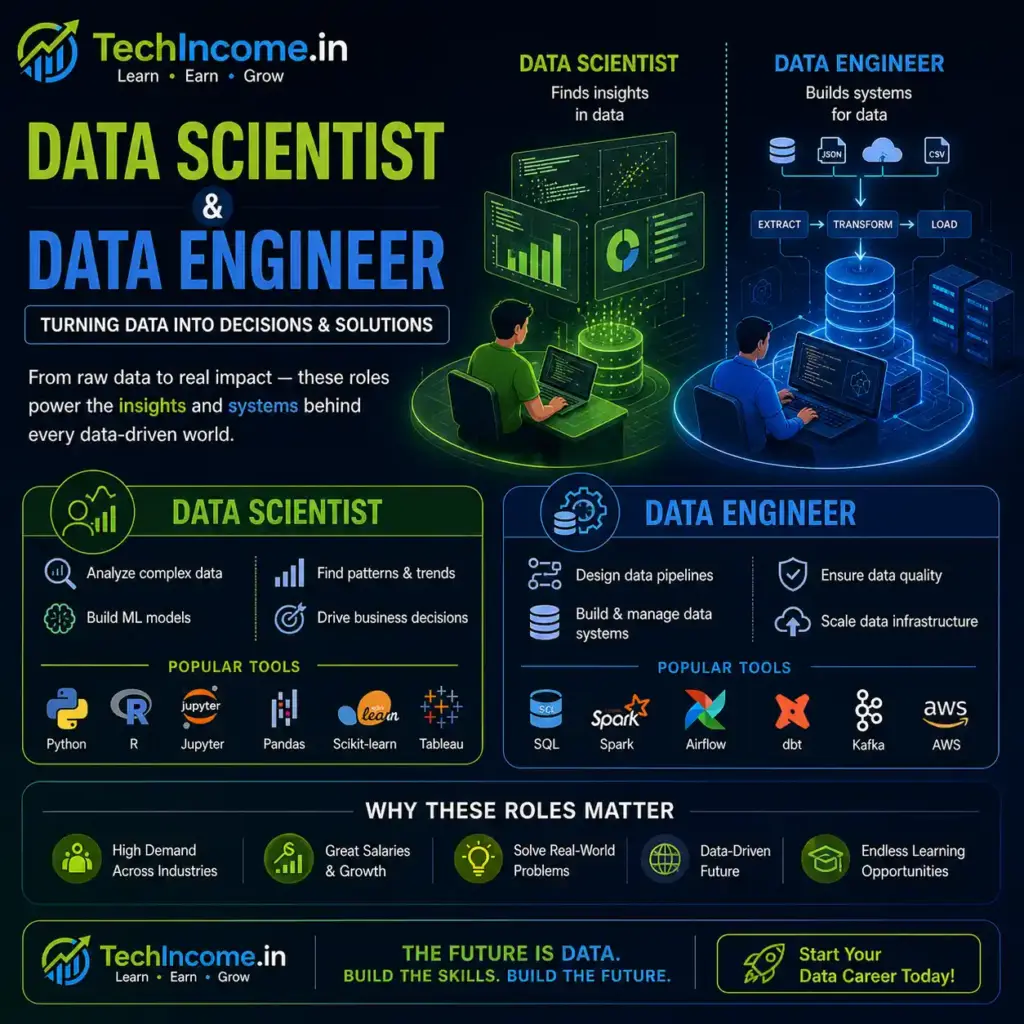
A Data Scientist builds statistical models, creates predictive systems, and finds patterns in data that help organisations make smarter decisions. They often work closely with business stakeholders and need to communicate insights clearly to non-technical leaders.
A Data Engineer builds the infrastructure that makes all of that possible — the pipelines, databases, and data architecture that Data Scientists then use. Data Engineering is arguably more in-demand right now because it’s less glamorous and therefore less saturated.
Why the demand is real: Data science roles have seen documented growth of over 400% in the past decade, and the AI revolution has only accelerated the need for quality data infrastructure. Bad data produces bad AI — so companies investing in AI are simultaneously investing in data engineering.
What you actually need: Python and SQL are your starting points. For Data Science, add machine learning fundamentals, statistics, and tools like Pandas, Scikit-learn, and Tableau. For Data Engineering, focus on Apache Spark, Kafka, dbt, Airflow, and cloud data warehouses like BigQuery or Snowflake.
India-specific context: Indian IT services companies and product startups are both aggressively hiring for data roles. Expect ₹7–15 LPA at the junior level for Data Analysts moving into Data Science, and ₹20–50 LPA for experienced Data Engineers with strong cloud data pipeline experience.
5. DevOps and Platform Engineer
A few years ago, software was built by developers and then handed to a separate operations team to deploy. That division created constant friction — developers pushed code, operations struggled to keep things stable, and everyone blamed everyone else when things broke.
DevOps solved that. And DevOps engineers are now among the most quietly in-demand professionals in all of tech.
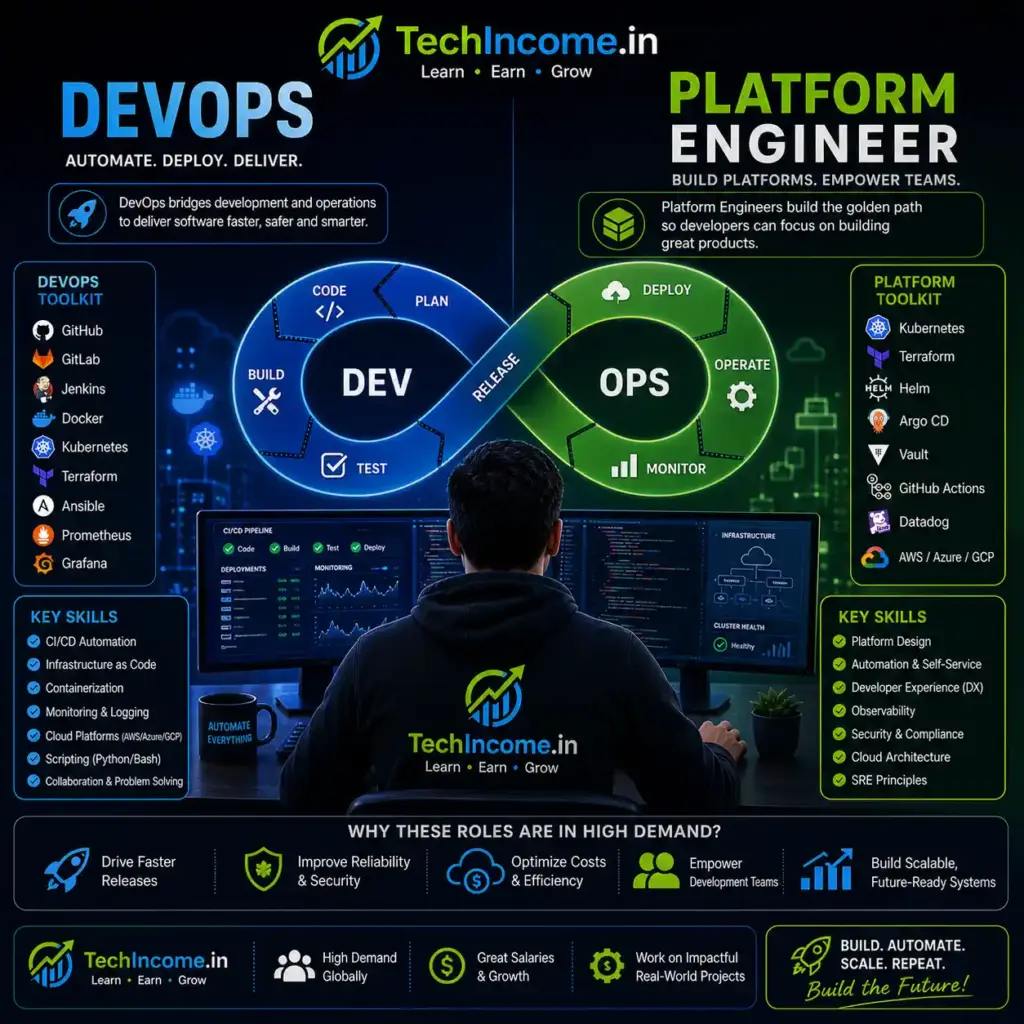
A DevOps Engineer bridges software development and IT operations — automating deployment pipelines, managing containerised infrastructure (Docker, Kubernetes), ensuring systems scale reliably, and keeping production environments healthy. The newer evolution of this role is the Platform Engineer, who builds the internal tools and infrastructure that other developers use, essentially creating an internal developer platform.
Why the demand is real: Companies releasing software faster need DevOps expertise to do it without breaking things. Robert Half consistently lists DevOps engineers among roles where employers are willing to pay above-market salaries to find the right candidate. The combination of coding skills plus cloud plus infrastructure knowledge is genuinely rare.
What you actually need: Linux fundamentals, scripting (Bash, Python), CI/CD tools (Jenkins, GitHub Actions, GitLab CI), containerisation (Docker + Kubernetes), and cloud platform experience. Infrastructure-as-code tools like Terraform and Ansible are increasingly expected. Certifications like CKA (Certified Kubernetes Administrator) carry weight.
India-specific context: DevOps is one of the most actively advertised roles on Indian job platforms. Companies that have modernised their tech stacks are particularly hungry for experienced DevOps engineers. Salaries range from ₹8–18 LPA mid-level and ₹25–55 LPA for senior platform engineers at product companies.
6. Full Stack Developer — Still Solid, But Only If You Evolve
Full Stack Development is one of the most common IT careers in India, and its future is frequently debated. Is it still worth pursuing? Yes — but with an important asterisk.
A Full Stack Developer who only knows how to build standard CRUD applications and REST APIs is facing real headwinds from AI-assisted coding tools. But a Full Stack Developer who can build AI-integrated applications, understands system design, writes clean and scalable code, and can take a product from concept to deployment? That person is as valuable as ever.
Why the demand is real: Despite the noise, software development remains one of the most consistently in-demand IT roles. The demand has not collapsed — it has shifted toward developers who can build higher-quality, AI-augmented products rather than just writing boilerplate.
What you actually need: React or Next.js on the frontend. Node.js, Python (Django/FastAPI), or Go on the backend. SQL + NoSQL databases. Git, basic DevOps, and — this is increasingly important — the ability to integrate LLMs and AI APIs into your applications. Projects on your GitHub matter more than certifications.
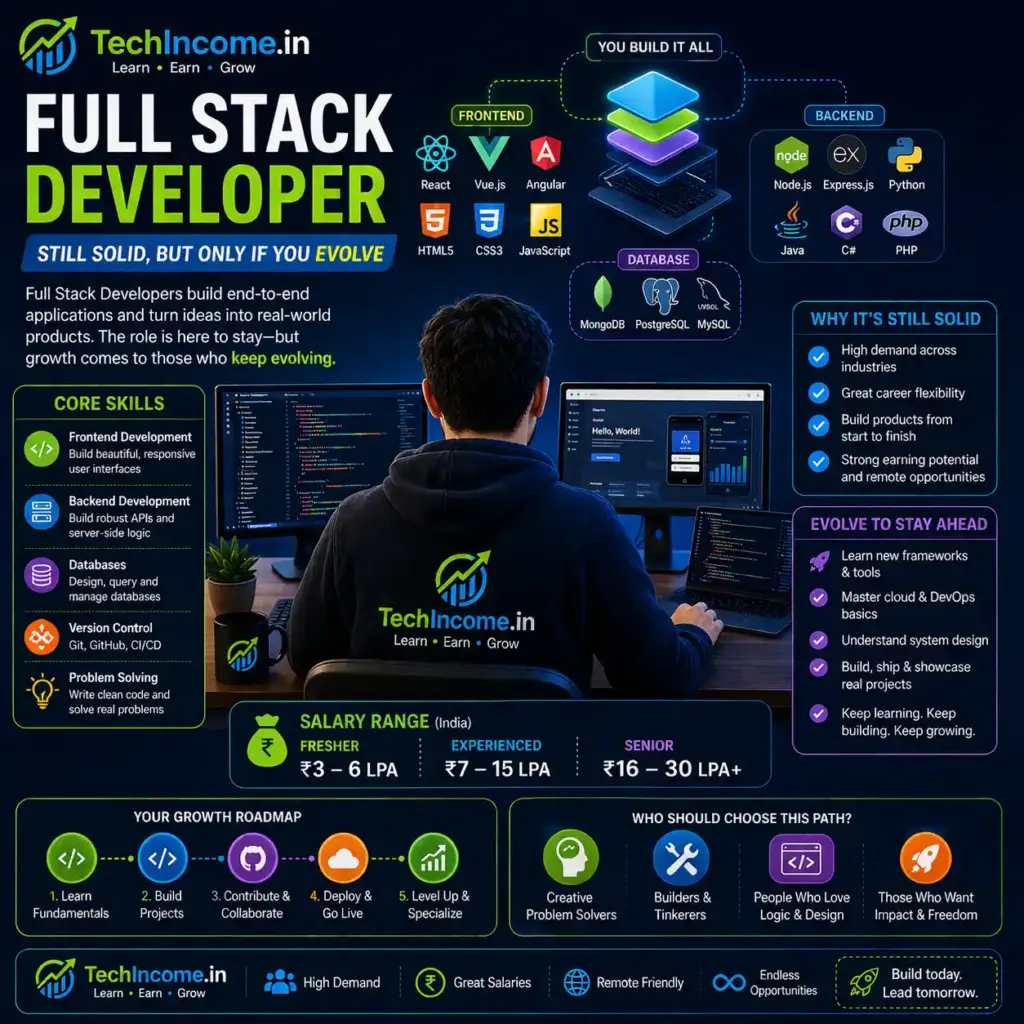
India-specific context: Full Stack Development is the most common entry point into a tech career in India. The ceiling is real though — developers who stop learning after landing their first job see salary growth stagnate. Those who keep building, learning system design, and adding AI/cloud skills consistently move toward ₹20–40 LPA within 5–7 years.
7. Prompt Engineer and AI Product Manager
This is the newest category on this list, and the most misunderstood.
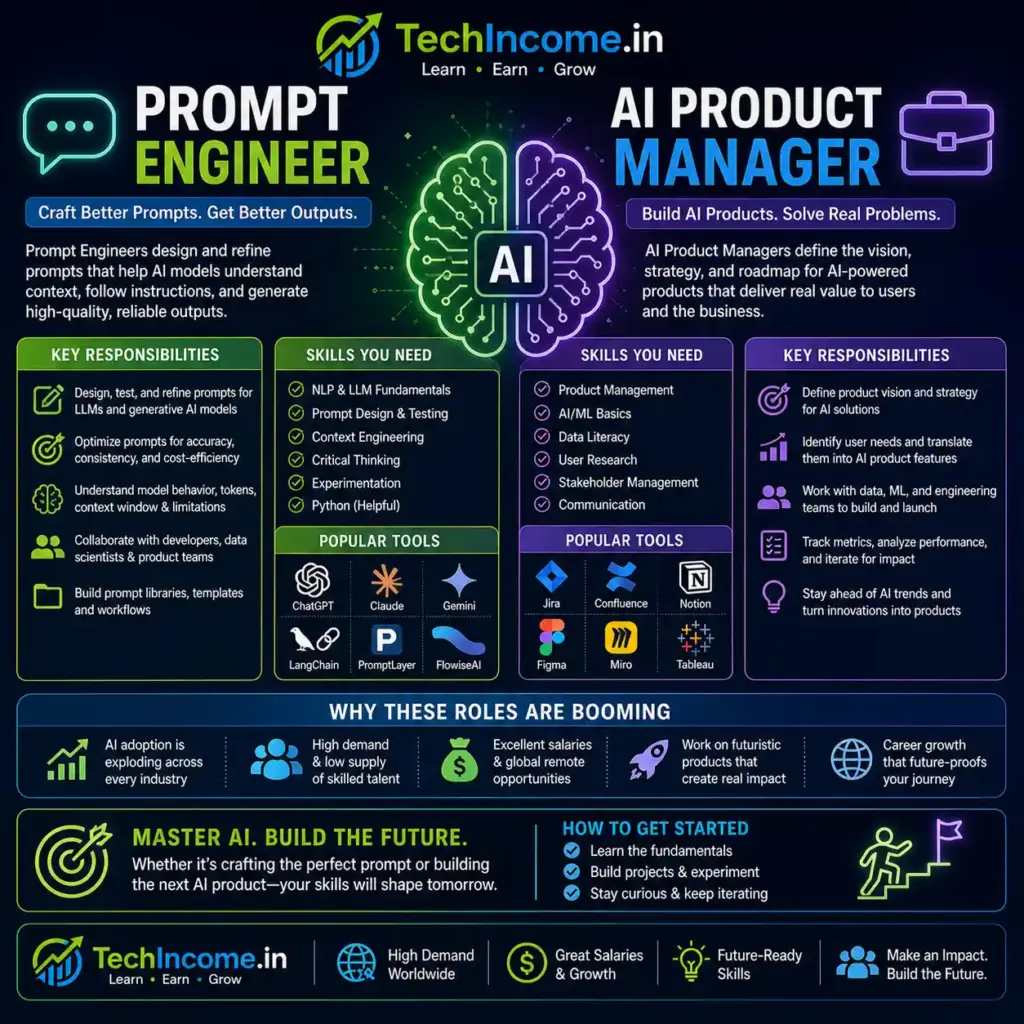
Prompt Engineering is not just “typing better questions into ChatGPT.” At its professional level, it involves designing structured prompting systems, building reliable AI workflows using tools like LangChain or LlamaIndex, evaluation and red-teaming of AI outputs, and working with engineering teams to deploy LLM-powered features in production.
The AI Product Manager role sits adjacent to this — these are people who understand AI capabilities deeply enough to make smart product decisions about where and how to deploy AI in a company’s product. They don’t need to build the models, but they need to understand what the models can and cannot do.
Why the demand is real: As every company scrambles to build “AI features,” the gap between companies that use AI well and those that use it badly is enormous — and the people who bridge that gap are in short supply.
What you actually need: Deep familiarity with LLM APIs (OpenAI, Anthropic, Gemini), prompt design patterns, output evaluation methods, and ideally some coding ability. For AI Product Management, add product management fundamentals — roadmapping, stakeholder communication, user research — to your AI knowledge.
India-specific context: This is an emerging category in India but growing fast, particularly in Bangalore’s startup ecosystem and at MNC product offices. Roles are often titled “AI Engineer,” “LLM Engineer,” or “GenAI Product Manager.” Compensation ranges widely from ₹12–50 LPA depending on experience.
8. IoT Engineer and 5G Specialist
Not everything runs in the cloud. Billions of physical devices — factory machines, medical devices, smart meters, vehicles, agricultural sensors — need to communicate, process data at the edge, and connect to broader systems. The professionals who design and maintain these systems are IoT Engineers.
With 5G networks now more widely deployed, the speed and reliability of device communication has jumped significantly, opening up use cases (real-time robotics, connected vehicles, smart city infrastructure) that were previously impractical. That creates demand for engineers who understand both the hardware and software dimensions of connected systems.
Why the demand is real: IoT spending globally is in the hundreds of billions of dollars annually, and the 5G rollout is still mid-way in most countries including India. The talent pipeline for embedded systems and IoT engineering is narrow, which means qualified professionals command strong compensation.
What you actually need: Embedded C/C++, MQTT and other IoT protocols, edge computing frameworks, and increasingly — experience with AI at the edge (TinyML). For 5G-focused roles, telecommunications networking knowledge is essential. Certifications like Cisco IoT or AWS IoT Core specialisations help.
India-specific context: Indian manufacturing, agriculture (precision farming), and smart infrastructure sectors are adopting IoT rapidly. BSNL and Jio’s 5G expansions are also driving demand for 5G specialists. Salaries are ₹8–20 LPA at mid-level, with strong upside for specialists in industrial IoT or telecom.
9. Blockchain Developer
Blockchain had a hype cycle. The hype cooled. And what was left after the hype cooled? Real, sustained enterprise demand for blockchain development in specific sectors — supply chain transparency, healthcare data management, digital identity, and financial settlement systems.
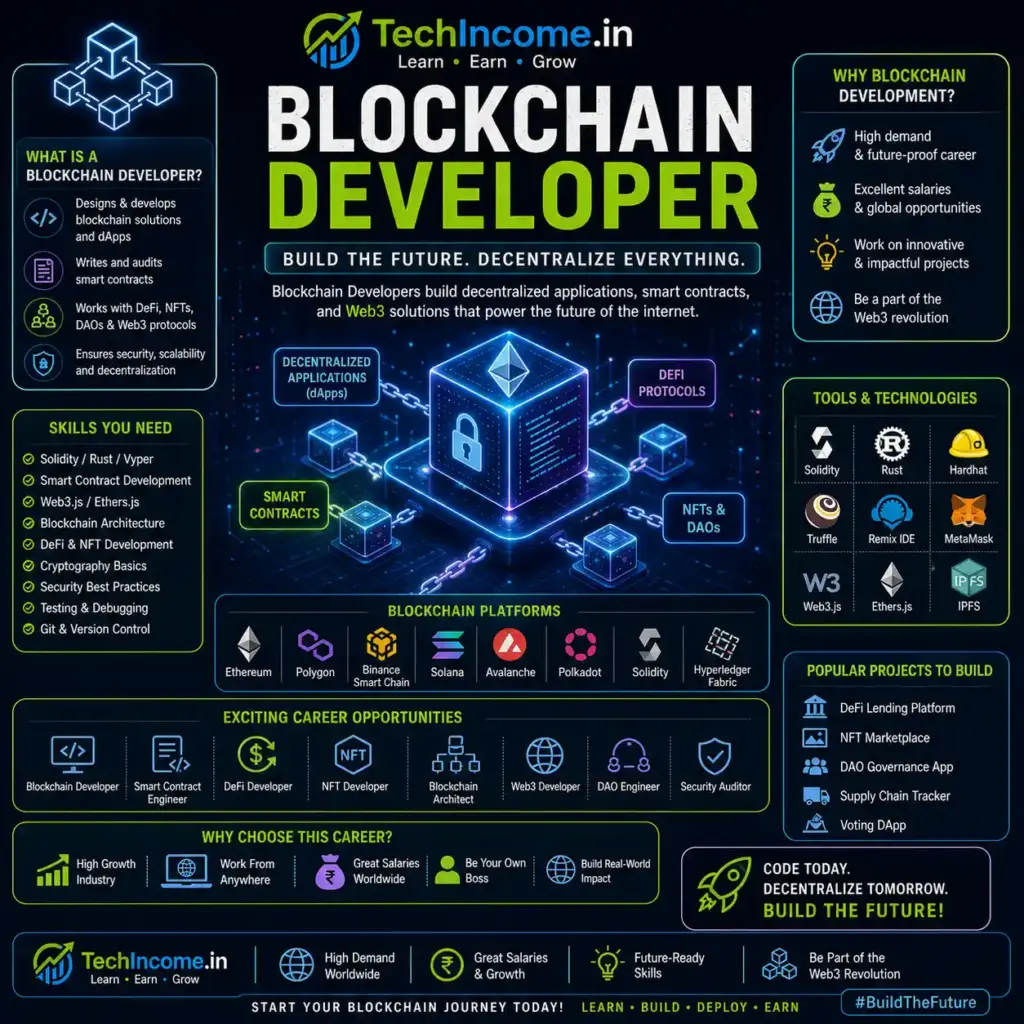
A Blockchain Developer builds and maintains blockchain-based applications and smart contracts. The speculative crypto side of blockchain may have quieted, but the enterprise application of distributed ledger technology has continued to grow quietly and steadily.
Why the demand is real: Global financial institutions, healthcare companies, and logistics firms are running active blockchain implementations. Developers with experience in Solidity (Ethereum), Hyperledger Fabric, or Polkadot are finding consistent demand, particularly from fintech and enterprise software companies.
What you actually need: Depending on your focus, either Solidity and Web3.js for public blockchain development, or Java/Go with Hyperledger Fabric for enterprise blockchain. Strong understanding of cryptographic fundamentals and consensus mechanisms rounds out the knowledge base.
India-specific context: Indian fintech companies, BFSI enterprises, and government-backed digital identity projects are the primary employers. Blockchain developers in India earn ₹10–35 LPA depending on depth of experience and domain focus.
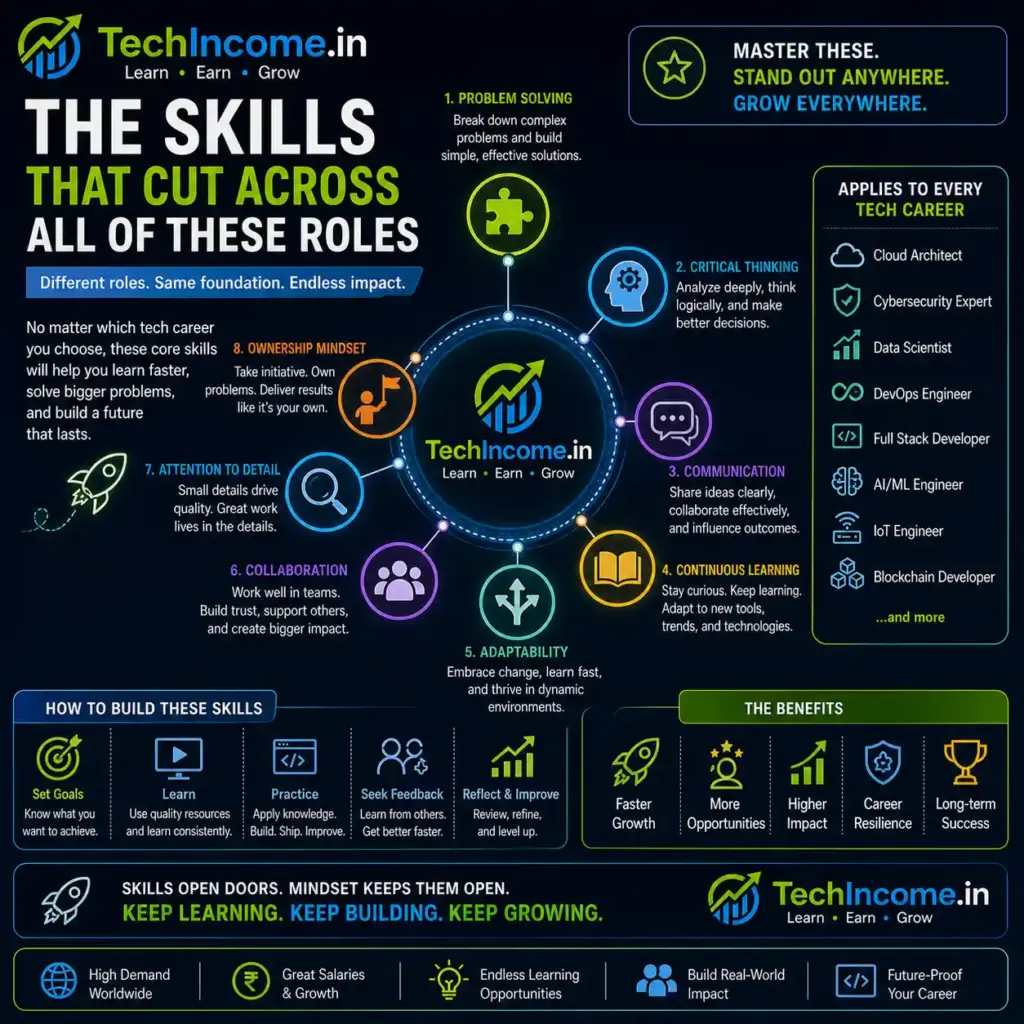
The Skills That Cut Across All of These Roles
Before you close this page and immediately sign up for a random YouTube course, I want to leave you with something more useful: the cross-cutting skills that make you better at almost any IT role on this list.
Cloud fluency. Not every role needs a cloud certification, but understanding how cloud services work — storage, compute, serverless, IAM — is now baseline literacy in IT. It’s the equivalent of knowing how to use a spreadsheet was 20 years ago.
Python. If you’re picking one programming language to learn that applies across AI/ML, data, automation, DevOps scripting, and backend development — Python is it. It’s not the only language worth learning, but it’s the most versatile starting point.
Systems thinking. The IT professionals who grow fastest are the ones who understand how things connect — how a database design decision affects application performance, how an infrastructure choice affects security posture, how a data pipeline failure ripples downstream. This is a mindset, not a skill you get from a course. You build it through building things and breaking things.
Clear communication. The highest-paid IT professionals are almost universally people who can explain complex technical topics to non-technical stakeholders. The ability to translate between the engineering team and the business side is genuinely rare and genuinely valuable.
How to Pick Your Starting Point
If you are a student or career changer, the honest answer is: don’t chase the highest salary on this list. Chase the intersection of what genuinely interests you and what has real demand.
If you like problem-solving at the system level, Cloud or DevOps is a natural fit.
If you find data and statistics interesting, Data Engineering or Data Science gives you enormous career flexibility.
If security and defence appeal to you — the cat-and-mouse of finding vulnerabilities before attackers do — Cybersecurity is a career that’s almost recession-proof.
If you are already a developer looking to level up, adding AI integration skills to your existing stack is the fastest path to a meaningful salary jump right now.
What I’d suggest avoiding: starting from the salary number and working backwards. That approach produces professionals who are technically competent in a tool they don’t care about, which always shows up eventually in the quality of their work — and in how quickly they plateau.
The IT careers with genuine future demand are the ones where someone is curious enough to keep learning even when it gets hard. That curiosity is, in the end, the most important skill of all.
At techincome.in, we write honestly about tech careers, income strategies, and skills worth building. No fluff, no sponsored rankings, just what’s actually working.
Here are the FAQs, written to rank in Google’s People Also Ask and Featured Snippets — structured for both SEO and genuine reader value.
Recommended Next Reads:
- https://techincome.in/how-to-become-an-ai-ml-engineer-in-india/
- https://techincome.in/cybersecurity-career-india/
- https://techincome.in/cloud-architect-vs-cloud-engineer/
- https://techincome.in/data-engineer-vs-data-scientist/
- https://techincome.in/the-best-it-certifications-2026/
- https://techincome.in/tech-industry/
Frequently Asked Questions
1. Which IT job has the highest demand in the future?
AI/ML Engineer is currently the single highest-demand IT role going into 2025–2030. Businesses across every industry — banking, healthcare, retail, logistics — are actively integrating AI into their products and operations, and the number of engineers who can actually build and deploy production-grade ML systems is far smaller than what companies need. Closely behind are Cloud Architects, Cybersecurity Engineers, and Data Engineers. If you’re picking purely by demand-to-supply ratio, cybersecurity is worth noting too — there is a documented global shortage of over 3 million cybersecurity professionals, and that gap is not shrinking.
2. Which IT skills will be most in demand by 2030?
By 2030, the IT skills with the strongest and most durable demand are expected to be: cloud infrastructure (AWS, Azure, GCP), AI/ML development and model deployment, cybersecurity and cloud security, data engineering and pipeline architecture, and the ability to build AI-integrated applications. Python will remain the most cross-applicable programming language across almost all of these. Beyond specific tools, the ability to design scalable systems — what the industry calls “systems thinking” — will separate average engineers from the ones who advance fast. Soft skills like communicating technical ideas to non-technical stakeholders will also become increasingly valuable as AI handles more routine coding tasks.
3. Is IT still a good career in 2025?
Yes, but with an important nuance. IT is a good career in 2025 if you are in or moving toward the roles that are genuinely growing — AI, cloud, cybersecurity, data engineering. It is a harder career if you are doing work that AI tools are beginning to automate, such as basic code generation, routine QA testing, or generic IT support. The overall sector is still projected to grow at more than double the average rate of all other occupations through 2033. The key is being deliberate about which part of IT you’re in. Generic is increasingly risky. Specialised and adaptable is increasingly valuable.
4. Which IT field is best for the future in India specifically?
For India, the strongest future-facing IT fields right now are AI/ML engineering, cloud computing, cybersecurity, and data engineering. All four are seeing aggressive hiring by both Indian product companies and the India offices of global tech firms. Cybersecurity stands out in the Indian context because demand is being driven not just by tech companies but by banking, fintech, healthcare, and government sectors — which are all digitising rapidly under regulatory pressure. Full stack development remains viable in India but requires continuous upskilling, particularly in AI integration, to stay competitive. For freshers, getting into a cloud or data role with a relevant certification is one of the most reliable paths right now.
5. Can I get an IT job without a computer science degree in 2025?
Yes, and this is increasingly common. Many companies — including large product companies and startups — now evaluate candidates primarily on demonstrated skills rather than degrees. Certifications like AWS Solutions Architect, Google Cloud Professional, CompTIA Security+, or a strong portfolio of GitHub projects carry significant weight. Bootcamp graduates have successfully entered roles in cybersecurity, cloud, DevOps, and full stack development. That said, for certain specialised roles — particularly AI/ML research, data science with heavy statistics work, or enterprise architecture — a relevant degree or master’s-level education still gives you a meaningful advantage. The honest answer is: a degree helps, but it is no longer the only door.
6. How long does it take to become an AI/ML engineer?
For someone starting with basic programming knowledge, a realistic timeline to an entry-level AI/ML role is 12 to 18 months of focused learning. This includes mastering Python fundamentals, statistics and linear algebra basics, machine learning theory using Scikit-learn, and then building 3–5 real portfolio projects using frameworks like TensorFlow or PyTorch. For someone already working as a software developer or data analyst, the transition is often faster — 6 to 9 months of deliberate upskilling is enough to become a credible candidate for junior AI/ML roles. Landing senior positions takes 3 to 5 years of hands-on experience with real production ML systems.
7. What is the starting salary for IT freshers in India in 2025?
Starting salaries for IT freshers in India vary significantly by role and company type. At large IT service companies like TCS, Infosys, and Wipro, fresher packages typically range from ₹3.5–6 LPA. At mid-size product companies and SaaS startups, freshers with strong skills in cloud, AI, or cybersecurity are being offered ₹7–15 LPA. At top-tier product companies and unicorn startups, strong freshers from premier colleges or with standout portfolios can receive ₹20–35 LPA. The biggest factor separating a ₹4 LPA offer from a ₹12 LPA offer is almost always the same thing: demonstrable skills through personal projects, open-source contributions, or internship experience — not just a degree certificate.
8. Is Python enough to get an IT job in 2025?
Python alone is not enough, but Python is an excellent and almost essential starting point. The question is what you build on top of it. A Python-only developer without a clear specialisation is in a saturated market. But Python combined with data engineering libraries and SQL makes you a strong Data Engineer candidate. Python with machine learning frameworks makes you an AI/ML candidate. Python with cloud SDKs and scripting knowledge makes you a DevOps or Cloud candidate. Think of Python as the foundation — necessary but not sufficient. Pick a direction, go deep in that direction, and Python will serve you well as the scripting language that connects everything together.
9. Will AI replace IT jobs?
AI will replace some IT tasks, not IT jobs wholesale — and this distinction matters. Routine, repetitive parts of IT work — writing boilerplate code, basic test case generation, standard documentation, first-level support tickets — are already being handled partly by AI tools. But the roles that involve system design, architectural decisions, security strategy, complex data modelling, and understanding business context remain firmly human. In fact, the rise of AI is creating more IT jobs than it’s eliminating, because every AI system needs to be built, deployed, maintained, secured, and improved by people. The IT professionals most at risk are the ones who are doing purely routine work and not developing judgment, problem-solving ability, or specialised expertise alongside their technical skills.
10. What is the difference between a software developer and an IT professional?
“IT professional” is a broader umbrella term that includes software developers, but also covers roles like systems administrators, network engineers, cybersecurity analysts, cloud architects, database administrators, and DevOps engineers. Software developers specifically write and maintain software applications. IT professionals in other roles focus more on infrastructure, security, operations, and the systems that software runs on. In daily usage, the lines blur — especially at smaller companies where one person wears multiple hats. But in terms of career planning, knowing whether you want to build software (development) or manage the systems and infrastructure that software lives on (IT operations, cloud, security) helps you pick the right learning path early.
11. Which certification is best for an IT career in 2025?
The best IT certification depends on the career path you’re targeting. For cloud, the AWS Certified Solutions Architect – Associate is the most recognised and widely accepted across industries. For cybersecurity, CompTIA Security+ is the standard entry-level certification, with CISSP being the gold standard for senior roles. For data, the Google Professional Data Engineer certification carries strong weight. For AI/ML, certifications from AWS (Machine Learning Specialty) or Google Cloud (Professional ML Engineer) are well regarded, though a strong project portfolio often matters more than the certification itself in AI roles. For DevOps and Kubernetes, the CKA (Certified Kubernetes Administrator) is the most practical and employer-recognised credential. Pick the certification that aligns with the specific role you are targeting — and combine it with hands-on practice, not just exam prep.
12. How do I future-proof my IT career?
There is no permanently future-proof skill, but there are habits that keep you consistently employable. The most important one is building a learning practice — genuinely engaging with new tools, frameworks, and concepts on a regular basis, not just when your employer forces you to. Beyond that: develop a specialisation deep enough that you’re known for something specific. Understand how the business side of your company works, not just the technical side. Build communication skills that let you explain your work to non-engineers. And cultivate a portfolio of things you’ve built — projects, open-source contributions, or documented case studies — that demonstrate what you can actually do rather than just listing tools on a resume. The IT professionals who thrive across 20–30-year careers are almost always people who are genuinely curious about how things work — and that curiosity is the most future-proof asset of all.