
If you’ve been exploring cloud computing as a career path in India, you’ve almost certainly run into both of these job titles — sometimes in the same job listing, sometimes described so similarly that they feel interchangeable.
They’re not.
Cloud Architect and Cloud Engineer are genuinely different roles with different daily responsibilities, different skill requirements, different career trajectories, and meaningfully different salaries. Choosing the wrong one to aim for — or worse, preparing for one while applying for the other — is a mistake that costs people months of wasted effort.
This guide settles the confusion once and for all. By the time you finish reading, you’ll know exactly what each role involves, what the real salary numbers look like in India in 2026, which certifications matter for each path, and most importantly — which one you should be working toward given your current experience and goals.
Let’s start with the market context, because it matters for understanding why both roles are valuable right now.
Why Cloud Careers Are Booming in India Right Now
NASSCOM and Oliver Wyman project 14 million cloud jobs in India through 2026 — more than three times the 4.7 million that existed just five years ago. Cloud job openings in India grew over 35% in the last two years alone, with over 100,000 active vacancies right now on Indian job platforms.
The driver isn’t just digital transformation. It’s AI.
Every AI system, every machine learning model, every GenAI application runs on cloud infrastructure. GPU servers, vector databases, LLM inference APIs, and model training pipelines all require cloud engineers and architects to provision, manage, and optimise them. The Indian cloud services market is projected to reach $17 billion by 2027, growing at 25% annually.
What this means practically: cloud computing is not a trend that’s going to peak and fade. It’s the infrastructure layer that everything else in tech runs on — including the AI revolution everyone is talking about. You cannot automate the people who build and manage the systems that run the automation.
Both Cloud Engineers and Cloud Architects are deeply in demand within this picture. The question is which one fits you.
The Simple Version First
Before we go deep, here’s the one-paragraph version of the difference:
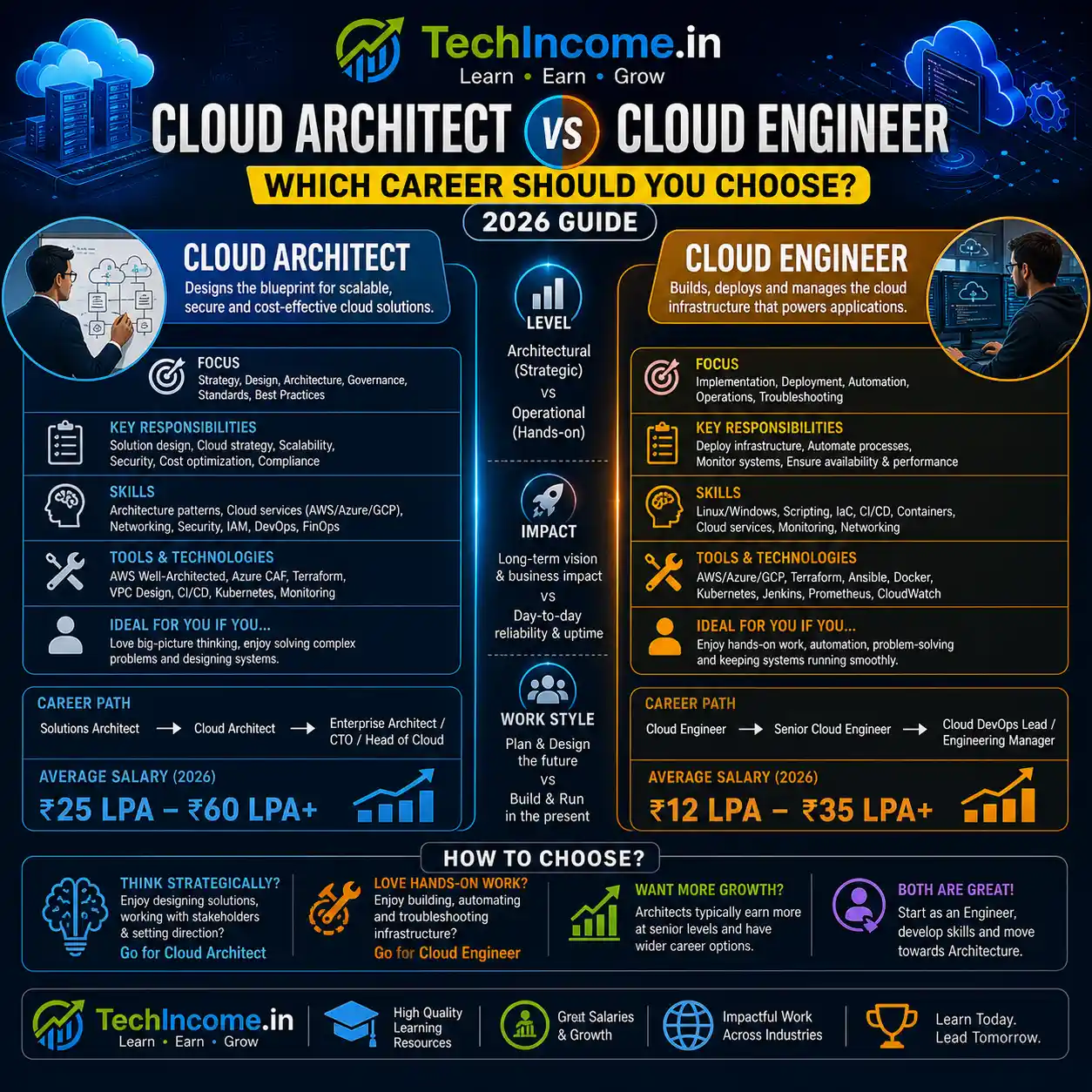
A Cloud Engineer builds and maintains things. They’re hands-on — provisioning servers, configuring networks, writing infrastructure-as-code, managing databases, setting up monitoring, fixing things when they break. The daily work involves a lot of actual doing.
A Cloud Architect designs and decides things. They figure out how a company’s entire cloud environment should be structured — which services to use, how data should flow, where security controls should sit, how to balance cost against performance and reliability. The daily work involves a lot of thinking, planning, and communicating with both technical teams and business leadership.
In most organisations, Cloud Engineers build what Cloud Architects design. They work closely together, and the line between them blurs more at smaller companies where one person wears both hats. But as a career path, they require different strengths and lead to different places.
What a Cloud Engineer Actually Does Day to Day
Let’s be specific, because “builds cloud infrastructure” is too vague to be useful.
A Cloud Engineer on a typical workday might:
- Provision a new set of EC2 instances on AWS for a product team that needs more compute capacity
- Write a Terraform script to automate the creation of a network configuration so it can be reproduced consistently across environments
- Set up a CI/CD pipeline that automatically deploys application code to a staging environment after each code commit
- Investigate why a Kubernetes cluster is consuming 40% more memory than expected and identify the misbehaving pod
- Configure S3 bucket policies to ensure a data team’s storage is accessible to the right services but locked down to everything else
- Set up CloudWatch alerts so the on-call team gets notified if the application’s error rate spikes
Notice the pattern: Cloud Engineers are solving specific, concrete, technical problems. They’re working with actual systems — writing code, running commands, reading logs, and making changes that have immediate effects.
The core skills you need as a Cloud Engineer:
Platform depth on at least one cloud provider. You need to genuinely know one cloud — AWS, Azure, or GCP — well enough to implement solutions, not just talk about them. AWS is the most widely used globally and has the most job postings in India (35,000+ active listings in Bangalore alone), making it the highest-leverage starting point for most people.
Infrastructure as Code (IaC). Terraform is the most important tool here — it allows you to define cloud infrastructure in code so it can be version-controlled, reviewed, and reproduced. CloudFormation (AWS-native) and Bicep (Azure-native) are also worth knowing. The ability to write IaC is increasingly considered baseline for mid-level cloud roles, not an advanced skill.
Containerisation and orchestration. Docker and Kubernetes are now standard parts of the cloud engineer toolkit. Understanding how containerised applications are packaged, deployed, and scaled is not optional anymore. The CKA (Certified Kubernetes Administrator) certification is widely recognised as evidence of this skill.
Scripting. Python and Bash are the two most used scripting languages in cloud engineering. You’ll use them to automate repetitive tasks, build monitoring scripts, and glue together different cloud services.
Networking fundamentals. VPCs, subnets, load balancers, DNS, security groups, VPNs — cloud networking is different from traditional networking but the concepts overlap. You need to understand how traffic flows through cloud systems to debug problems and design secure configurations.
Monitoring and observability. Knowing how to set up logging (CloudWatch, Azure Monitor, Google Cloud Logging), define meaningful alerts, and read dashboards to diagnose problems is a practical skill that cloud engineers use constantly.
What a Cloud Architect Actually Does Day to Day
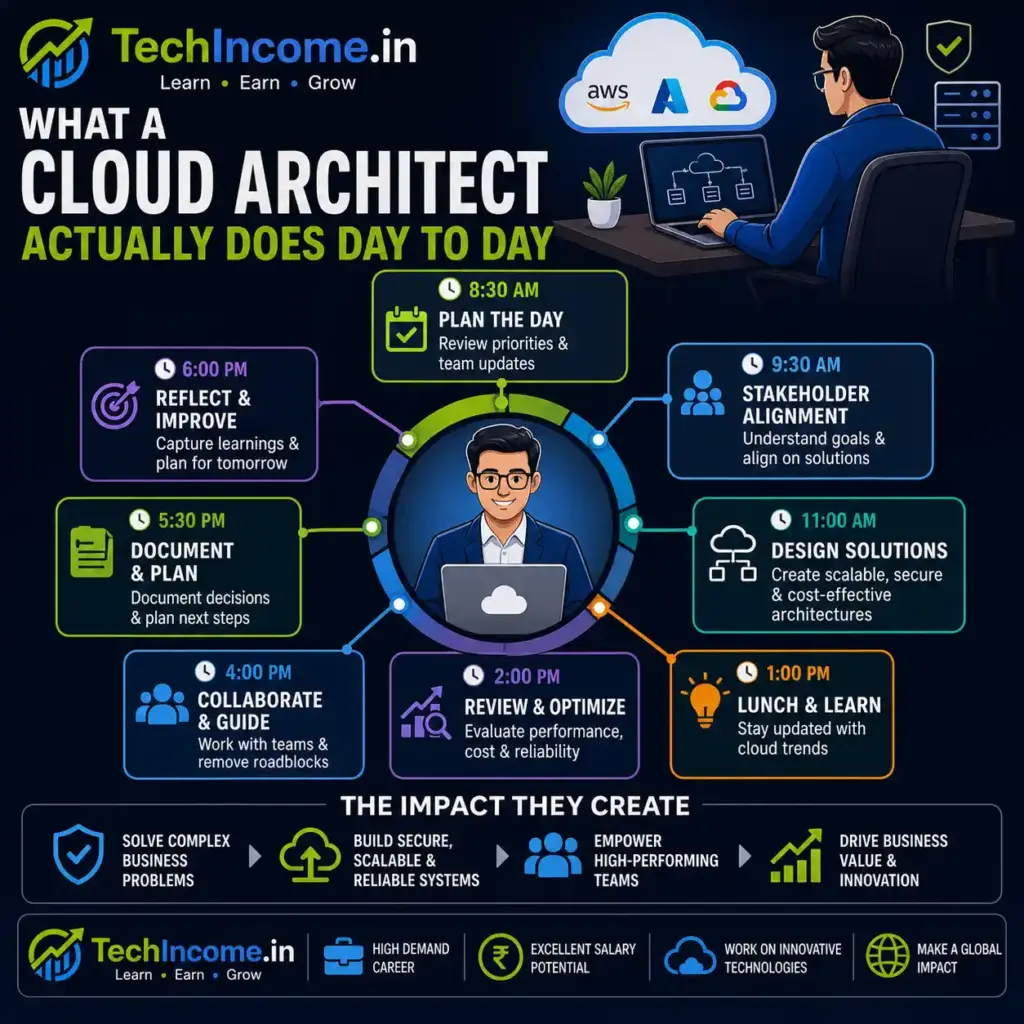
A Cloud Architect’s day looks quite different.
A Cloud Architect might spend their day:
- Meeting with a business team to understand the requirements for a new product feature — how many users it needs to support, what the latency requirements are, what data regulations apply — and then translating those requirements into an architectural design
- Drawing up a migration plan for moving a legacy on-premise application to the cloud, documenting which components go where, what the dependencies are, and what the risk mitigation strategy is
- Reviewing a Cloud Engineer’s proposed infrastructure design and identifying potential failure points, security vulnerabilities, or cost inefficiencies before anything is built
- Presenting a cloud cost optimisation proposal to the CTO — showing where the company is overspending and recommending reserved instances, spot instances, or right-sizing changes that could save ₹50 lakhs annually
- Designing a multi-region disaster recovery architecture for a banking client that requires 99.99% uptime guarantees
- Writing a technical specification document that will guide three Cloud Engineers over the next six weeks of implementation work
Notice what’s different: Cloud Architects operate at a higher level of abstraction. They’re thinking about systems, not individual components. They’re talking to business stakeholders as much as they’re talking to engineers. They’re making decisions that affect large budgets and long timelines.
The core skills you need as a Cloud Architect:
Broad, deep cloud knowledge across multiple services. While a Cloud Engineer can be highly effective with deep expertise in a specific subset of cloud services, a Cloud Architect needs to understand the full ecosystem — compute, storage, networking, databases, security, identity management, analytics, serverless, and increasingly AI services — well enough to know which tools to reach for in different situations.
Multi-cloud awareness. Many enterprise organisations use a combination of AWS, Azure, and GCP. A Cloud Architect needs to understand the trade-offs between platforms and design systems that work reliably across them. This doesn’t mean being equally expert in all three — but it means understanding each well enough to have informed opinions.
Security and compliance architecture. Cloud Architects own the security posture of an organisation’s cloud environment. This means understanding identity and access management (IAM), encryption, network security, regulatory compliance requirements (GDPR, India’s DPDP Act, PCI-DSS for fintech), and how to design systems that are secure by default rather than secured as an afterthought.
Cost architecture. At enterprise scale, cloud costs can run into crores per month. Cloud Architects are responsible for designing systems that deliver required performance within budget — which requires understanding reserved vs. on-demand vs. spot pricing, how different architectural choices affect cost, and how to build cost visibility into an organisation’s cloud operations.
Communication and stakeholder management. This is the skill gap that surprises most engineers who want to move into architecture. Cloud Architects spend significant time in meetings — translating between what engineers are technically capable of and what business leaders need to achieve. The ability to explain a complex architectural decision to a non-technical CFO, get buy-in from a skeptical engineering team, and write documentation that junior engineers can actually follow is genuinely essential.
Systems thinking. This is harder to teach than technical skills. Cloud Architects need to think about how changing one part of a system affects everything else — how a database migration affects application performance, how a security change affects developer workflow, how a cost-cutting measure affects reliability. This is a mindset built through years of building and managing complex systems.
Salary Comparison: What Each Role Actually Pays in India
Here is the honest salary picture for both roles in 2026, based on Glassdoor data from March 2026, Scaler’s 2026 report, and NASSCOM benchmarks.
Cloud Engineer Salary in India
Fresher (0–2 years): ₹4.5–8 LPA at IT service companies; ₹6–10 LPA at product companies and GCCs
Mid-level (3–5 years): ₹10–18 LPA at IT services; ₹15–25 LPA at product companies
Senior (6+ years): ₹20–35 LPA at product companies; ₹30–45 LPA at top-tier tech firms
Cloud Engineer + AI/ML skills premium: Engineers who add AI/cloud integration skills earn a 25–50% salary premium over standard cloud roles
Cloud Architect Salary in India
Entry-level Architect (typically 5–7 years total experience): ₹15–22 LPA
Mid-level Architect (7–10 years): ₹22–35 LPA
Senior Architect (10+ years): ₹35–55 LPA at product companies and GCCs
Top earners (principal architects, BigTech India): ₹55–80 LPA+
The average Cloud Architect salary in India is ₹19.68 LPA, with the 75th percentile reaching ₹29.78 LPA and top earners reporting up to ₹44.3 LPA, according to Glassdoor data from March 2026.
The key takeaway on salary: Cloud Architects earn significantly more than Cloud Engineers at equivalent years of total experience — but Cloud Architects typically have more years of total experience because you generally don’t go directly into architecture. The realistic career path is Cloud Engineer first, then Cloud Architect after building depth through hands-on implementation work.
The Indian cloud services market is projected to reach $17 billion by 2027 at 25% CAGR according to NASSCOM 2025, and cloud job openings grew 35%+ in the last two years — creating sustained upward pressure on salaries at both levels.
The Certifications That Matter for Each Role
Certifications are not everything in cloud careers — practical experience always matters more. But in India specifically, the right certification is often what gets your resume past an initial screening, especially at large companies and GCCs.
For Cloud Engineers
Start here: AWS Certified Solutions Architect – Associate is the single most recognised cloud certification in India. It proves you understand AWS core services well enough to design and deploy basic cloud solutions. The exam fee is approximately ₹20,000 in India. Stephane Maarek’s AWS course on Udemy combined with Tutorials Dojo practice exams is the most widely recommended preparation path by Indian candidates who cleared the exam in 2025–2026.
Add this next: The CKA (Certified Kubernetes Administrator) is increasingly expected for mid-to-senior cloud engineering roles at product companies. It’s hands-on — the exam gives you real Kubernetes clusters to work with under time pressure — which makes it genuinely respected by hiring managers. Exam fee is approximately ₹30,000.
Also worth pursuing: AWS DevOps Engineer Professional or Azure Administrator (AZ-104, exam fee ~₹13,500) depending on which platform your target employers use most. HashiCorp Terraform Associate certification validates your IaC skills specifically.
For Cloud Architects
Start here: AWS Certified Solutions Architect – Professional is the gold standard for cloud architecture credentials. It’s significantly harder than the Associate level and requires strong breadth of knowledge across AWS services, architectural patterns, and migration strategies. This certification signals to employers that you have genuine architectural depth, not just familiarity.
Google Professional Cloud Architect is highly respected and covers multi-cloud and hybrid architecture patterns particularly well — useful for enterprise and GCC roles.
Microsoft Azure Solutions Architect Expert (AZ-305) is the equivalent for Azure-focused organisations, which includes a large portion of India’s enterprise and BFSI sector.
Domain-specific additions: AWS Security Specialty for security-focused architect roles; AWS Advanced Networking Specialty for network architecture depth; FinOps Certified Practitioner for roles with cloud cost responsibility.
The honest certification advice: No certification replaces the credibility that comes from having actually designed and implemented cloud systems at scale. Certifications open doors; what’s behind the door is your actual experience. Get certified and build things simultaneously — don’t treat them as separate activities.
Cloud Engineer vs Cloud Architect: The Career Progression Path
The most common and reliable path into cloud architecture in India looks like this:
Stage 1: Cloud Support / Junior Cloud Engineer (0–2 years) You’re learning the fundamentals — understanding core AWS/Azure/GCP services, helping set up infrastructure, managing tickets, learning how real cloud environments are organised. This is where you get your Associate-level certification and start building hands-on experience with real systems.
Stage 2: Cloud Engineer (2–5 years) You’re owning pieces of infrastructure end to end — designing and implementing specific solutions, writing IaC, managing deployments, optimising costs and performance in your area. This is where you get your Professional-level certifications and start developing opinions about how systems should be designed. Most Cloud Architects spend 3–5 years here.
Stage 3: Senior Cloud Engineer / Lead Engineer (4–7 years) You’re making architectural decisions for the systems you own, mentoring junior engineers, reviewing others’ infrastructure designs, and starting to interact with product and business stakeholders on technical decisions. This is where the transition to architect begins.
Stage 4: Cloud Architect (6+ years) You’re responsible for the overall cloud strategy and architecture for an organisation or a major product area. You’re setting standards, making platform decisions, driving cloud adoption and migration strategy, and representing cloud capabilities to business leadership.
Important note: This path is not the only one. Engineers who have a strong background in network engineering, systems administration, or software development sometimes move into cloud architecture faster by leveraging existing depth in specific domains. A network engineer moving into cloud, for instance, already has the networking fundamentals that take cloud-native engineers years to develop.
Which Role Is Right for You Right Now?
Here’s a direct framework for deciding, based on your current situation.
Choose Cloud Engineer if:
You’re early in your career (0–5 years of IT experience) and still building technical foundations. Cloud engineering is the right place to start — the hands-on implementation work teaches you how cloud systems actually behave, which is the knowledge that good cloud architects eventually build on.
You prefer doing over deciding. If you get satisfaction from building something and seeing it work — from writing the Terraform code, seeing the infrastructure spin up, and diagnosing why something isn’t working — cloud engineering suits your working style well.
You want to get into the field relatively quickly. An Associate-level certification combined with hands-on project work can get you a junior Cloud Engineer role within 6–9 months of focused preparation. The bar for entry is lower than for architecture roles.
Choose Cloud Architect as your long-term target if:
You’ve already spent 3–5 years in IT — whether in cloud engineering, software development, networking, or systems administration — and you want to move into a higher-leverage, higher-paying strategic role.
You naturally think in systems and patterns. If you find yourself always thinking about how different components connect, what happens when one part fails, or how today’s decision will create problems two years from now — architectural thinking comes naturally to you.
You’re comfortable with ambiguity and communication. Architecture involves making decisions without complete information and explaining those decisions to people with different technical backgrounds. If that sounds engaging rather than stressful, architecture is likely a good fit.
If you’re completely new to cloud and can’t decide yet: Start with Cloud Engineering. The architecture path runs through engineering in almost every case anyway. Trying to go directly into architecture without hands-on implementation experience produces architects who design things that don’t work — which is worse than useless. Build first. Design after.
AWS vs Azure vs GCP: Which Platform to Focus On for Each Role
This question comes up constantly, and the answer depends on your target companies and career goals.
AWS has the largest global market share at approximately 33% and the most job postings in India. If you’re uncertain which platform to start with, AWS is the highest-leverage choice for maximum job opportunities. AWS certifications are also the most widely recognised and valued by Indian hiring managers.
Azure is dominant in India’s BFSI (banking, financial services, insurance) sector and at large enterprises that run on Microsoft infrastructure (Windows Server, Active Directory, Office 365). If you’re targeting banking, insurance, or large enterprise clients, Azure certification alongside AWS gives you a significant advantage.
GCP (Google Cloud Platform) is the strongest platform for data engineering, machine learning, and analytics workloads. If you’re interested in the cloud + AI intersection — which is where the premium salaries are — GCP’s BigQuery, Vertex AI, and data ecosystem are worth understanding even if AWS is your primary platform.
The multi-cloud reality for architects: Most senior Cloud Architects in India need to be conversant with at least two platforms because enterprise organisations increasingly run multi-cloud environments. Being certified on AWS and Azure — or AWS and GCP — is a significant differentiator at the architect level.
The Emerging Role You Should Know About: Cloud DevOps Engineer
Between Cloud Engineer and Cloud Architect sits a role that’s growing rapidly in India and worth understanding: the Cloud DevOps Engineer.
This role combines the infrastructure skills of cloud engineering with the automation, deployment, and developer experience focus of DevOps. Cloud DevOps Engineers build and maintain the CI/CD pipelines, container orchestration platforms, and developer tooling that allow software teams to ship code reliably and frequently.
Cloud Architects, SREs (Site Reliability Engineers), and DevOps Engineers often earn even higher than standard cloud engineers depending on the complexity of infrastructure they manage — and engineers who acquire advanced cloud DevOps skills can earn 40–80% more than average cloud engineering salaries.
If you have a software development background and want to move into cloud without going the pure infrastructure route, Cloud DevOps Engineering is an excellent middle path — and it’s a natural bridge toward cloud architecture for people with coding backgrounds.
What Indian Companies Are Actually Hiring For in 2026
Based on active job listings patterns across Indian job platforms:
IT services companies (TCS, Infosys, Wipro, HCL): Hiring heavily for Cloud Engineers with AWS and Azure certifications. Entry to mid-level. Project-based work. Good for getting started but growth ceiling on salary and technical depth.
Global Capability Centres (JPMorgan, Goldman Sachs, Walmart Global Tech, Atlassian): Hiring for both Cloud Engineers and Cloud Architects, with emphasis on multi-cloud skills, Kubernetes, Terraform, and security. Compensation approaches product company levels. Highly underrated as a destination.
Product startups and scale-ups (Swiggy, Zepto, Razorpay, Juspay, Freshworks): Hiring for Cloud Engineers who can work autonomously, wear multiple hats (cloud + DevOps + SRE), and build scalable infrastructure for high-traffic products. Best for learning speed and future salary growth.
Cloud service providers and consulting (AWS Professional Services, Deloitte Cloud, Accenture Cloud): Hiring for both roles. Architecture consulting roles at these firms are where many experienced Cloud Architects build breadth across multiple client environments quickly.
AI-native companies and GCC AI teams: Hiring specifically for Cloud Engineers and Architects with AI/ML infrastructure experience — GPU cluster management, LLM deployment, vector database infrastructure, MLOps pipeline architecture. Cloud engineers who add AI/ML skills earn a 25–50% salary premium over standard cloud roles, and a 42% AI/data skills gap exists in BFSI Global Capability Centres, creating premium salaries for cloud professionals who bridge both domains.
A Practical Starting Plan for 2026
If you’re reading this trying to figure out your next move, here is the most direct starting path depending on your current situation:
If you’re a fresher or have 0–1 years of IT experience: Get the AWS Solutions Architect Associate certification within 3–4 months using Stephane Maarek’s Udemy course and Tutorials Dojo practice exams. Simultaneously build 2–3 hands-on projects: a static website hosted on S3 with CloudFront, a VPC setup with public and private subnets, and a simple three-tier web application deployed using EC2 and RDS. Document everything on GitHub. Apply for junior Cloud Engineer or Cloud Support Engineer roles.
If you’re a developer or software engineer with 2–4 years of experience: Get the AWS Solutions Architect Associate, then the AWS DevOps Engineer Professional or CKA. Learn Terraform until you can write modules from scratch without looking up the syntax. Apply for mid-level Cloud Engineer or Cloud DevOps Engineer roles at product companies or GCCs. Target a 60–80% salary increase in your next switch.
If you have 5+ years in IT and want to move toward architecture: Get the AWS Solutions Architect Professional. Add Azure Administrator or Google Professional Cloud Architect as a second certification. Start taking on architectural responsibilities in your current role — design documents, architecture reviews, cost optimisation proposals. Build a portfolio of architectural decisions you’ve made and their outcomes. Apply for Senior Cloud Engineer roles with an architecture track, or Cloud Architect roles at mid-size companies where the definition of the role is broader.
techincome.in is where India’s tech professionals come for career guidance without the hype — practical roadmaps, honest salary data, and skills that actually get you hired.
Recommended Next Reads:
-
What is the main difference between a Cloud Architect and a Cloud Engineer?
A Cloud Engineer builds and maintains cloud infrastructure — provisioning servers, writing automation scripts, managing deployments, and troubleshooting live systems. Their work is hands-on and technical, dealing with specific systems and services on a daily basis. A Cloud Architect designs the overall blueprint for how a company’s cloud environment should be structured — deciding which services to use, how components connect, where security controls go, and how to balance cost, performance, and reliability. In most organisations, Cloud Engineers implement what Cloud Architects design. The architect role requires deeper strategic thinking and business communication, while engineering requires deeper implementation and troubleshooting skills. At smaller companies, the same person often does both.
-
Which pays more — Cloud Architect or Cloud Engineer in India?
Cloud Architects earn significantly more than Cloud Engineers in India. The average Cloud Architect salary in India is ₹19.68 LPA, with top earners reporting up to ₹44.3 LPA, while Cloud Engineers typically earn ₹10–18 LPA at mid-level and ₹20–35 LPA at senior levels. However, the comparison is not entirely apples-to-apples — Cloud Architects typically have more total years of experience, since most people spend 4–6 years as Cloud Engineers before moving into architecture roles. At equivalent years of experience, the salary gap between a senior Cloud Engineer and an entry-level Cloud Architect is meaningful but not dramatic. The largest salary jumps in cloud careers happen when Engineers move to product companies and when senior engineers transition into architect roles at GCCs or top-tier product firms.
-
Can a fresher directly become a Cloud Architect in India?
No — not in any practical sense. Cloud Architecture is almost universally a role that requires several years of hands-on implementation experience first. You need to have built and broken enough cloud systems to develop genuine judgment about how systems should be designed. Some very experienced professionals from adjacent fields — senior network architects, experienced systems engineers, or long-tenured software engineers — can make the transition into cloud architecture faster than a typical fresher. But for someone starting out, the path is always Cloud Engineer first. The good news is that the Cloud Engineer path is very well-defined, well-compensated, and leads naturally into architecture if that’s your long-term goal.
-
Which certification is best to start a cloud career in India — AWS, Azure, or GCP?
AWS is the best starting point for most people. It holds the largest global cloud market share at approximately 33% and has the most active job listings in India — over 35,000 active AWS roles in Bangalore alone. The AWS Solutions Architect Associate certification is what Bangalore hiring managers at TCS, Infosys, HCL, and product companies use to shortlist candidates for technical interviews. If you’re targeting BFSI (banking, insurance, financial services) specifically, adding Azure is valuable since Microsoft’s platform dominates in that sector. GCP is worth learning if you’re interested in data engineering or AI/ML cloud infrastructure, where Google’s tooling is particularly strong. For most freshers: start with AWS, add one other platform once you have your first job.
-
How long does it take to become a Cloud Architect in India?
Realistically, 6–10 years from starting as a fresher — though this varies significantly based on how aggressively you learn and how deliberately you position your career. The typical path looks like: 2–3 years as a junior Cloud Engineer building foundational skills, 2–3 years as a mid-level Cloud Engineer taking ownership of infrastructure and developing architectural instincts, and then a transition into architecture roles either through internal promotion or a strategic job switch. Some professionals make the jump in 5 years with exceptional focus and deliberate skill-building; others are still in engineering after 10 years because they haven’t actively pursued the architectural track. The pace is largely determined by the quality of experience you accumulate, not just the quantity of years.
-
Is Cloud Engineering a good career for freshers in India in 2026?
Yes — cloud engineering is one of the most reliable entry points into a high-growth IT career in India right now. Fresher cloud engineers earn ₹5–9 LPA, and NASSCOM projects 14 million cloud jobs in India through 2026. The demand for cloud skills is broad and durable — cloud infrastructure underlies every major tech trend right now including AI, which means cloud demand grows as AI adoption grows. The entry barrier is relatively clear: an Associate-level certification (AWS, Azure, or GCP) combined with hands-on project work is enough to compete for junior roles. Career growth is fast for people who actively upskill — mid-level engineers with 3–5 years and strong skills are earning ₹15–25 LPA at product companies.
-
What is multi-cloud and why does it matter for cloud careers?
Multi-cloud refers to organisations using more than one cloud provider simultaneously — for example, running production workloads on AWS while using Azure for Microsoft-integrated services and GCP for data analytics. Most large enterprises in India have evolved toward multi-cloud or hybrid cloud strategies, which means Cloud Architects especially need to understand the strengths and trade-offs of different platforms. For Cloud Engineers, being strong on one platform is usually sufficient for junior and mid-level roles. For Cloud Architects at enterprise companies, multi-cloud fluency — and ideally certifications on at least two platforms — is increasingly expected. Being multi-cloud certified (AWS + Azure, or AWS + GCP) significantly boosts salary potential and the breadth of roles you can access.
-
What skills does a Cloud Engineer need to get hired in India in 2026?
The core skills Indian employers are looking for in Cloud Engineers in 2026 are: proficiency in at least one cloud platform (AWS most in demand), Infrastructure as Code using Terraform or CloudFormation, Docker and Kubernetes for container management, Linux command-line skills, scripting in Python and Bash, networking fundamentals (VPCs, load balancers, DNS, security groups), and monitoring/observability tools. Cloud Engineers who acquire advanced skills like multi-cloud expertise and Terraform can earn 40–80% more than average, and these skills significantly boost salary potential. A relevant Associate-level certification is effectively mandatory for passing initial screening at most companies. Hands-on project experience demonstrated through a GitHub portfolio or deployed applications carries more weight than additional certifications beyond the first.
-
Can a non-IT professional switch to a cloud computing career in India?
Yes, though the path requires more preparation time than for someone already in IT. Entry-level roles like Cloud Support Specialist or Cloud Administrator are ideal starting points before moving toward higher-paying cloud computing jobs. Professionals from electronics engineering, networking, mathematics, or even commerce backgrounds have successfully made this transition. The recommended starting point is a beginner-level cloud course on a platform like Udemy or Coursera, followed by an Associate-level certification, and then hands-on labs through platforms like AWS Free Tier or Google Cloud Free Tier where you can build real projects at no cost. The transition typically takes 9–15 months of consistent effort for someone coming from a non-IT background, and starting with Cloud Support or Cloud Administrator roles is more practical than aiming directly for Cloud Engineer.
-
What is the difference between a Cloud Architect and a Solutions Architect?
The terms are often used interchangeably, but there’s a subtle distinction worth understanding. A Cloud Architect focuses specifically on cloud infrastructure design — how systems are structured within cloud platforms like AWS, Azure, or GCP. A Solutions Architect has a broader scope — they design end-to-end technical solutions for specific business problems, which may involve cloud infrastructure but also includes application architecture, integration patterns, and technology stack decisions. At AWS specifically, “Solutions Architect” is the official certification title, which is why many Cloud Architects in India have it. In job listings, “Cloud Architect” and “Solutions Architect” often describe the same role, but Solutions Architect titles at large enterprises sometimes carry broader scope and responsibility than pure Cloud Architect roles. When evaluating a job, look at the actual responsibilities described rather than the title alone.
-
How important is cloud security knowledge for both roles?
Security is essential for both roles but weighted differently. For Cloud Engineers, security knowledge means knowing how to implement security controls correctly — configuring IAM policies with least-privilege access, setting up network security groups, encrypting data at rest and in transit, and following security best practices in your day-to-day infrastructure work. For Cloud Architects, security is a design-level responsibility — building security architecture into a system from the ground up, understanding compliance requirements (India’s DPDP Act, GDPR, PCI-DSS for fintech), designing identity and access management frameworks, and thinking about threat modelling at the system level. As organisations face growing cybersecurity pressure, cloud professionals with strong security knowledge consistently earn 20–30% more than those without. The AWS Security Specialty certification is the most recognised credential for demonstrating cloud security depth in India.