Here’s a number that should get your attention.
According to NASSCOM’s 2024 report, India’s demand for AI professionals is growing at over 40% every single year. Right now, there are more than 450,000 active AI job listings across Indian job platforms. And the supply side? Fewer than 3% of India’s 1.5 million annual engineering graduates have real, usable AI/ML skills.
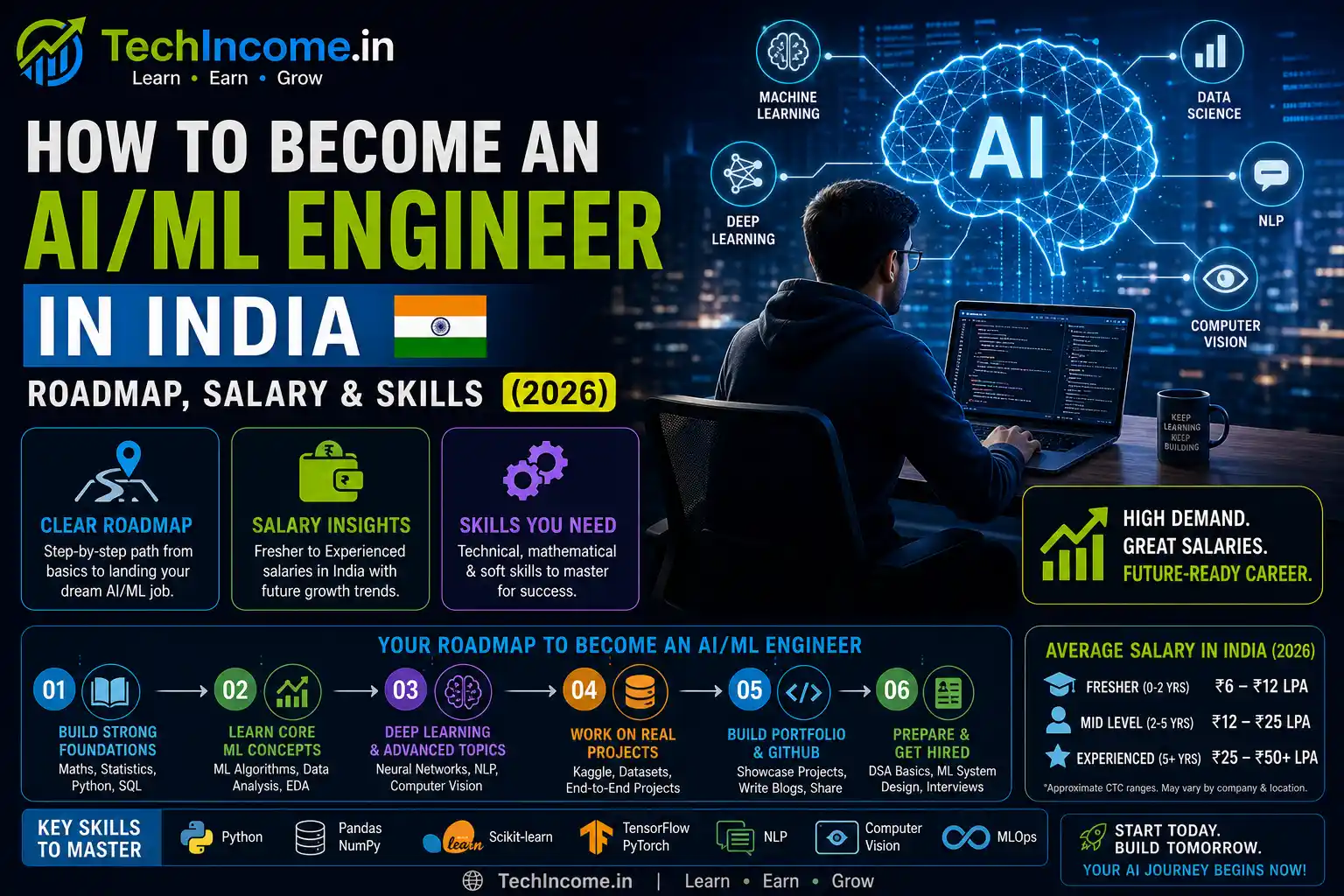
That gap — between what companies desperately need and what the market can actually provide — is why AI/ML engineers in India are being offered salaries that would have seemed unrealistic three years ago. Freshers with strong project portfolios are landing ₹8–12 LPA. Engineers with 3–4 years of experience are routinely clearing ₹20–35 LPA. Senior GenAI and MLOps specialists at product companies are touching ₹50–80 LPA.
But here’s what most career guides don’t tell you honestly: getting here requires a very specific sequence of learning and building. Random YouTube courses, half-finished Kaggle notebooks, and a “I know Python” line on your resume won’t cut it anymore.
This guide gives you the real roadmap — what to learn, in what order, how long it actually takes, and what you need to do to stand out in a market that’s both huge and increasingly competitive.
First, Let’s Clarify: AI Engineer vs ML Engineer vs Data Scientist
These three titles are often used interchangeably in job listings, which creates confusion for anyone trying to enter the field. They’re related but genuinely different roles.
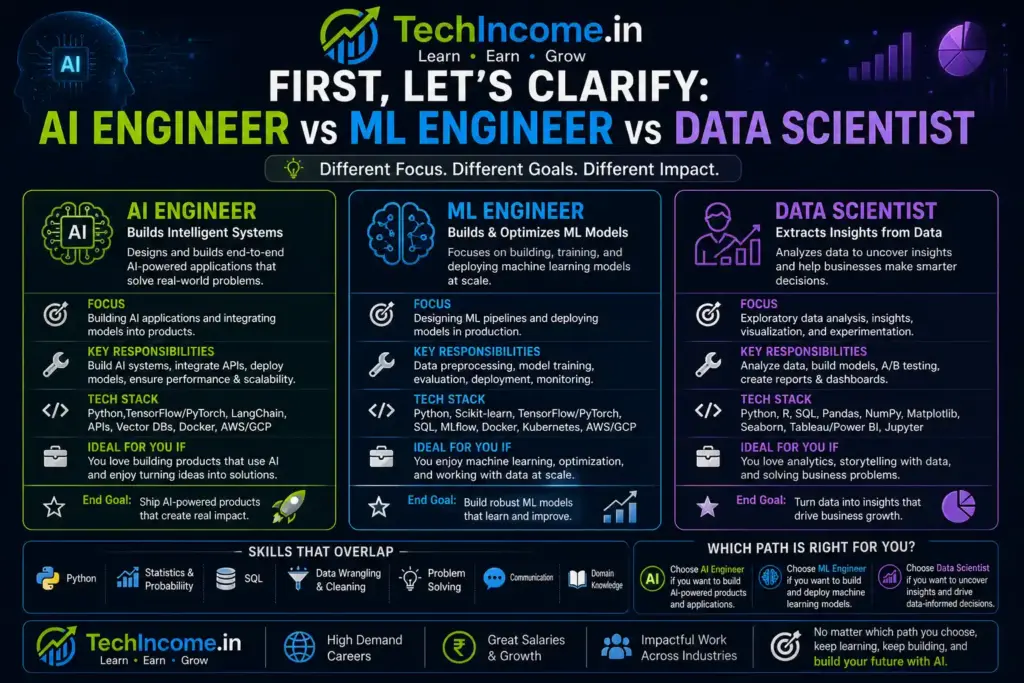
A Machine Learning Engineer focuses on building and deploying ML models. Their job is to take a model from a research notebook and make it work reliably in a production environment — handling data pipelines, model training, optimisation, versioning, and deployment. They write a lot of code.
An AI Engineer (especially in 2026) has a broader scope. This increasingly means working with large language models (LLMs), building GenAI-powered applications, integrating AI APIs into products, and using frameworks like LangChain or LlamaIndex to build AI workflows. Think of an AI Engineer as someone who builds things using AI, rather than building the AI itself from scratch.
A Data Scientist sits closer to the research end. They analyse data, build statistical models, and generate business insights. They typically work more in Jupyter notebooks, less in production codebases. The role overlaps significantly with ML engineering at mid-level, but the daily work is different.
For most people reading this who want a high-paying, high-demand career, the ML Engineer + AI Engineer combination is the most practical and lucrative target. That’s what this roadmap focuses on.
The Honest Salary Picture in 2026
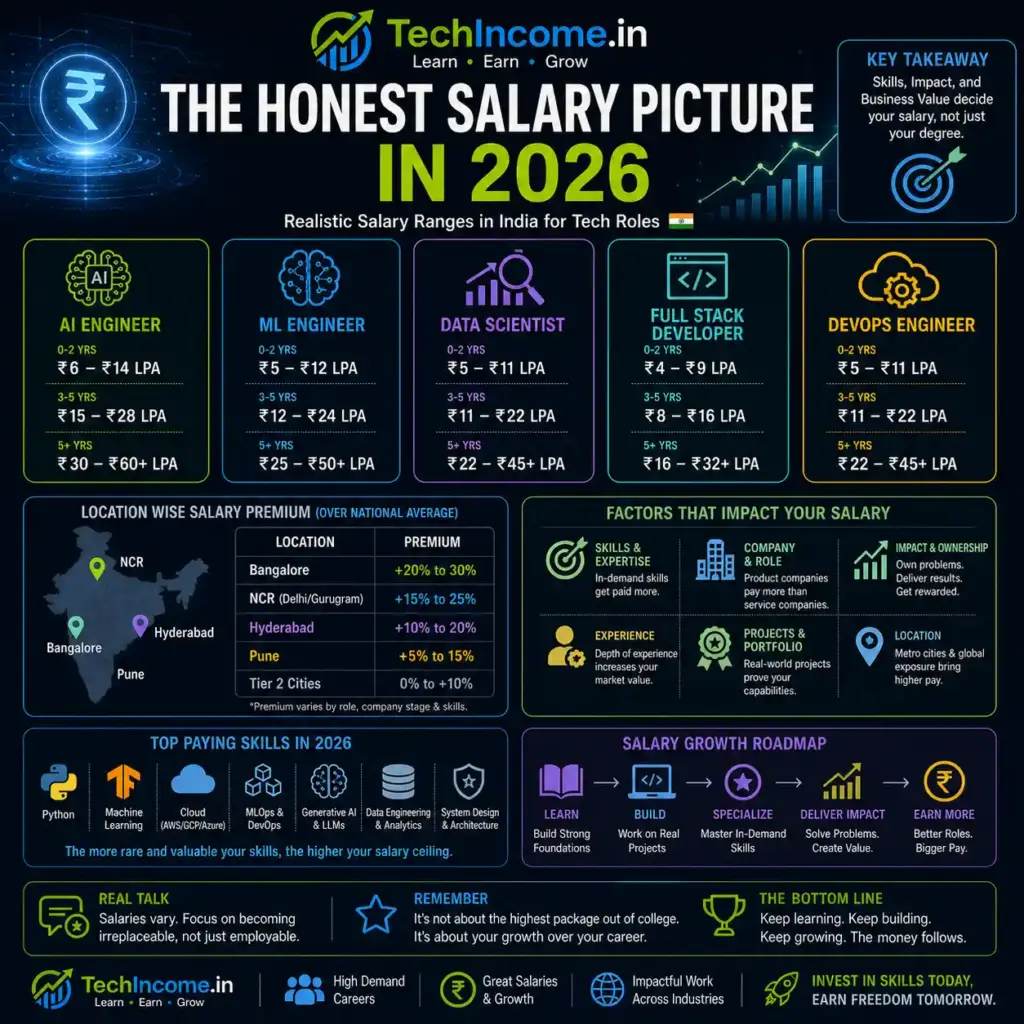
Let’s get the numbers out of the way upfront, because they vary wildly and most articles either inflate or undercount them.
Fresher (0–2 years experience):
- IT services companies (TCS, Infosys, Wipro): ₹5.8–8 LPA
- Product startups and mid-size companies: ₹8–12 LPA
- With strong GitHub portfolio + GenAI skills: ₹10–15 LPA
- IIT/NIT grads joining FAANG India directly: ₹20 LPA+
Mid-level (3–5 years experience):
- IT services: ₹10–18 LPA
- Product companies and GCCs: ₹20–35 LPA
- GenAI/LLM specialists: ₹25–45 LPA
- MLOps engineers: ₹30–50 LPA
Senior (6+ years experience):
- Product companies: ₹40–70 LPA
- BigTech India (Google, Amazon, Microsoft): ₹60–80 LPA
- Remote roles for US-based companies: ₹60–80 LPA (with Indian cost of living)
- Senior GenAI architects at top firms: ₹80 LPA–1 Cr+
City matters a lot. Bengaluru leads with an average AI engineer salary of ₹12.67 LPA (Glassdoor, Feb 2026) and significantly higher ceilings at top companies. Hyderabad offers comparable senior-level pay but with 30–35% lower cost of living — making your actual purchasing power stronger there. Mumbai pays the highest premium for fintech and BFSI AI roles.
The most important number: The jump from a service company to a product company at 3–4 years of experience typically produces a 60–100% salary increase in a single switch. That transition is the single highest-impact career move in AI engineering in India right now.
The Step-by-Step Roadmap to Becoming an AI/ML Engineer in India
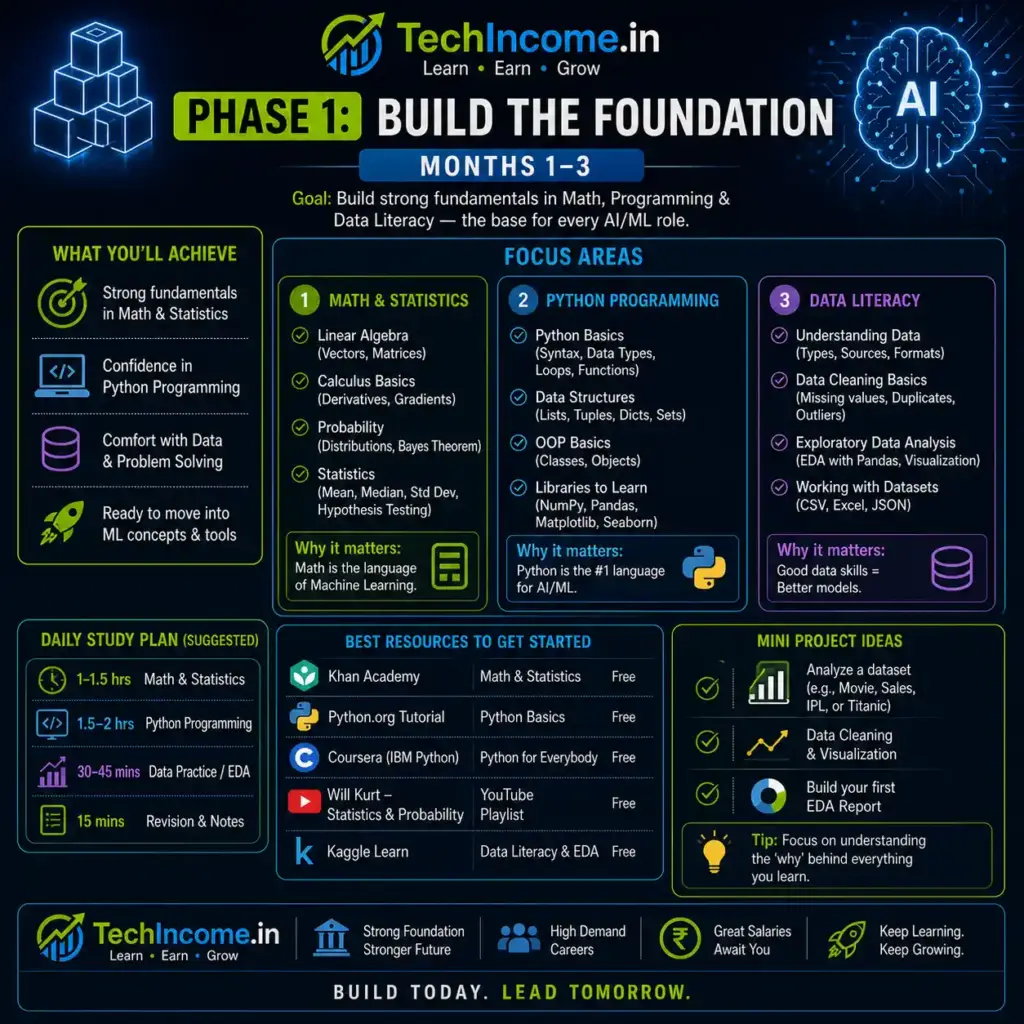
Phase 1: Build the Foundation (Months 1–3)
Before you touch machine learning, you need the underlying skills that everything else is built on. Skipping this phase is why most people plateau early.
Python — for real, not just the basics
Most “learn Python” courses teach you syntax. What you actually need for ML work is different: list comprehensions, generators, decorators, working with files and APIs, and writing clean, modular code. Spend 4–6 weeks genuinely getting comfortable with Python — not just running it, but writing it the way professional engineers do.
Resources: Python’s official documentation, Automate the Boring Stuff with Python (free online), and 30 days of daily coding practice on LeetCode or HackerRank at the easy level.
Mathematics — just enough, not a PhD
You don’t need to be a mathematician. But you do need to understand three areas well enough to reason about what your models are doing:
- Linear algebra: Vectors, matrices, matrix multiplication, eigenvalues. You’ll see these everywhere in ML model internals.
- Statistics and probability: Mean, variance, distributions, Bayes’ theorem, correlation. This is how you evaluate whether your model is actually working.
- Calculus basics: Derivatives, gradients, and the concept of gradient descent. This is how neural networks learn.
The 3Blue1Brown YouTube channel (Essence of Linear Algebra + Essence of Calculus playlists) explains these visually in a way that makes them genuinely understandable. StatQuest with Josh Starmer covers statistics for ML beautifully.
SQL and basic data handling
Real ML work starts with data — messy, incomplete, inconsistently formatted data. You need to know how to query databases with SQL, clean data using Python’s Pandas library, and understand how data flows from a source system into a model training pipeline. This sounds unglamorous. It’s also what 60% of the actual job involves.
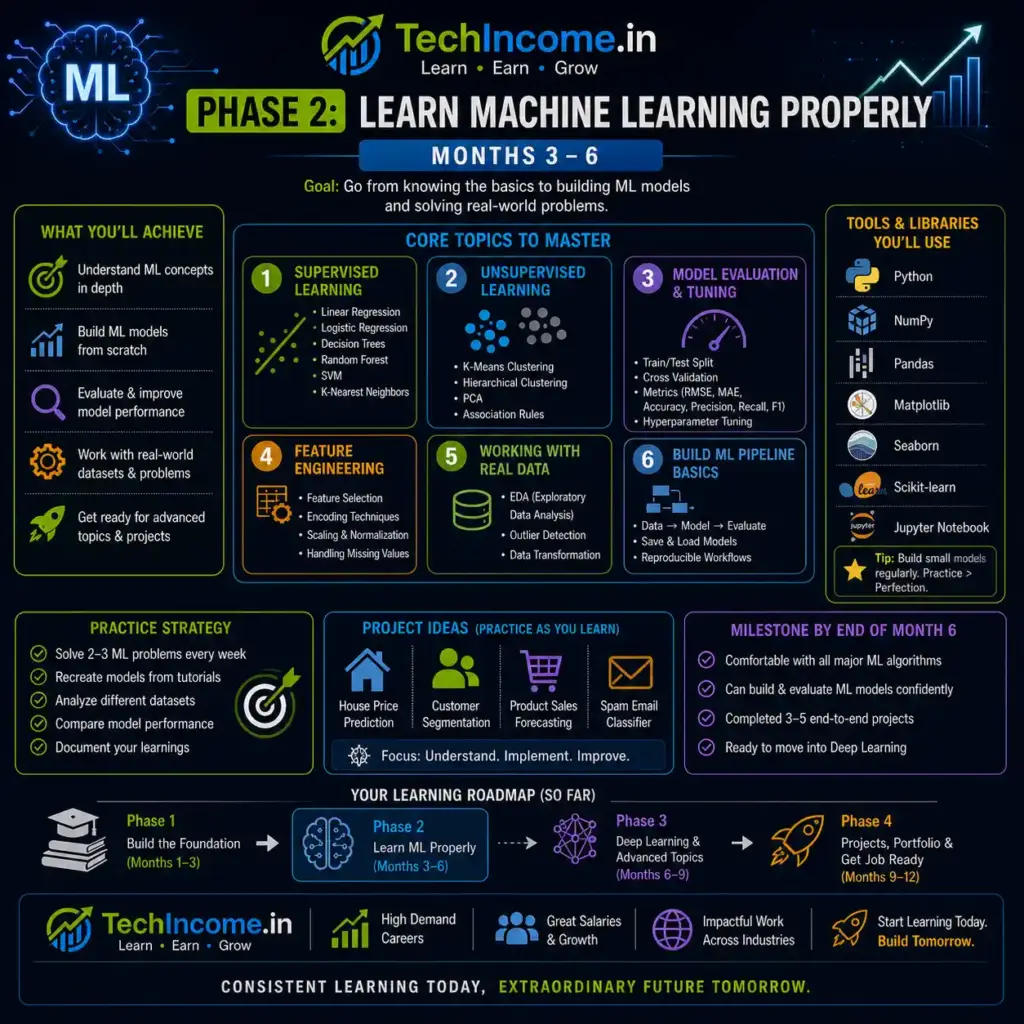
Phase 2: Learn Machine Learning Properly (Months 3–6)
With your foundation in place, now you start building the actual ML skills.
Core ML concepts
Work through these in order:
- Supervised learning (linear regression, logistic regression, decision trees, random forests)
- Unsupervised learning (clustering with K-means, dimensionality reduction with PCA)
- Model evaluation (train/test splits, cross-validation, precision, recall, F1 score, ROC curves)
- Feature engineering (how you prepare and transform data to make your model smarter)
- Gradient boosting algorithms (XGBoost, LightGBM — extremely important for structured data problems)
Best resource: Andrew Ng’s Machine Learning Specialisation on Coursera is still, in 2026, the clearest and most well-structured introduction to ML fundamentals. Do not skip the assignments. The assignments are where the actual learning happens.
Scikit-learn — your first real ML library
Once you understand the concepts, learn to implement them with Scikit-learn. This library handles most classical ML tasks — classification, regression, clustering, preprocessing — in a clean, consistent API. Build 3–4 small projects using real datasets (Kaggle has hundreds of free datasets) and practice the full workflow: loading data, preprocessing, training, evaluating, and iterating.
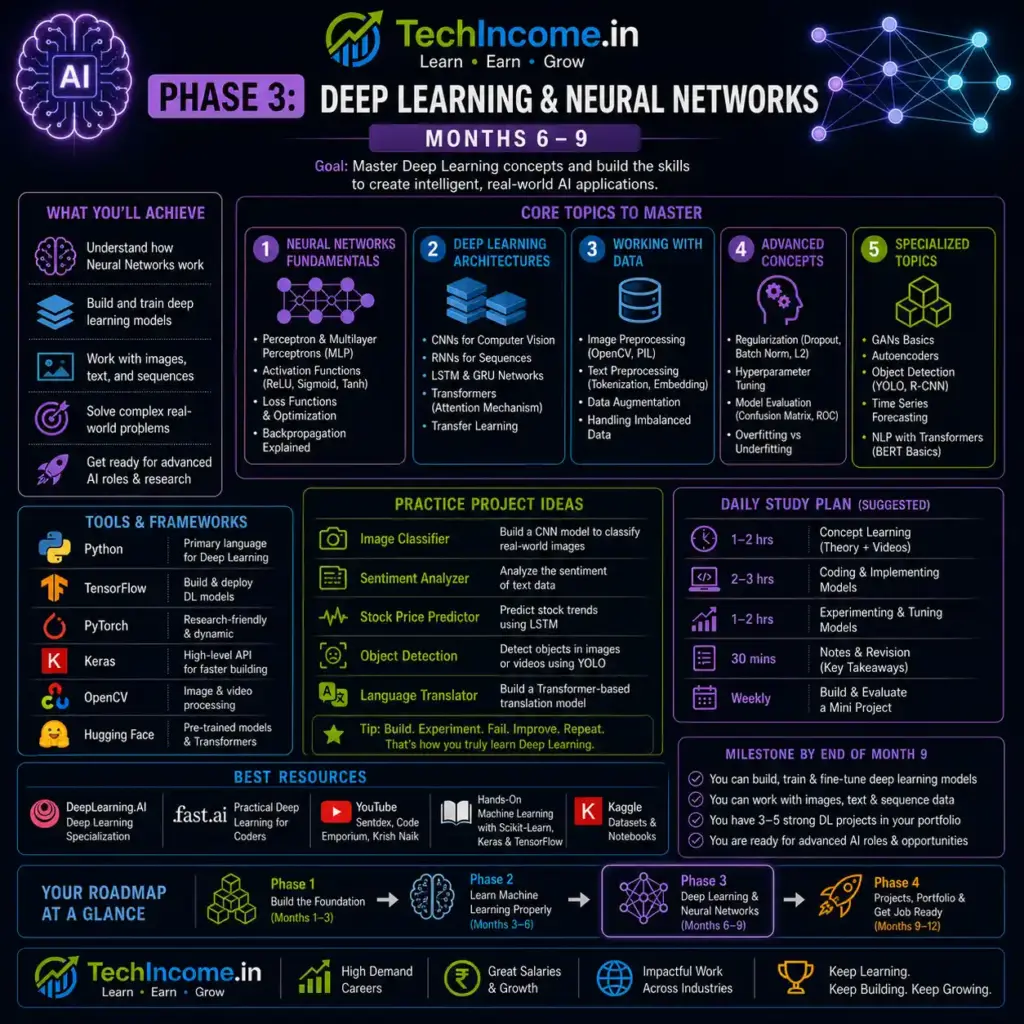
Phase 3: Deep Learning and Neural Networks (Months 6–9)
This is where things get more challenging — and where the higher-paying roles begin.
Neural network fundamentals
Understand how a neural network actually works: layers, weights, activation functions, backpropagation, and loss functions. Don’t just accept them as black boxes. The moment you understand why a ReLU activation function is used instead of sigmoid in hidden layers, or why batch normalisation helps training, you’ll think differently about every model you work with.
PyTorch — the industry standard
PyTorch has largely overtaken TensorFlow in research and is widely used in production ML at product companies. Learn to build, train, and evaluate neural networks in PyTorch. Start with simple feedforward networks, move to convolutional neural networks (CNNs) for image data, then recurrent networks and transformers for text.
Fast.ai’s Practical Deep Learning for Coders (free online) is exceptional here — it takes a top-down approach that gets you building real models quickly, then digs into the theory. Pair it with the official PyTorch tutorials.
Specialise in at least one area:
- Natural Language Processing (NLP) — working with text, transformers, and increasingly LLMs
- Computer Vision (CV) — image classification, object detection, medical imaging
- Time Series Forecasting — demand forecasting, financial prediction, sensor data
NLP is the highest-demand specialisation in India right now because of the GenAI explosion. If you have to pick one, pick NLP.
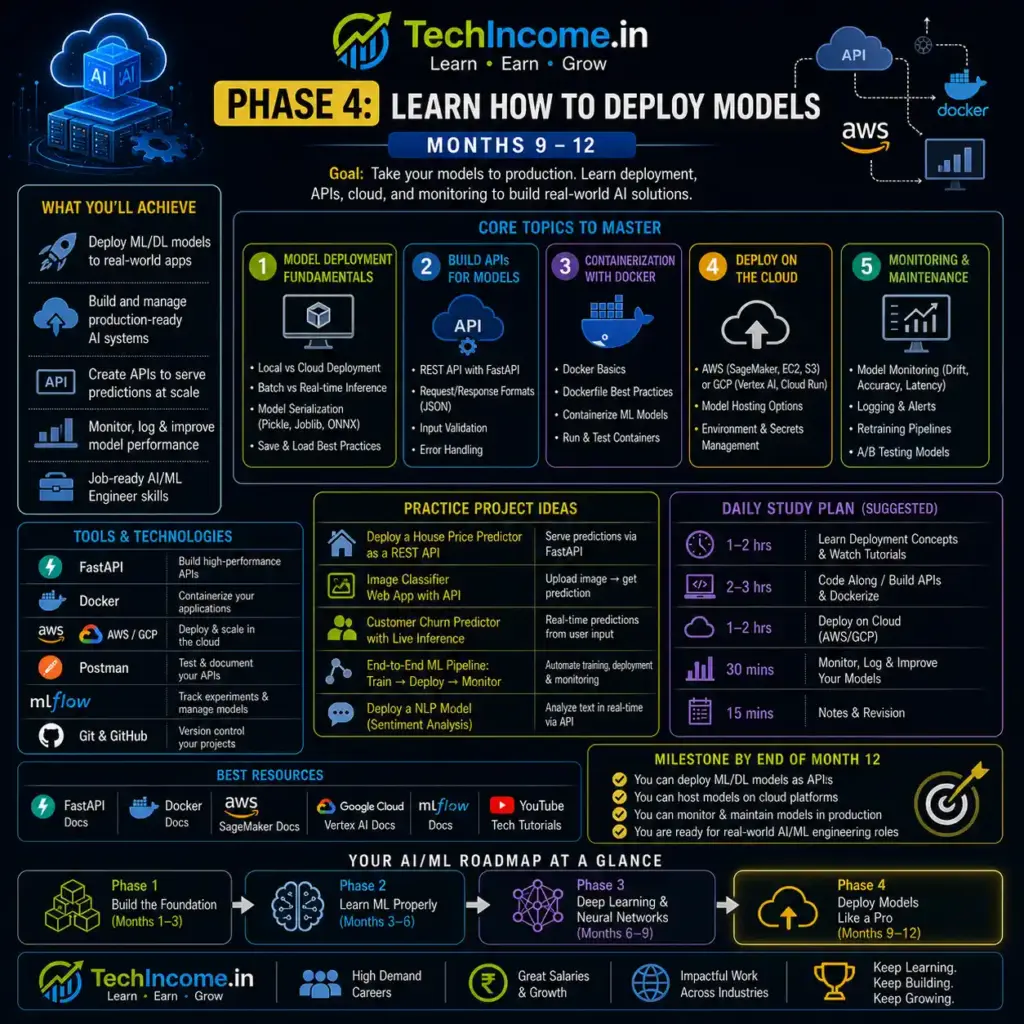
Phase 4: Learn How to Deploy Models (Months 9–12)
This is the phase most self-taught ML engineers skip — and it’s precisely what separates candidates who get hired at ₹8 LPA from those who get hired at ₹18 LPA.
Building a model that works in a Jupyter notebook is one thing. Building a model that works reliably in a product used by 10,000 people, handles edge cases, doesn’t degrade silently over time, and can be updated without taking the whole system down — that is a completely different skill.
MLOps fundamentals
MLOps (Machine Learning Operations) is the discipline of getting ML models into production and keeping them there. Learn:
- Docker — containerising your model so it runs the same everywhere
- FastAPI or Flask — building an API endpoint that serves your model’s predictions
- MLflow — tracking experiments, versioning models, comparing runs
- Basic CI/CD — automating the testing and deployment of model updates
- Cloud deployment — deploying your model on AWS SageMaker, GCP Vertex AI, or Azure ML
You don’t need to be a DevOps expert. But you need to know how to get a model out of a notebook and into a running service. Build at least one end-to-end project where you train a model, wrap it in an API, containerise it, and deploy it to a cloud service.
Phase 5: Learn Generative AI and LLM Engineering (Months 12–15)
This is the most important phase for 2026 and beyond. Generative AI engineers and LLM engineers now earn the same salary bands as senior traditional ML engineers — and the field is so new that the talent shortage is extreme.
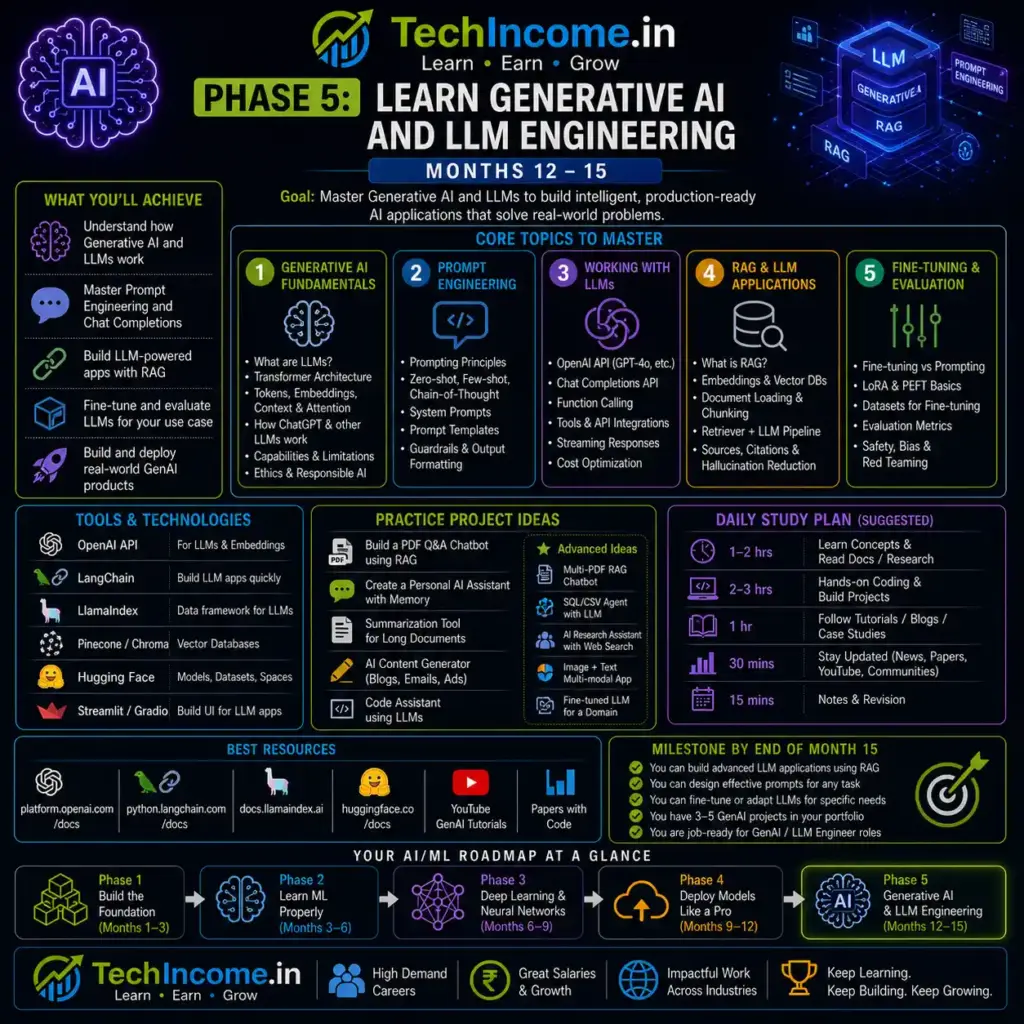
What you need to learn:
Large Language Model basics Understand transformer architecture conceptually — attention mechanisms, tokens, embeddings, context windows. You don’t need to build GPT from scratch, but you need to understand why a 32K context window matters, what temperature does, and how to reason about what a model will and won’t do reliably.
Prompt engineering (the real version) Not “write better prompts” — the professional version. System prompts, few-shot examples, chain-of-thought prompting, structured output forcing, and building prompt templates that behave consistently across a wide range of user inputs. This is a real engineering skill when done at production scale.
RAG (Retrieval Augmented Generation) Almost every enterprise GenAI application uses RAG — the technique of connecting an LLM to a knowledge base so it can answer questions based on your specific data rather than just its training data. Learn how to build a RAG pipeline: document loading, chunking, embedding, vector storage (Pinecone, ChromaDB, Weaviate), retrieval, and final generation. This is probably the single most hirable skill in GenAI right now.
LangChain and LlamaIndex These frameworks are the standard tools for building LLM-powered applications. Learn to chain together LLM calls, tool use, and data retrieval steps into coherent AI workflows.
OpenAI, Anthropic, and Gemini APIs Get comfortable calling these APIs, understanding their pricing, handling rate limits, and building applications that work reliably with them. Building something real using these APIs — even a small project — is infinitely more valuable on your resume than a certification.
Phase 6: Build a Portfolio That Gets You Hired (Ongoing)
Here’s the truth about getting your first AI/ML job in India: your GitHub profile matters more than your degree. Companies hiring in this space are desperately short on people who can actually do the work — and a demonstrated portfolio is the clearest signal that you can.
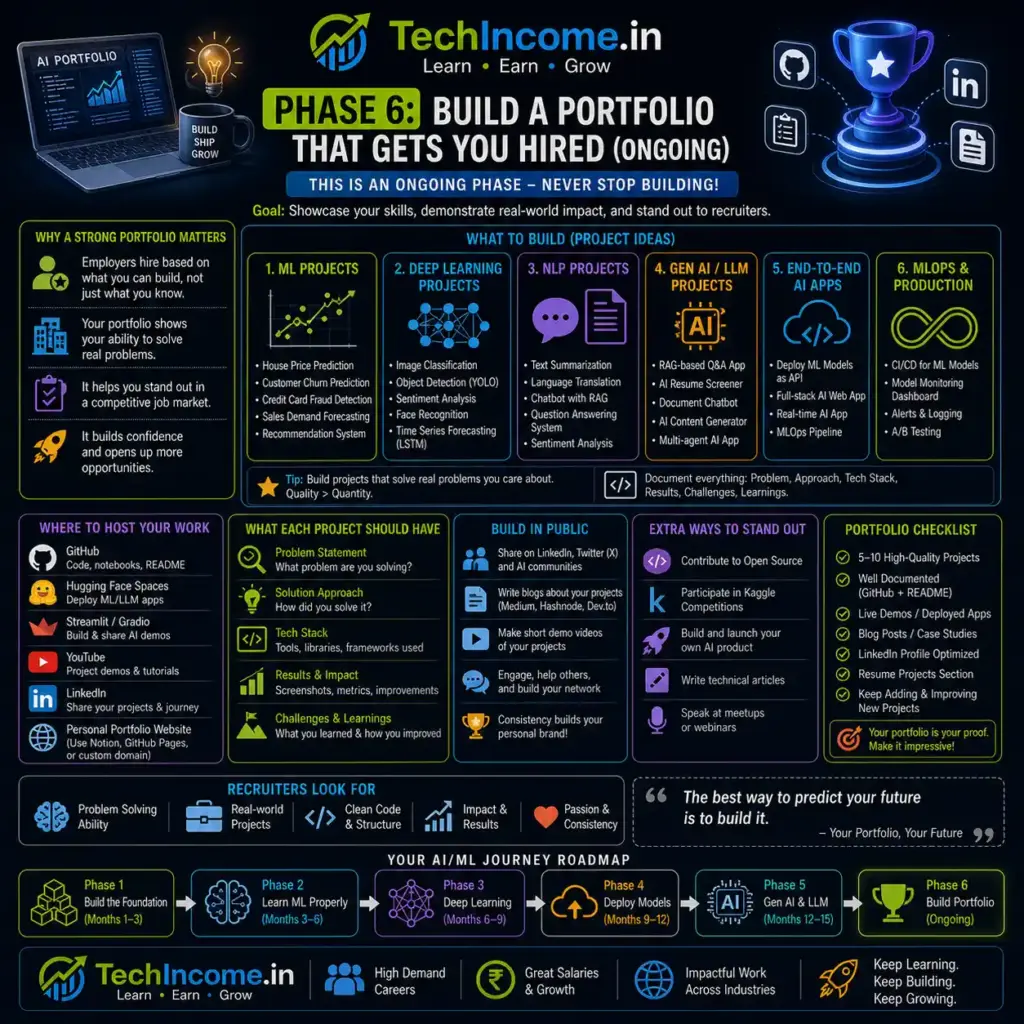
What your portfolio needs:
At least 3–5 end-to-end projects. Not tutorials you followed. Projects where you identified a problem, found or built a dataset, trained a model, evaluated it honestly (including where it fails), and deployed it somewhere accessible. A working Streamlit app or a live API endpoint is worth ten times more than a clean notebook.
One GenAI project. Build a RAG-based chatbot, a document summarisation tool, a GenAI-powered search system, or an AI agent that can use tools. Deploy it. Write a clear README explaining what it does and how it works.
Write about your projects. A LinkedIn post or a short blog article explaining what you built, what you learned, and what went wrong is extremely valuable. Most engineers don’t do this. The ones who do get noticed by recruiters.
Kaggle competitions. Not as the primary activity, but competitions expose you to real problem-solving under constraints, give you benchmark comparisons, and a top-500 finish on a competition is a legitimate resume line.
Which Degree or Educational Background Do You Need?
The honest answer is: a relevant degree helps but is not a requirement.
If you have a CS/IT engineering background: You’re in a good starting position because you already have programming foundations and exposure to algorithms. Fill the ML-specific gaps and you can make the transition relatively quickly.
If you’re from electronics, mechanical, or other engineering backgrounds: You can absolutely transition into AI/ML, but expect to spend more time in Phase 1 getting comfortable with Python and software development practices. Many successful ML engineers in India came from non-CS backgrounds.
If you’re a graduate from a non-engineering field: It’s harder but not impossible. Focus on Python, mathematics, and building a visible portfolio. A master’s degree in Data Science or AI from a reputable institution can accelerate this path and open doors that are otherwise harder to access.
Certifications worth doing:
- Google Professional Machine Learning Engineer — well-regarded at product companies
- AWS Machine Learning Specialty — valuable if targeting cloud-heavy roles
- DeepLearning.AI Specialisations (Andrew Ng’s courses) — not as a credential but as structured learning
- Fast.ai’s Practical Deep Learning — free, and more practical than most paid options
A note on master’s degrees: an M.Tech or M.S. in AI/ML/Data Science from a decent institution (IITs, IIITs, or reputable private universities) gives you a 15–20% higher starting package and opens FAANG-level recruiting pipelines that are otherwise nearly impossible to access. If you’re early in your career and have the option, it’s worth considering.
The Best Companies to Target in India for AI/ML Roles
Not all employers are equal when it comes to AI/ML career growth. Knowing where to apply — and where not to — can save you years.
Tier 1 — Highest learning and salary (but hardest to enter): Google India, Microsoft India, Amazon (AWS AI teams), Flipkart, Swiggy, Zepto, PhonePe, Razorpay, CRED. These companies have mature ML infrastructure, strong engineering culture, and some of the highest AI salaries in India.
Tier 2 — Strong product experience and good growth trajectory: Meesho, Zomato, MakeMyTrip, Paytm, Juspay, Freshworks, Zoho, Postman, Hasura. Excellent places to build real production ML experience early in your career.
Global Capability Centres (GCCs): JPMorgan Chase, Goldman Sachs, American Express, Walmart Global Tech, Atlassian, and dozens of other global companies run significant AI teams out of India. GCCs often pay near product-company levels while offering more stability than startups. Highly underrated as a career destination for AI engineers.
AI-focused startups: Sarvam AI, Krutrim, Yellow.ai, Observe.AI, and dozens of GenAI-native startups are building AI products from India. These are riskier but offer extraordinary learning and often aggressive compensation for the right candidates.
Where to avoid starting: Large IT service companies (TCS, Infosys, Wipro) for AI/ML specifically. The AI work at these firms is often project-based and not production ML — which limits your learning and stagnates your salary. Use them as a bridge if necessary, but plan your exit to a product company within 2–3 years.
The Biggest Mistakes People Make When Trying to Get Into AI/ML
After everything above, it’s worth calling out the common pitfalls — because many people spend months on the wrong things.
Mistake 1: Collecting certificates instead of building things. Certifications are supporting evidence. They don’t replace demonstrated ability. Every hour spent on a certificate that you don’t back up with a real project is an hour not spent on what actually gets you hired.
Mistake 2: Only doing Kaggle. Kaggle competitions give you clean, pre-packaged datasets and a clear evaluation metric. Real ML problems don’t come that way. Kaggle experience is useful but insufficient — you need projects where you collected or sourced the data yourself, defined the problem, and made deployment decisions.
Mistake 3: Learning too broadly, too soon. Trying to learn computer vision, NLP, time series, reinforcement learning, and GenAI simultaneously leads to shallow knowledge of all of them. Pick one area, go genuinely deep, build real projects in that area, then expand.
Mistake 4: Not understanding deployment. The engineers who get hired at the highest packages are the ones who can take an idea from concept to a working, deployed system — not just a notebook. If your portfolio has no deployed projects, fix that before you start applying.
Mistake 5: Underestimating soft skills. AI/ML engineers at product companies work closely with product managers, business analysts, and company leadership. The ability to explain what your model does, why it works, what it doesn’t do well, and what the business implications are — in plain language — is a skill that directly affects your promotion trajectory.
A Realistic Timeline
Let’s be honest about how long this actually takes for different starting points.
If you’re a CS/IT engineer or developer (currently employed): With consistent effort of 2–3 hours per day, you can become a credible junior AI/ML candidate within 12–15 months. 6 months if you already have strong Python skills and move aggressively.
If you’re a fresher with a CS degree: 8–12 months of focused self-study plus 1–2 internships or open-source contributions puts you in a competitive position for junior AI/ML roles.
If you’re career-switching from a non-tech background: 18–24 months is a realistic timeline, and this is a case where a formal master’s degree in AI/ML or Data Science genuinely accelerates the path.
If you already work in data analytics or data engineering: 6–9 months of focused learning in ML and GenAI is often enough to make the jump. You already have the data intuition and a significant portion of the tooling knowledge.
The biggest variable across all of these is not intelligence. It’s consistency. Someone who studies 1–2 hours every single day for a year will consistently outpace someone who does intense weekend cramming sessions and disappears for weeks.
Is AI/ML Engineering the Right Career for You?
This is worth asking seriously, because the hype around AI salaries is attracting people who would actually be miserable in the day-to-day work.
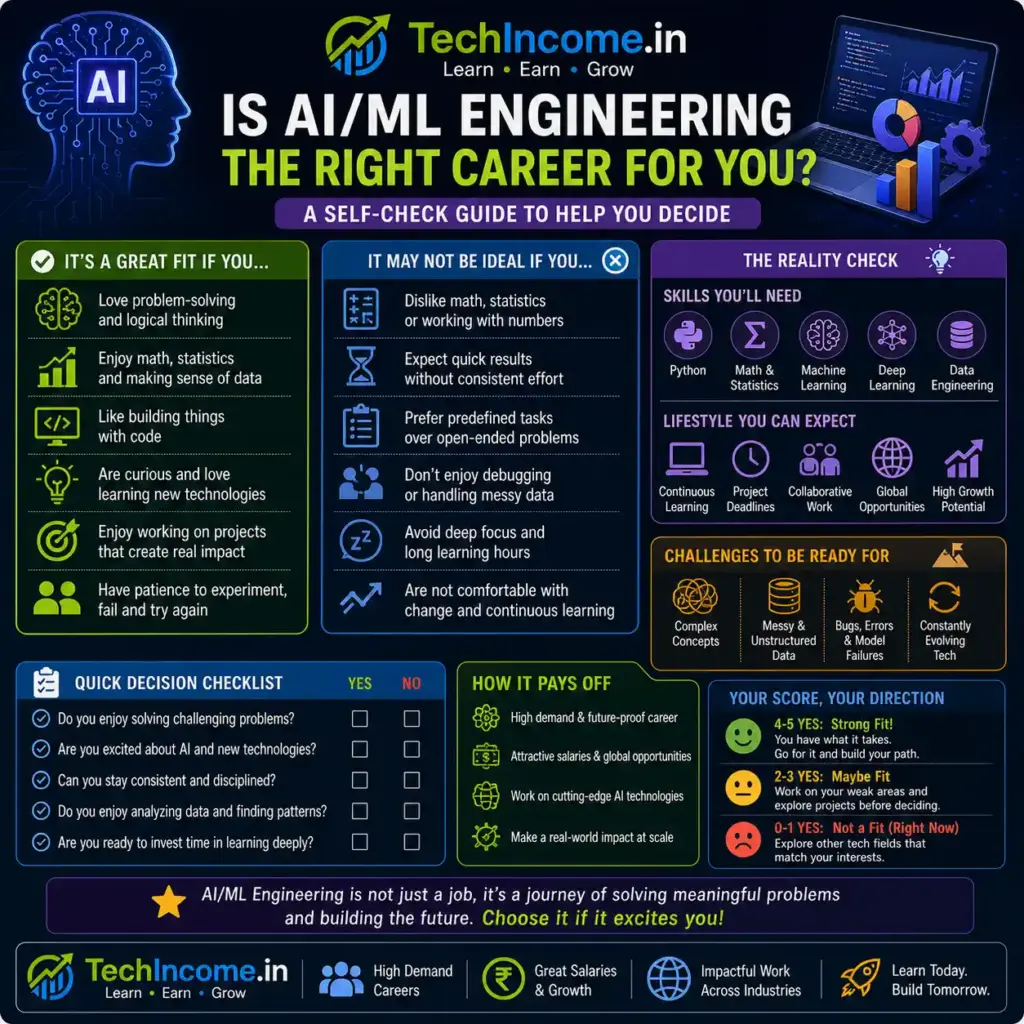
AI/ML engineering is a good fit if:
- You genuinely enjoy understanding how and why things work, not just that they work
- You’re comfortable with ambiguity — ML models are probabilistic, and “good enough” often requires significant judgment
- You don’t mind spending hours debugging something that looks like it should work but doesn’t
- You’re willing to keep learning indefinitely — the tools and techniques in this field change faster than almost any other area of software engineering
It’s a harder fit if:
- You want clear, predictable, defined tasks with obvious completion criteria
- You find mathematics genuinely frustrating rather than challenging
- You’re looking for a quick route to a high salary without sustained skill-building
The field is rewarding — intellectually, professionally, and financially. But it rewards people who are genuinely curious about it, not just people who followed the salary numbers.
techincome.in covers practical career and income guidance for India’s tech generation — no sponsored rankings, no inflated promises.
Recommended Next Reads:
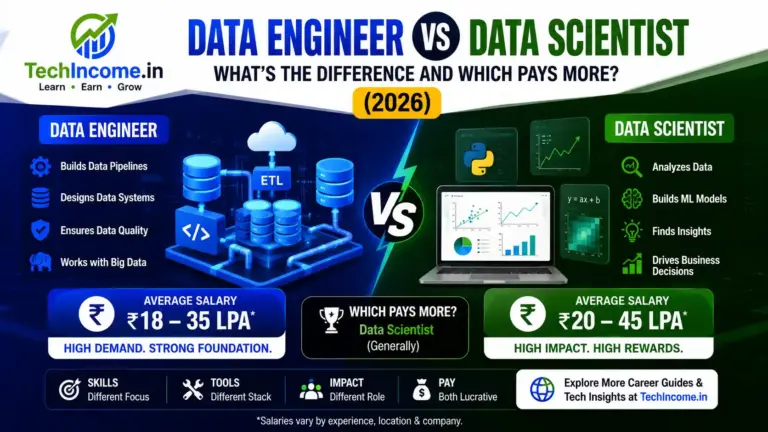
- Data Engineer vs Data Scientist
- Top IT Jobs in Demand for the Future
- The Best IT Certifications in 2026
FAQs
-
What qualifications do I need to become an AI/ML engineer in India?
There is no single required qualification, but most AI/ML roles in India prefer candidates with a bachelor’s degree in Computer Science, IT, Mathematics, Electronics, or a related field. A master’s degree in AI, Data Science, or ML gives you a 15–20% higher starting salary and opens FAANG-level recruiting pipelines. That said, companies — especially startups and product-focused firms — are increasingly evaluating candidates on demonstrated skills rather than degrees. A strong GitHub portfolio with end-to-end projects, solid Python and ML fundamentals, and at least one deployed project can get you shortlisted at many companies without a postgraduate degree. Certifications from Google, AWS, or DeepLearning.AI add credibility but should be combined with real project work to be meaningful to hiring managers.
-
What is the starting salary of an AI/ML engineer fresher in India in 2026?
AI/ML fresher salaries in India in 2026 range from ₹5.8–8 LPA at IT service companies to ₹8–12 LPA at product startups and mid-size firms. Freshers with strong GitHub portfolios, GenAI project experience, and good communication skills are landing ₹10–15 LPA. IIT/NIT graduates entering top-tier companies directly can receive ₹20 LPA and above. The single biggest factor that separates a ₹6 LPA offer from a ₹12 LPA offer at the fresher level is almost always the same: real, deployed projects that demonstrate actual ability — not just completed courses or certifications.
-
How long does it realistically take to become an AI/ML engineer from scratch?
For someone starting with basic programming knowledge, a realistic timeline to a credible junior AI/ML role is 12–15 months of focused, consistent learning. This assumes 2–3 hours of daily study and project work. For someone already working as a software developer with Python experience, 6–9 months of targeted upskilling is often enough to make the transition. For career changers from completely non-technical backgrounds, 18–24 months is more realistic, and a formal master’s degree often provides a faster and more structured path. The timeline depends heavily on consistency — daily practice over a year consistently outperforms weekend cramming over the same period.
-
Which programming language is most important for AI/ML in India?
Python is non-negotiable. It is the primary language for data science, machine learning, deep learning, and GenAI development. Libraries like NumPy, Pandas, Scikit-learn, PyTorch, TensorFlow, LangChain, and FastAPI are all Python-based. SQL is equally important for working with data at the source — you will use it constantly. Beyond these two, R is useful for statistical analysis in certain industries (pharma, research), while Java and Scala appear in big data engineering contexts (Apache Spark, Hadoop). For most AI/ML career paths, becoming very strong in Python and SQL first, then adding specialised frameworks as needed, is the right sequence.
-
Is a master’s degree required to get into AI/ML in India?
No, it is not required — but it helps significantly in specific situations. If you are targeting research roles, AI teams at top-tier companies like Google, Microsoft, or Amazon, or you are switching from a non-technical background, a master’s degree in AI, ML, or Data Science from a reputable institution (IITs, IIITs, or established private universities) accelerates your path meaningfully. For people already in the tech industry who want to transition into ML, a strong portfolio combined with targeted online learning often gets the job done without an additional degree. The honest answer: a master’s is more of an accelerator and door-opener than a strict requirement at most Indian companies.
-
What is the difference between an AI engineer and a data scientist?
An AI Engineer focuses on building and deploying AI-powered systems and applications — writing production code, integrating LLMs and ML models into products, and ensuring models work reliably at scale. A Data Scientist sits closer to the research and analysis end — exploring data, building statistical models, and generating insights that inform business decisions. They typically work more in exploratory notebooks and less in production codebases. In practice at many Indian companies, these roles overlap significantly — especially at smaller companies where one person wears multiple hats. But in terms of daily work, AI/ML Engineers write more production code while Data Scientists spend more time on analysis, experimentation, and stakeholder communication.
-
Which city in India has the most AI/ML job opportunities?
Bengaluru leads India’s AI job market by a significant margin — it hosts Google, Amazon, Flipkart, Swiggy, and hundreds of AI-native startups, offering the highest average AI engineer salaries at ₹12.67 LPA average (Glassdoor, Feb 2026) and significantly higher ceilings for experienced professionals. Hyderabad is a strong second, with comparable senior-level pay and 30–35% lower cost of living than Bengaluru — making it very attractive for actual purchasing power. Mumbai is the best city for AI roles in fintech and BFSI, where domain premium adds 35–50% on top of standard AI salaries. Pune and Delhi NCR round out the top five, with active GCC presence and startup ecosystems growing fast. Tier-2 cities like Chennai and Coimbatore are emerging as AI hubs as companies decentralise talent.
-
Can I get an AI/ML job without a computer science degree?
Yes. India’s AI job market is skill-driven enough that professionals from electronics engineering, mechanical engineering, commerce, economics, and even non-engineering backgrounds have successfully made the transition. What you need is demonstrably strong Python skills, ML fundamentals, at least 3–5 real project builds (preferably deployed), and excellent communication of what you’ve built and why. The path is harder from a non-CS background — you’ll spend more time in the foundation phase — but the transition is absolutely achievable. Many hiring managers care more about what you’ve built than where you studied. A master’s degree in AI or Data Science becomes more valuable the further you are from a CS background, as it provides structured learning and credential signalling.
-
What are the highest-paying specialisations in AI/ML in India right now?
As of 2026, the three highest-paying AI specialisations in India are: Generative AI Engineering (LLM engineers, RAG engineers, AI product engineers) earning ₹20–70 LPA at mid-to-senior levels; MLOps Engineering earning ₹30–60 LPA at senior levels because these engineers keep AI systems running reliably in production — a problem that directly costs companies money; and Computer Vision for specific domains like autonomous vehicles, medical imaging, and industrial quality control, which command significant premiums due to the scarcity of qualified practitioners. GenAI roles currently carry the highest premium of all three because the field is new, talent is scarce, and business impact is immediate and visible to leadership.
-
What is GenAI engineering and why is it so in demand right now?
Generative AI Engineering involves building applications and systems powered by large language models (LLMs) like GPT-4, Claude, or Gemini. In practice, this means building RAG pipelines (connecting LLMs to private knowledge bases), designing multi-agent AI systems using frameworks like LangChain or LlamaIndex, fine-tuning open-source models for specific business tasks, and deploying these systems reliably in production. The demand is intense because every company — from large enterprises to early-stage startups — is urgently trying to ship AI-powered features, and the number of engineers who can actually build these systems reliably is genuinely tiny. GenAI engineers at mid-to-senior levels in Indian product companies earn ₹20–70 LPA, with entry-level GenAI roles starting at ₹8–12 LPA for freshers with strong project exposure.
-
How important is mathematics for becoming an AI/ML engineer?
Mathematics is important but often overstated as a barrier. You do not need a PhD in mathematics to become a working AI/ML engineer. What you genuinely need is: linear algebra (matrices and vectors, because this is how data flows through models), basic statistics and probability (because this is how you evaluate whether your model is doing something meaningful), and the concept of calculus gradients (because this is how neural networks learn — gradient descent). This is roughly equivalent to a solid first-year engineering maths foundation. The 3Blue1Brown YouTube channel explains linear algebra and calculus visually and intuitively, which is enough for most practical ML work. If you want to go deeper into research or algorithm design, stronger mathematics becomes progressively more important.
-
What should my first AI/ML project be?
Your first project should be something small, end-to-end, and genuinely your own — not a tutorial you followed step by step. A few practical starting points: build a spam email classifier using a public email dataset; build a movie or product recommendation system using collaborative filtering; build a sentiment analysis model on product reviews; or build a simple house price predictor using Indian real estate data from sources like MagicBricks or 99acres. The key is to go through the complete workflow yourself: find the data, clean it, build the model, evaluate it honestly including where it fails, and deploy it as a simple web app using Streamlit. A project where you document what went wrong and what you learned is more impressive to a technical hiring manager than a polished tutorial reproduction where nothing went wrong because you already had the answer.