
Blogging is no longer the “easy passive income” idea it was often marketed as. In 2026, it sits somewhere between a real digital asset and a long-term business. Whether it is a good side hustle depends on expectations, strategy, and execution.
This article breaks down the reality – what works, what does not, and whether it is worth your time today.
The Short Answer
Yes, blogging is still a good side hustle in 2026—but only if you approach it strategically and consistently.
If you expect:
- Quick money
- Viral success
- Passive income in 2–3 months
It will likely fail.
If you treat it as:
- A long-term asset
- A skill-based income stream
- A system that compounds
Then it can outperform most side hustles.
What Changed in Blogging (2020 → 2026)
As the technology has advanced with the new writing tools and easy research accessibility with AI tools, the expectations with written content are also High.
Blogging has evolved significantly due to:
1. AI Content Explosion
Tools like ChatGPT have made content creation easier, but also flooded the internet with low-quality articles. The search engines do not like the low quality content.
Impact:
- Generic content no longer ranks, You need to add some unique Value.
- Google prioritizes depth and originality, Copying AI content will just not work in long run.
2. Google’s Focus on Helpful Content
Google’s algorithm updates now reward:
- Real experience
- Problem-solving content
- User satisfaction signals
Thin, keyword-stuffed blogs are filtered out. So make sure you don’t just ask AI to bulk generate the content for blogging. Give it your much human attention and do it properly as if one of your own is going to read it.
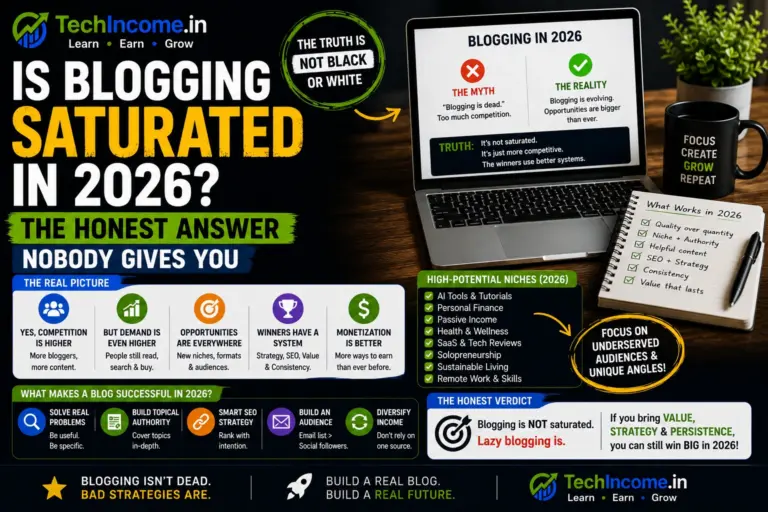
3. Competition Increased—but So Did Opportunity
More competition exists, but:
- More people search online than ever, people have just shifted their attention towards the internet now more then ever.
- New niches emerge constantly, as the people using the internet are increasing so does the different types of people interests and topics to write on increases.
- Monetization methods have expanded
Why Blogging Still Works in 2026

1. It Builds a Digital Asset
Unlike freelancing or gigs:
- A blog keeps generating traffic over time
- Old posts can earn for years (Only till the posts are relevant and still has the quality and demand)
This is compounding income, not linear income.
2. Multiple Income Streams
A single blog can earn from:
- Ads (like Google AdSense)
- Affiliate marketing
- Digital products
- Freelance leads
- Sponsorships
You are not dependent on one source of income. You can build and power a full business around a single blog if done properly.
3. Low Startup Cost
You can start with:
- Domain + hosting
- Basic theme
No inventory, no office, no staff. Just build up the right mind set, work hard and consistently. Provide regular and quality input to your blog and keep going.
4. Skill Leverage
Blogging builds valuable skills:
- SEO
- Writing
- Marketing
- Audience building
These can be monetized outside the blog as well. You get to learn a lot when you try to build an income online around via blogging.
Why Most People Fail at Blogging
This is where reality matters.
1. Wrong Expectations
Many expect:
- Income in 1–2 months
- Traffic without strategy
Blogging typically takes:
- 3–6 months for traction
- 6–12 months for income
2. Writing for Google, Not Users
Common mistake:
- Keyword stuffing
- Rewriting existing articles
What works now:
- Solving real problems better than competitors
- Write in such a way that a real human searching for a particular problem get the solution reading your blog and can discover your blog and provide them unique and valuable value for their time.
3. No Niche Focus
Random topics = no authority.
Example of weak approach:
- One post on fitness
- One on crypto
- One on travel
Google cannot understand your expertise. Before writing a single blog, you must figure out the keywords and topics you want to write and create your whole content accordingly.
4. Inconsistent Publishing
Blogging rewards consistency.
Posting:
- 5 articles → stop → 10 more later
does not build momentum.
You must create a pattern and stick to that pattern, random posting here and there is less likely to grow.
What Actually Works in 2026
1. Niche Authority Strategy
Pick one clear niche:
Examples:
- Online income for beginners
- Freelancing in India
- Digital products
Then go deep, not wide.
As you start going “deep” you will know what was the “wide” you were doing wrong.
2. Problem-Solving Content
Every post should answer:
What problem does this solve?
Weak:
“Benefits of blogging”
Strong:
“How to start a blog in India with ₹0 (step-by-step guide)”
Just figure out alternative titles for you blog post and compare them. Work in advance so you still have enough decision making time before the posting deadline is near.
3. High-Quality Content
Each post should:
- Be 1000–2000+ words
- Include examples
- Provide actionable steps
No fluff.
You can explain things straight forward, and different scenarios relating the topic you are writing, list down the natural questions that arose in your mind when you were researching about the topic under consideration. Check whether those questions are asked on the internet, are there satisfactory answers on the first page of Google/Bing if not you can go deep on it.
4. Internal Linking System
Every post should connect to others.
This:
- Improves SEO
- Increases user time on site
- Builds topical authority
Here by others I mean, there should be relevant links to your own posts and your posts should be inter connected via links. Its just like back linking but within your site itself.
5. Consistency (Non-Negotiable)
Minimum:
- 2–3 posts per week
Target:
- 30 high-quality posts in 30–45 days (for early traction)
Make sure you don’t miss this. I have missed this one till now, I was implementing various ideas and always thinking! Why my websites are never getting enough traffic and adsense approval. The main reason for not getting what I wanted and what most bloggers want is due to the high expectations but lower consistency and lack of a proper posting schedule.
How Much Can You Earn?
Realistic expectations:
Beginning Phase(0–6 months)
- ₹0 – ₹5,000/month
- Focus: learning + indexing
Growth phase (6–12 months)
- ₹5,000 – ₹30,000/month
Scaling phase (12+ months)
- ₹30,000 – ₹1L+/month
Depends on:
- Niche
- SEO execution
- Monetization strategy
- Learn the terms like CTR and you will learn more about choosing the right niches to go beyond Scaling phase.
Blogging vs Other Side Hustles
| Factor | Blogging | Freelancing | Dropshipping |
|---|---|---|---|
| Startup cost | Low | Low | Medium |
| Time to income | Slow | Fast | Medium |
| Scalability | High | Limited | High |
| Passive income | Yes | No | Partial |
Blogging is slower but more scalable.
Who Should Start Blogging in 2026
Blogging is suitable if you:
- Can stay consistent for 3–6 months
- Prefer long-term income
- Like writing or explaining
- Are willing to learn SEO
Not suitable if you:
- Need immediate money
- Get bored quickly
- Avoid learning technical skills
A Simple 30-Post Strategy (Proven for Growth)
If starting today:
Step 1: Pick one niche
Example: “online income in India”
Step 2: Create 30 topics
- Freelancing
- Blogging
- Affiliate marketing
- Digital products
Step 3: Write posts like:
- “How to start freelancing with no experience”
- “Best digital products to sell in India”
- “Is blogging still worth it in 2026”
Step 4: Interlink all posts
Step 5: Optimize with Rank Math
Final Verdict
Blogging in 2026 is:
- Not easy
- Not fast
- Not dead
It is a high-leverage side hustle that rewards:
- Patience
- Strategy
- Consistency
If treated like a business, it can outperform most side hustles.
If treated casually, it will not work.
Bottom Line
Blogging is still a good side hustle in 2026—but only for those willing to play the long game.
Recommended Next Reads:
- https://techincome.in/how-long-does-it-take-to-make-money-blogging/
- https://techincome.in/how-much-can-you-earn-from-blogging-india/
- https://techincome.in/blogging-vs-youtube-vs-freelancing-2026/
- https://techincome.in/how-to-start-a-blog-in-2026-step-by-step-guide/
FAQs: Is Blogging a Good Side Hustle in 2026?
1. Do I need to show my face or build a personal brand to succeed in blogging?
No. Many successful blogs are content-focused and do not rely on personal branding or visibility.
2. Can I do blogging alongside a full-time job?
Yes. Blogging is flexible and can be done part-time, especially with a structured content schedule.
3. Is it necessary to know coding before starting a blog?
No. Platforms like WordPress allow you to create and manage blogs without coding knowledge.
4. Can blogging work in regional languages or only in English?
Blogging works in regional languages as well, often with lower competition and growing audience demand.
5. Do I need social media to grow a blog?
Not necessarily. Many blogs grow primarily through SEO and search traffic without active social media promotion.
6. How do I know if my blog idea will work before starting?
You can validate by checking search demand using tools like Google Keyword Planner or analyzing existing content performance.
7. Is blogging affected by AI and automation tools?
Yes, but mainly for low-quality content. High-value, original, and experience-based content continues to perform well.
8. Can I start multiple blogs at the same time?
It is not recommended for beginners. Focusing on one blog helps build authority faster.
9. What is more important: writing skills or SEO skills?
Both matter, but clear communication and problem-solving content are more important than advanced writing skills.
10. Do I need to invest in paid tools to succeed in blogging?
No. You can start with free tools and upgrade later when scaling your blog.