
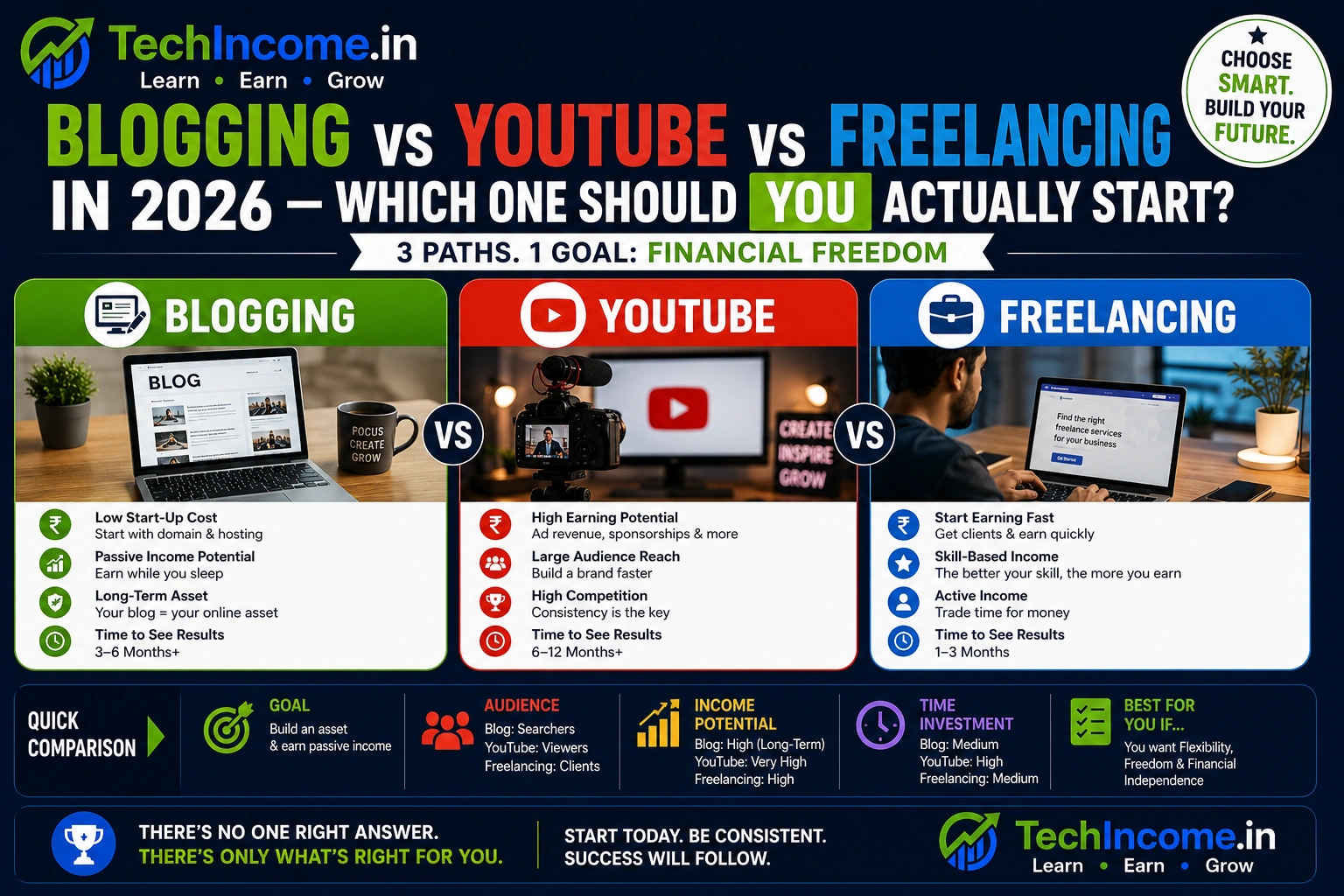
Everyone Has an Opinion on This. Here’s the Actual Answer.
Ask ten people online which is better — blogging, YouTube, or freelancing — and you’ll get ten different answers, all delivered with complete confidence. The freelancer will tell you nothing beats getting paid within your first month. The blogger will explain how their traffic compounds while they sleep. The YouTuber will show you a screenshot of their ad revenue and tell you video is the future.
They’re all right. They’re also all missing the point.
The question isn’t which model is objectively better. It’s which model is right for your goals, your timeline, your skills, and what you’re actually willing to do consistently for the next 12 months. This guide breaks down all three clearly — no hype, no agenda — so you can make that decision with accurate information.
The Core Difference Between the Three Models
Before comparing income timelines and earning potential, it helps to understand the fundamental mechanic of each one — because they operate on completely different principles.
Blogging is a search-driven model. You create written content that answers specific questions people type into Google. When your content ranks, it sends you traffic — consistently, without ongoing promotion. The work you do today continues paying you months and years later. The downside is that “later” is the operative word. Ranking takes time.
YouTube is an attention-driven model. You create video content that earns watch time, subscribers, and algorithmic distribution. Growth can be faster than blogging when content resonates, and the ceiling on income is genuinely higher. The downside is that you’re dependent on an algorithm that rewards some creators and ignores others for reasons that aren’t always clear.
Freelancing is a service-based model. You have a skill — writing, design, coding, video editing, marketing — and you get paid to apply it for clients. Income is the most immediate of the three. The downside is that your time directly limits your income. You can’t earn while you sleep the way a blogger or YouTuber can.
Same ultimate goal — online income — three completely different mechanisms for getting there.
Option 1: Blogging — The Long Game That Pays Repeatedly
Blogging works through a simple compounding mechanism: you publish content, it ranks on Google, it sends traffic, you monetize that traffic. The more content you publish in a focused niche, the more traffic you accumulate, the more income you generate.
How it earns: Google AdSense pays you for displaying ads to your visitors. Affiliate marketing pays you commissions when readers buy products you recommend. Digital products — ebooks, templates, courses — let you sell directly to your audience. Sponsored content pays when brands want placement on your established platform.
What the timeline looks like: The first 3 to 6 months are almost entirely investment. You’re publishing, building topical authority, waiting for Google to trust your site enough to rank your content. It feels like nothing is happening. Around month 4 to 6, posts start appearing on page 1 for low-competition keywords. By month 9 to 12, if you’ve been consistent, traffic is real and income is meaningful.
Who it’s genuinely right for: Blogging rewards patience and process. If you can tolerate delayed gratification, prefer writing to speaking on camera, and want to build something that generates income without requiring your constant active participation — blogging is the model for you. If you need income within the next 60 days, it isn’t.
The real challenge in 2026: AI has flooded the internet with generic content, which has made Google’s quality standards stricter. Thin, surface-level, keyword-stuffed articles don’t rank the way they did in 2018. Blogging still works — but it requires genuine depth, real keyword research, and content that’s actually better than what’s already ranking. The bar is higher. The reward for clearing that bar is still substantial.
Option 2: YouTube — The Fastest Path to Audience, the Hardest to Predict
YouTube’s ceiling is higher than blogging’s. The biggest YouTubers earn amounts that no blogger can match purely from ad revenue, because video advertising rates are significantly higher than display ads, and viral growth is possible in a way it simply isn’t with SEO-driven content.
How it earns: YouTube Partner Program ad revenue (requires 1,000 subscribers and 4,000 watch hours to qualify). Sponsorships and brand deals — often the largest income source for established creators. Affiliate links in video descriptions. Courses, memberships, and digital products sold to a subscriber base.
What the timeline looks like: Channel growth varies enormously — some channels hit monetization thresholds in 3 months, others take 18 months with the same effort. The algorithm rewards early watch-time signals, and getting those early signals right (strong thumbnails, engaging first 30 seconds, topics that people actually search for) is a skill that takes time to develop. Income typically starts later than freelancing but can grow faster than blogging once momentum builds.
Who it’s genuinely right for: YouTube rewards people who are comfortable being on camera or behind a strong audio presence, who can produce content consistently (not just when inspired), and who have the patience to develop video production skills without immediate financial return. It also favors people building a personal brand — YouTube creates audience intimacy in a way that anonymous blogging doesn’t.
The real challenge in 2026: Algorithm dependency is real. A policy change, a shift in recommendation patterns, or a category getting demonetized can cut your income overnight. Creators who’ve built their entire business on YouTube ad revenue have discovered how vulnerable that single-platform dependence can be. The smart YouTube strategy in 2026 is using the channel to build an audience and then monetizing that audience through platforms you control — your own email list, your own products.
Option 3: Freelancing — The Fastest Way to Actually Get Paid
If you need income within the next 30 to 60 days and you have a marketable skill — or can develop one quickly — freelancing is the most direct path. You’re not waiting for traffic, not waiting for algorithm favor, not waiting for Google to trust your domain. You’re finding clients and doing work in exchange for money, starting essentially from day one.
How it earns: Direct client payments for services — writing, graphic design, web development, video editing, social media management, SEO, translation, virtual assistance, and dozens of other categories. You can work through platforms like Fiverr or Upwork which provide built-in client discovery, or find clients directly through LinkedIn, cold outreach, or personal network.
What the timeline looks like: A motivated beginner with a real skill can land their first paid client within 2 to 4 weeks. Income can reach ₹20,000 to ₹50,000 a month within 3 to 6 months for someone working consistently on client acquisition and skill development. That’s a faster path to meaningful income than either blogging or YouTube.
Who it’s genuinely right for: Freelancing is the right starting point if you need income now, if you have a specific skill people will pay for, or if you want financial stability while you build a longer-term asset like a blog or YouTube channel. It’s also right for people who don’t mind active work and client relationships — some people find the freelance model more satisfying than content creation because the feedback is immediate and the income is predictable.
The real challenge: Your income is capped by your time. You can charge more per hour as your skills and reputation develop, but there are only so many hours in a day. Freelancers who don’t consciously plan for this eventually hit an income ceiling that requires either raising rates, specializing, or building a team — all of which require a different set of skills than the original service work.
Comparing the Models Honestly
Here’s how the three stack up on the factors that matter most for most beginners:
Speed to first income: Freelancing wins clearly — weeks, not months. YouTube is second — months, with high variability. Blogging is last — typically 3 to 6 months before meaningful income appears.
Long-term income potential: YouTube has the highest ceiling, followed by blogging, followed by freelancing (without scaling into an agency). But YouTube also has the highest variance — the gap between successful and unsuccessful YouTubers is enormous.
Passive income: Blogging and YouTube both generate income while you’re not actively working. Freelancing doesn’t — if you stop working, you stop earning.
Stability: Freelancing is most stable in the short term — clients pay for work delivered, regardless of algorithms. Blogging becomes stable after growth is established. YouTube is the least stable because algorithm changes can dramatically affect reach and income.
Skill requirements: Freelancing requires a specific marketable skill and client management ability. Blogging requires writing, SEO, and keyword research. YouTube requires video production, scripting, on-camera comfort, and consistency — arguably the highest initial skill requirement of the three.
Startup cost: Freelancing and blogging are both very low cost to start. YouTube requires at minimum decent audio equipment — poor audio quality is the fastest way to lose viewers — which adds some initial investment.
The Strategy That Actually Works Best
Here’s what a lot of experienced online income creators have figured out: you don’t have to choose one of these forever. You choose the right starting point for your situation — and then build from there.
The sequence that makes the most sense for most beginners:
Step 1 — Start with freelancing (months 1 to 6). Develop a marketable skill if you don’t have one already — content writing, graphic design, SEO, video editing, web development. Land your first clients. Generate actual income. This does two things simultaneously: it pays your bills while you build longer-term assets, and it develops real skills that will directly improve the quality of whatever you build next.
Step 2 — Build your blog in parallel (months 3 to 12). Once your freelancing generates enough income to cover your basics, start investing 1 to 2 hours a day in building a blog in your niche. The blog compounds quietly while you’re earning from freelancing. By month 9 to 12, the blog starts generating its own income — at which point you have two streams running simultaneously.
Step 3 — Add YouTube when you’re ready (month 12+). Once your blog gives you a content foundation and you understand your audience well, YouTube becomes a natural amplifier. You already know what topics people search for, what questions they have, and what kind of content performs in your niche. The YouTube channel extends your reach and builds audience depth in a way that blogging alone can’t.
The key caveat to this strategy: don’t try to run all three simultaneously from day one. Spreading yourself across three different content models before you’ve mastered any one of them is the fastest path to producing mediocre content everywhere and building nothing strong anywhere.
Pick your starting point based on your immediate situation. If you need income now, start with freelancing. If you can wait 6 months for income and prefer writing over service work, start with blogging. If you’re genuinely comfortable on camera and have a strong content angle, YouTube can be the starting point too — but go in with realistic expectations about the timeline.
The Mistake That Derails Most Beginners
The most common mistake isn’t choosing the wrong model — it’s either trying to do all three simultaneously before you’re ready, or switching between them every few months when results are slow.
Every one of these models requires a 6 to 12 month investment before it produces consistent results. Freelancing is fastest, but even building a solid client base and reputation takes 3 to 6 months of consistent effort. Blogging and YouTube both have longer timelines before income becomes meaningful.
The bloggers, YouTubers, and freelancers who succeed are the ones who picked a direction, committed to it for long enough to see compound results, and resisted the urge to pivot to something new every time growth felt slow.
Whatever you choose, treat the first 6 months as an investment period — not an evaluation period.
Recommended Next Reads:
- Is Blogging a good Side Hustle in 2026
- How much can you Earn from Blogging India
- Blogging Side Hustles
FAQs
-
Which is better for beginners in India — blogging, YouTube, or freelancing?
It depends on your immediate financial situation and your skills. If you need income within 1 to 2 months and have a marketable skill, start with freelancing. If you can invest 6 to 12 months without needing income from this specifically and prefer writing, start a blog. If you’re comfortable on camera and have strong content ideas, YouTube is viable — but expect 6 to 12 months before monetization. For most beginners, freelancing first and blogging second is the most practical sequence.
-
How much can you realistically earn from blogging in India?
Realistic monthly earnings range from ₹5,000 to ₹30,000 in the 6 to 12 month range for a consistent blogger in a monetizable niche, scaling to ₹50,000 to ₹2 lakh+ per month after 12 to 24 months of consistent publishing. The range is wide because it depends heavily on niche selection, keyword targeting, content quality, and monetization strategy. Bloggers in high-CPC niches like finance, software tools, and online income earn more per visitor than those in low-CPC niches.
-
Can you do blogging and freelancing at the same time?
Yes — and this is actually the recommended approach for most beginners. Freelancing generates income while you’re building your blog’s SEO foundation. The challenge is time management — try to keep your freelancing commitments to a fixed number of hours per week so your blog gets consistent attention. Many successful bloggers started as freelance writers, and the skill overlap is significant.
-
Is YouTube worth starting in 2026 as a beginner?
Yes, but with realistic expectations. The platform is more competitive than it was 5 years ago, and the early months of a channel are slow and often discouraging. YouTube rewards creators who can produce content consistently over 12 to 18 months — not those who post 10 videos and expect viral growth. If you’re genuinely comfortable on camera, have a clear content angle, and can commit to consistent production, YouTube is a worthwhile long-term investment.
-
Which has more passive income potential — blogging or YouTube?
Both generate passive income, but in different ways. Blog posts that rank on Google send traffic continuously without ongoing effort after publishing. YouTube videos continue generating ad revenue as long as people watch them, but the algorithm determines how widely they’re distributed — which can change. Blogging’s passive income is more predictable and stable because it’s driven by search rankings rather than algorithm recommendations. YouTube’s passive income ceiling is higher but more volatile.
-
How long does it take to make ₹50,000 a month from freelancing in India?
For someone starting with a marketable skill and actively pursuing clients, ₹30,000 to ₹50,000 per month is achievable within 6 to 12 months. Freelancers who specialize in high-demand skills — UI/UX design, software development, technical SEO, performance marketing, video editing — tend to reach that threshold faster than generalists. Building a reputation through consistent delivery, good communication, and client reviews on platforms like Upwork or Fiverr accelerates growth significantly.
-
Should I start with blogging if I don’t have any SEO knowledge?
Yes — you don’t need to be an SEO expert to start. The fundamentals you need for a beginner blog (keyword research basics, on-page optimization with Rank Math, understanding search intent) can be learned in a few weeks of focused study and applied from your first post. The more important question is whether you’re willing to keep learning as you go — SEO is something you understand progressively through practice more than through upfront study.