
Here’s something that happens more often than it should.
Someone spends six months learning Python, statistics, and machine learning. They build a few Kaggle models, get their first data science interview, and then freeze when the interviewer asks: “So, can you walk me through how you’d build a data pipeline to feed this model in production?”
Or the reverse — someone spends months learning Spark and SQL and dbt, lands a Data Engineer role, and then realises their colleagues in the “Data Science” team are doing the work that actually interested them all along.
Both of these situations happen because Data Engineer and Data Scientist are frequently lumped together in career conversations — as if “data careers” is one thing. It isn’t.
They are different jobs. Different daily work. Different skill sets. Different career paths. And yes — different salaries, though not always in the direction people assume.
I’m going to break this down as clearly as I can, because choosing the right one to pursue can save you a year of learning the wrong things. And if you’re already in one and wondering whether to switch — I’ll give you the honest framework for that too.
Let’s start at the beginning.
The One-Line Version of Each Role
Before I go deep, let me give you the clearest one-liner I can for each:
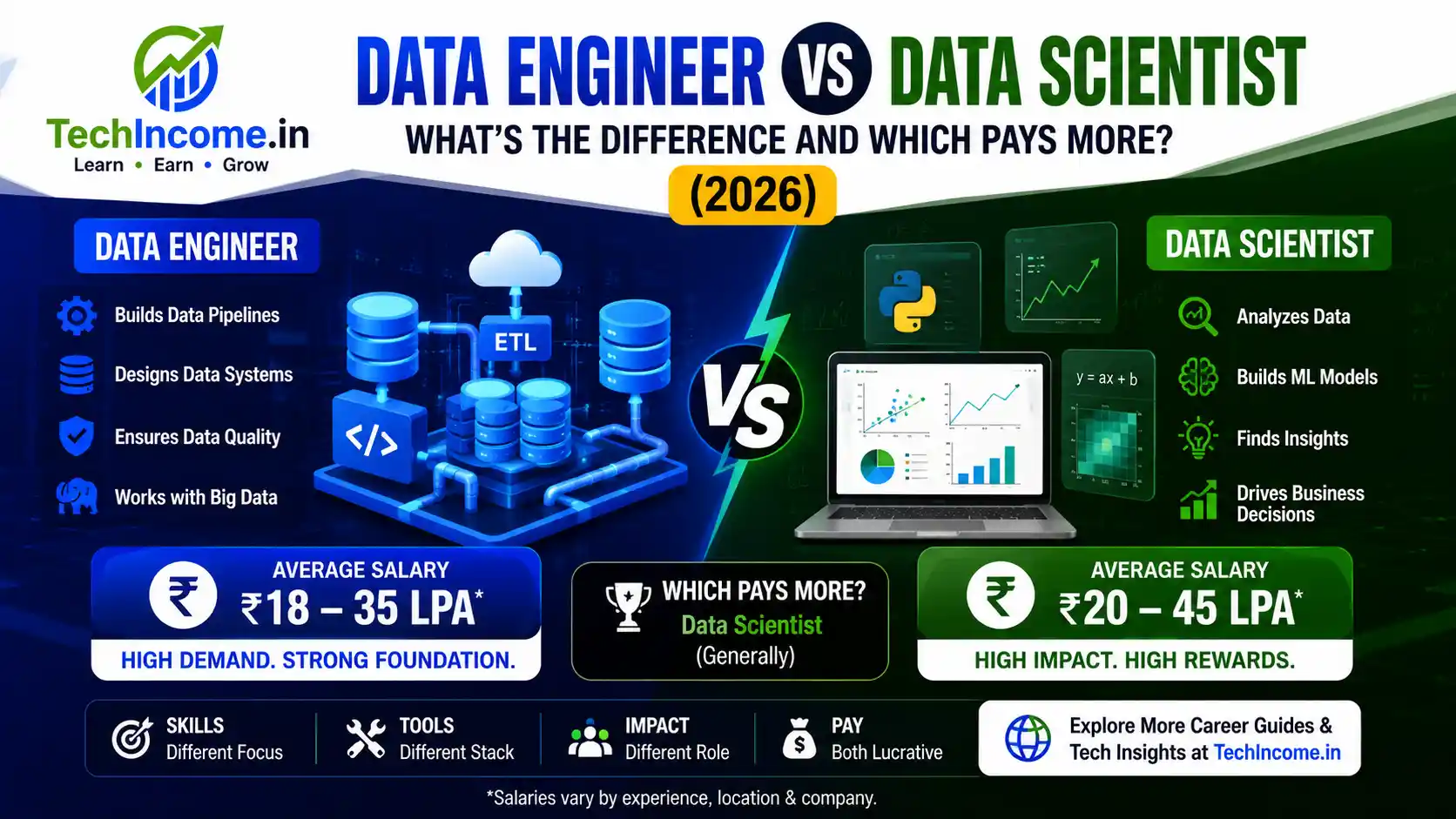
A Data Engineer builds the infrastructure that gets data from where it is to where it needs to be — reliably, at scale, on time.
A Data Scientist uses that data to build models, find patterns, and generate insights that help a business make better decisions.
One builds the roads. The other drives on them.
Both are essential. Most organisations that use data well need both. But the skills, the daily work, and the career arc are genuinely different — and the “road builder” role is currently more in demand than most people realise.
What a Data Engineer Actually Does Every Day
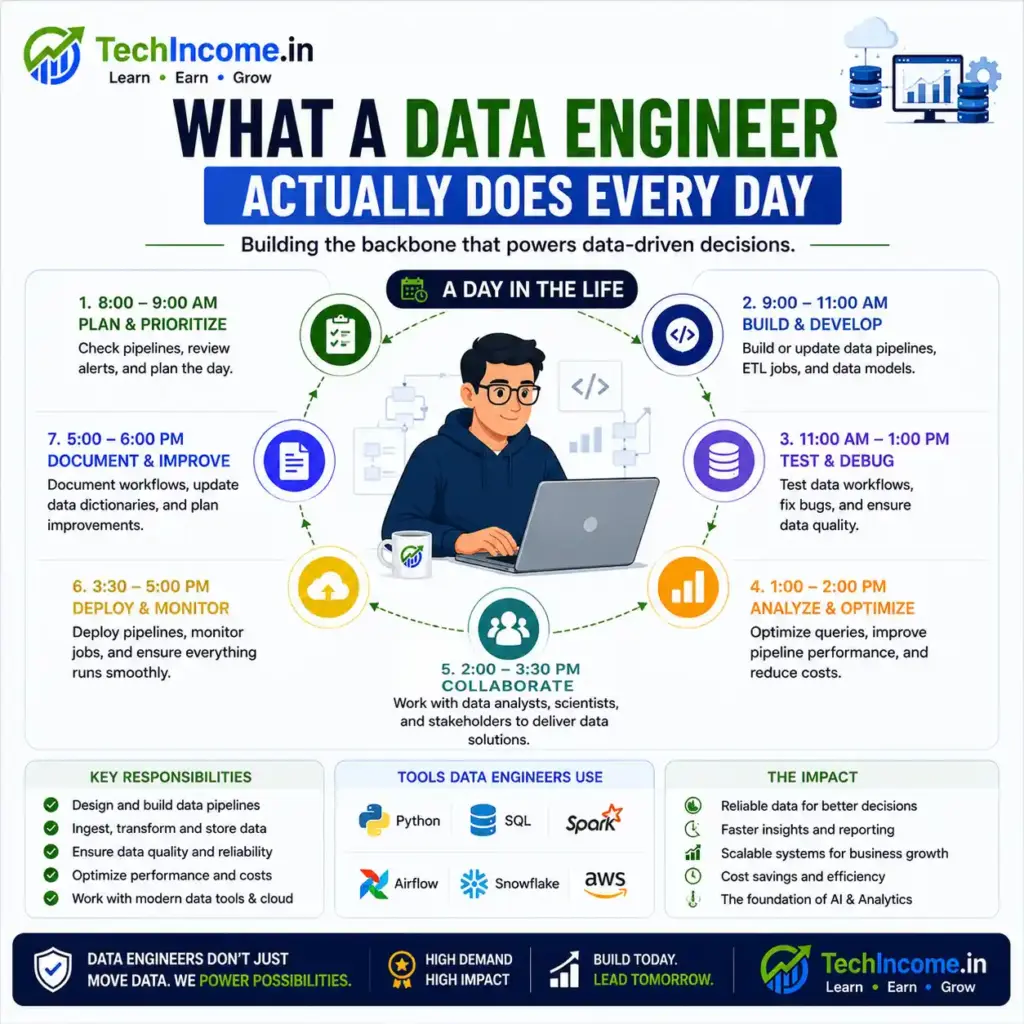
Let me paint you a picture.
Imagine you work at a mid-size e-commerce company. Every minute, thousands of transactions are happening — orders placed, payments processed, carts abandoned, products returned. That data exists scattered across a dozen different systems: the order management database, the payment gateway logs, the CRM, the app analytics platform, the customer support ticketing system.
A Data Engineer’s job is to pull all of that data together, clean it, transform it into a consistent format, and deliver it to wherever it needs to go — the analytics warehouse that the business intelligence team queries, the data lake that the Data Science team uses to train models, the real-time dashboard that the operations team monitors.
Specifically, on a typical day, a Data Engineer might:
- Write an Apache Spark job to process 50 million rows of clickstream data and load it into Snowflake
- Debug a broken Airflow DAG — an automated pipeline that runs every hour and just started failing silently at 3am
- Design a new data model in the warehouse so that marketing can query customer lifetime value without needing to join 8 different tables every time
- Optimise a slow SQL query that’s making the entire reporting dashboard crawl
- Migrate a legacy on-premise data warehouse to BigQuery and make sure nothing breaks during the transition
- Work with a backend engineering team to ensure that a new product feature is logging the right events in the right format
Notice what you don’t see in that list: machine learning, statistical modelling, or building predictive algorithms. Data Engineers are software engineers who specialise in data systems. They think about reliability, scalability, latency, schema design, and data quality. Their output is infrastructure — pipelines, warehouses, data models — not insights or predictions.
The core skills of a Data Engineer:
SQL — at a deep level, not surface level. Data Engineers write SQL that’s more complex than most developers ever encounter — window functions, recursive CTEs, query optimisation, partitioning strategies. If you only know SELECT and GROUP BY, you know beginner SQL. Data Engineering requires intermediate to advanced.
Python — for orchestration and transformation logic. Most data pipeline code is written in Python — using libraries like Pandas, PySpark, or dbt (data build tool) to transform raw data into structured, analysis-ready formats.
Cloud data platforms. The modern data stack runs on cloud. AWS (Redshift, Glue, S3), Google Cloud (BigQuery, Dataflow, GCS), and Azure (Synapse Analytics, Data Factory, ADLS) are where data lives. A Data Engineer needs to be genuinely comfortable working within at least one cloud provider’s data ecosystem.
Workflow orchestration. Apache Airflow is the most widely used tool for scheduling and monitoring data pipelines. dbt (data build tool) has become standard for transformation logic. Knowing how to build, schedule, monitor, and debug automated workflows is core to the role.
Big data processing. For large-scale data (billions of rows, petabytes of storage), Apache Spark is the standard distributed processing framework. You don’t need to be a Spark expert as a junior Data Engineer, but you need to understand the concept of distributed computing and be able to write basic Spark jobs.
Data modelling. Designing how data is structured in a warehouse — choosing between star schema and data vault, deciding how to handle slowly changing dimensions, thinking about how query patterns affect schema design — is a specialised skill that separates good Data Engineers from exceptional ones.
What a Data Scientist Actually Does Every Day
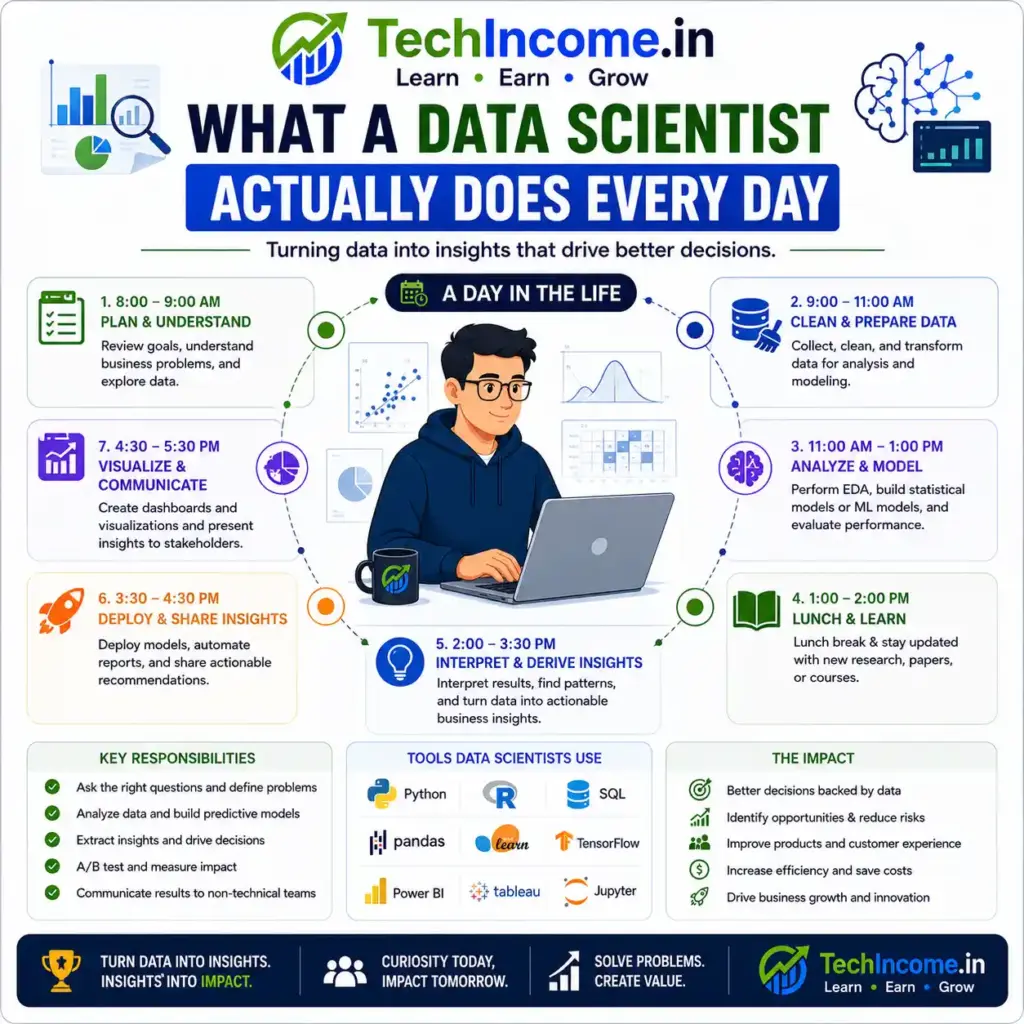
Now let’s flip to the other side.
At that same e-commerce company, the Data Scientist is consuming the clean, structured data that the Data Engineer built. Their job is to extract value from it — not just describe what happened (that’s a Data Analyst’s job), but predict what will happen and prescribe what the company should do about it.
On a typical day, a Data Scientist might:
- Build a churn prediction model that identifies customers likely to stop buying within the next 30 days — so the marketing team can target them with retention offers before it’s too late
- Run an A/B test to determine whether a new checkout flow actually increases conversion rate, or whether the apparent improvement is just statistical noise
- Build a product recommendation engine that suggests items a customer is likely to buy based on their browsing and purchase history — similar to what Amazon and Flipkart use
- Analyse why a particular product category saw a sudden drop in sales last month — was it seasonality, a pricing change, a competitor promotion, or a data quality issue?
- Fine-tune a text classification model that automatically tags customer support tickets by issue type, reducing the time support agents spend on manual categorisation
- Present findings to the product team: “Our model says customers who buy X within 7 days of signing up have 3x higher lifetime value — here’s what that means for our onboarding strategy”
Notice what’s different: Data Scientists work closer to the business problem and the decision. Their output is insight, prediction, or automation — not infrastructure. They spend significant time in exploratory analysis, building and evaluating models, and communicating findings to non-technical stakeholders.
The core skills of a Data Scientist:
Statistics and probability — genuinely. Not just knowing the words, but understanding when to use a t-test vs an ANOVA, what a p-value actually means (and why it’s frequently misinterpreted), how to design an experiment properly, and how to catch your own biases in analysis. This is the skill gap that separates candidates who can talk about data science from those who can do it.
Python for data science. Pandas for data manipulation, NumPy for numerical computation, Scikit-learn for classical machine learning, Matplotlib and Seaborn for visualisation. These are table stakes. Beyond that, TensorFlow or PyTorch for deep learning, and increasingly LangChain or Hugging Face for NLP and GenAI work.
SQL — at a working level. Data Scientists need SQL, but typically at a less advanced level than Data Engineers. You need to be able to write complex queries to extract and explore data. You don’t necessarily need to design warehouse schemas.
Machine learning — both theory and implementation. Understanding the intuition behind algorithms (why does regularisation help? what does a decision tree actually do? why does gradient descent sometimes get stuck?), implementing them correctly, and evaluating them honestly. Knowing that your model has 92% accuracy is meaningless without knowing whether 92% is actually good for your specific problem.
Experiment design and A/B testing. Running valid experiments — with correct sample sizes, control of confounders, and statistically sound analysis — is a practical skill that product-focused Data Scientists use constantly. Many candidates can build models but can’t design a valid experiment.
Communication and storytelling. This one is underrated and critical. A model that the business can’t understand or trust will never be used. The ability to translate statistical findings into clear business recommendations — in plain language, in a deck, to a room full of non-technical people — directly determines how much impact you have.
The Honest Salary Comparison in India (2026)
This is the question everyone actually wants answered, so let’s be direct.
Data Engineer Salary in India
Fresher (0–2 years): ₹5–9 LPA at IT services companies; ₹8–14 LPA at product companies and GCCs with strong SQL, Python, and one cloud platform. Data Engineers who already know Spark or Airflow at the fresher level command the higher end.
Mid-level (3–5 years): ₹14–22 LPA at IT services; ₹20–35 LPA at product companies. Cloud data engineers with Snowflake, BigQuery, or Redshift experience specifically are at the top of this range.
Senior (6+ years): ₹30–50 LPA at product companies and GCCs; ₹40–70 LPA at BigTech India and top-tier fintech/data companies. Principal Data Engineers and Data Platform Architects at the highest levels.
In India, data engineers earn around ₹21,00,000/year for 10–15 years of experience, with an average base salary of ₹9,35,000/year. Those with expertise in cloud platforms like AWS, GCP, or Azure and big data tools like Apache Spark command significantly more.
Data Scientist Salary in India
Fresher (0–2 years): ₹6–10 LPA at analytics firms and IT services; ₹10–16 LPA at product companies. Freshers with strong Python, statistics, and at least one real deployed model on GitHub are at the higher end.
Mid-level (3–5 years): ₹14–22 LPA at IT services and analytics firms; ₹22–40 LPA at product companies. GenAI and LLM-specialised Data Scientists are already seeing premiums of 25–40% over generalists at this level.
Senior (6+ years): ₹30–55 LPA at product companies and GCCs; ₹50–80 LPA for specialised AI/ML scientists at BigTech India.
The salary gap between a generalist data scientist and an AI-specialised one is 25–40% and widening. GenAI, LLMs, MLOps, and Agentic AI are the skills driving that premium.
So Which Pays More?
Here’s the honest answer: at entry level, Data Scientists edge out Data Engineers slightly. At mid-to-senior levels, it depends almost entirely on specialisation — not job title.
Data scientists generally earn more than data analysts but slightly less than ML engineers at equivalent experience levels — and the distinction is narrowing in 2026 as both roles increasingly require deployment and production skills.
A Data Engineer who knows Spark, dbt, Snowflake, and cloud infrastructure well often earns more than a generalist Data Scientist at the same experience level. A Data Scientist who has moved into GenAI and MLOps territory often earns more than a Data Engineer doing standard ETL pipeline work.
The better question isn’t “which pays more” — it’s “which can I go deep enough in to become genuinely exceptional?” Because at the senior level, depth beats job title every time.
The Demand Side: Which One Is Actually Easier to Get Hired Into?
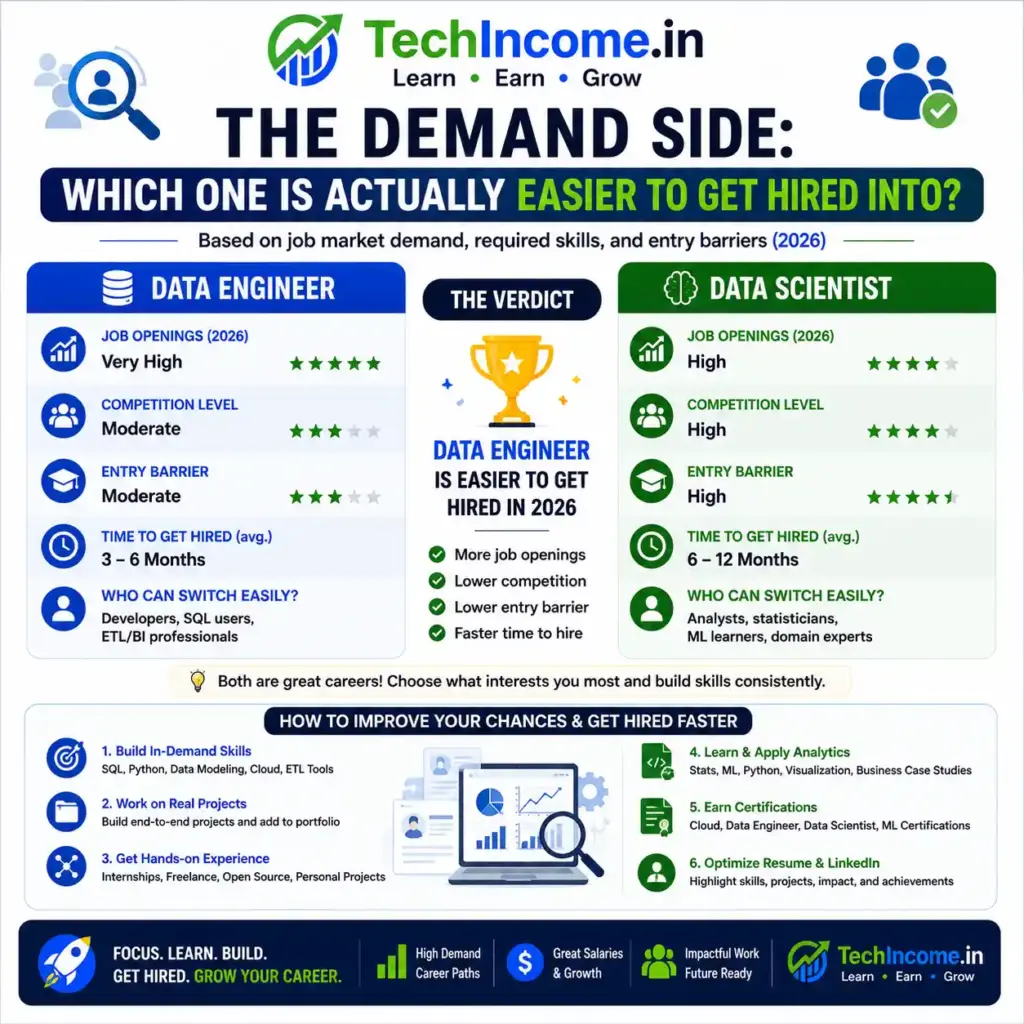
This is the more practical question for most people, and the answer might surprise you.
Data Engineering is currently more in demand and easier to get a first job in — despite being less talked about.
Here’s why. Every company that collects data needs a Data Engineer before it needs a Data Scientist. You cannot build models on data you haven’t collected, cleaned, and organised. The infrastructure comes first. And most companies — especially the vast majority of mid-size companies and enterprises that make up India’s bulk hiring market — need 3–5 Data Engineers for every 1–2 Data Scientists.
Data engineers earn more because companies depend on reliable data systems — in India, pay ranges from ₹8 LPA to ₹20 LPA, especially for those working with cloud and big data tools, and as companies collect more data every day, this role continues to grow in importance.
Data Science hiring is also competitive in a different way. Because “Data Scientist” sounds glamorous, the candidate pool is larger and often overqualified for entry-level roles — creating a mismatch where companies struggle to hire good Data Scientists (the bar is genuinely high) while candidates struggle to differentiate themselves from hundreds of applicants who also know Python and Scikit-learn.
Data Engineering has a different problem: there simply aren’t enough people with the specific combination of strong SQL, cloud platform knowledge, and data pipeline experience. That specific gap creates better fresher-hiring conditions.
The practical implication: If you’re deciding what to learn right now and your primary goal is getting a job within 9–12 months, Data Engineering gives you a clearer, faster path to employment. If your primary goal is working on machine learning problems and you’re willing to invest 18+ months into building the skill stack, Data Science is the right target.
The Overlapping Skills You Need Either Way
Before you decide, there’s good news: the core foundation for both careers is largely the same. Time you invest here is never wasted regardless of which direction you go.
SQL — the lingua franca of all data work
No matter which path you choose, you will write SQL every single day. For Data Engineers, it’s the primary language for transformation logic. For Data Scientists, it’s how you access and explore data before any modelling begins. The difference is depth — Data Engineers need more advanced SQL than Data Scientists typically do. But both need it genuinely, not superficially.
The trap most beginners fall into: completing a SQL course on Udemy, writing a few SELECT queries, and calling themselves “proficient in SQL.” That’s not what employers mean. Proficient in SQL means you can write window functions, subqueries, CTEs, handle NULLs correctly, understand query execution plans, and know when a JOIN is going to destroy performance on a large table. That level takes consistent practice over months, not a certificate.
Python — at a real working level
Both roles use Python. Data Engineers use it for pipeline logic, automation, and data transformation. Data Scientists use it for analysis, modelling, and increasingly for deployment. The libraries differ (Pandas, PySpark, Airflow for engineering; Pandas, Scikit-learn, Matplotlib for science), but the language fundamentals are shared.
Cloud fundamentals
Both roles increasingly work in cloud environments. You don’t need to be a cloud architect, but you need to be comfortable with S3 or GCS for storage, basic IAM for access management, and either Redshift/BigQuery/Synapse for data warehousing depending on which platform your target employers use.
Git and version control
Data Engineering code goes in Git repositories. Data Science models go in Git repositories. Everyone uses Git. If you don’t know how to use Git — branching, committing, pull requests, resolving conflicts — learn it before anything else.
The Key Differences That Actually Matter for Your Decision
Let me give you the clearest comparison I can on the dimensions that should influence your choice.
How you spend your day
Data Engineers spend most of their time writing code — SQL, Python, occasionally Scala for Spark — and debugging things that are broken. Pipelines fail. Data gets corrupted upstream. Schema changes break downstream dependencies. The work is often reactive and detail-oriented. You need a high tolerance for investigating problems in complex systems.
Data Scientists spend a significant amount of time exploring data, running experiments, and iterating on models. The work is often more open-ended — “find out why customer engagement dropped this quarter” doesn’t have a predefined answer or method. You need comfort with ambiguity and the patience to iterate many times before finding something meaningful.
Stakeholders you work with
Data Engineers primarily work with other engineers — Data Scientists, Analytics Engineers, Software Engineers, and DevOps. The communication is mostly technical. You’re building things for internal technical users.
Data Scientists work with a wider range of people — product managers, business analysts, marketing, operations, and company leadership. You need to communicate findings in business language, not just technical language. If presenting to a VP of Marketing sounds like something you’d enjoy, that’s a signal toward Data Science. If it sounds exhausting, that’s a signal toward engineering.
How your work is evaluated
Data Engineering success is largely objective: does the pipeline run reliably? Is the data accurate? Is the warehouse query performing well? Does everything still work after the schema changed? You know pretty quickly whether you’ve succeeded.
Data Science success is fuzzier: did the model actually improve the business metric? Was the A/B test designed correctly? Did leadership actually use the recommendation? You often can’t measure your own impact immediately, and sometimes months of model work gets shelved because business priorities changed. That ambiguity suits some people and frustrates others.
Which background advantages you
Coming from a software development or systems background — you’re probably better positioned for Data Engineering. The thinking patterns (system design, reliability, debugging, code quality) transfer directly.
Coming from a statistics, economics, research, or analytics background — you’re probably better positioned for Data Science. The comfort with data exploration, hypothesis testing, and communicating findings to decision-makers is a genuine head start.
Coming from a completely non-technical background — Data Engineering has a steeper initial learning curve but a clearer skill acquisition path. Data Science’s statistical foundation can be harder to build without prior exposure.
The Modern Reality: These Roles Are Converging (But Slowly)
Here’s something worth knowing for your long-term career planning.
The traditional wall between Data Engineering and Data Science is getting more porous. Companies increasingly want Data Scientists who can deploy their own models — at least for smaller deployments — rather than handing everything off to an ML Engineering team. And companies increasingly want Data Engineers who understand the downstream uses of the data they’re building — which means understanding ML workflows.
The distinction is narrowing in 2026 as both roles increasingly require deployment and production skills. Your skill stack is the single most controllable factor — switch companies every 2–3 years to expect 30–50% salary jumps versus 8–15% internal increments.
The roles are not merging into one job — but the most valuable professionals in both fields are the ones who can see across the boundary. A Data Engineer who understands enough about ML to design data systems that make model training efficient is more valuable than one who doesn’t. A Data Scientist who can write production-quality code, containerise a model, and push it to a REST API is more valuable than one who can only work in notebooks.
This convergence is also creating a new adjacent role — Analytics Engineer — that sits squarely between the two. Analytics Engineers build and maintain the data models and transformation layers (primarily in dbt) that make data usable for both analysis and ML. It’s a role that’s growing rapidly in India and worth knowing about if you find yourself attracted to both sides.
Which Career Should You Choose in India Specifically?

Let me give you a direct answer based on your situation.
Choose Data Engineering if:
You enjoy building systems more than analysing outcomes. You find debugging pipelines and optimising queries satisfying rather than tedious. You have a software development background and want to specialise in data infrastructure. You want to get hired faster — the supply-demand gap in Data Engineering is sharper right now.
Or practically: if you’re a fresher with a CS background who wants to break into a data role within the next 9–12 months, Data Engineering gives you the clearest path. Learn SQL deeply, get comfortable with Python, pick up one cloud platform (AWS or GCP), learn the basics of Airflow and dbt, build one end-to-end pipeline project, and you’re a competitive candidate.
Choose Data Science if:
You’re genuinely interested in statistics, machine learning, and finding patterns in data. You enjoy presenting findings to stakeholders and influencing decisions. You’re comfortable with ambiguity and iterative work. You have a background in mathematics, economics, or research that gives you a statistical foundation to build on.
Or practically: if your end goal is working on machine learning problems and building predictive systems, invest the extra time the Data Science path requires. It’s a longer journey to a first role but a deeply rewarding specialisation for the right person.
The most practical advice for 2026:
Target product companies — same role, same experience equals 2–3x more than IT services. Add GenAI and LLM skills — the highest demand, lowest supply combination available in data careers right now. The pay gap versus generalists will keep widening through 2027–28.
Regardless of which path you pick — Data Engineer or Data Scientist — the single highest-impact decision you can make for your salary growth is to target product companies or GCCs over IT services companies, and to add one GenAI or cloud-native specialisation to your core skill set as early as possible.
The Certifications Worth Pursuing for Each Path
I’ll keep this focused on what actually moves the needle with Indian employers in 2026.
For Data Engineers:
dbt Fundamentals — free course from dbt Labs. dbt is now standard in most modern data engineering stacks and the certification is widely recognised as evidence you can write production-quality transformation code.
Google Professional Data Engineer — one of the most respected certifications in the field globally. Covers the GCP data ecosystem (BigQuery, Dataflow, Pub/Sub, Dataproc). Exam fee approximately ₹20,000. Excellent for GCC roles since many global companies run on GCP.
Databricks Certified Data Engineer Associate — Databricks (which runs Apache Spark as a managed service) is growing rapidly in Indian enterprise adoption. Their certification is well-regarded and quite practical.
AWS Data Engineer Associate — if your target companies are AWS-heavy (common in fintech and SaaS companies), this validates your cloud data pipeline skills specifically.
For Data Scientists:
Google Professional Machine Learning Engineer — covers model training, deployment, and MLOps on GCP. Well-regarded at product companies and GCCs.
AWS Machine Learning Specialty — the equivalent for AWS-heavy organisations. More technically challenging than the Google version.
DeepLearning.AI specialisations (Andrew Ng’s courses on Coursera) — not certifications in the traditional sense, but the most respected structured learning path for ML fundamentals in India. The Machine Learning Specialisation and Deep Learning Specialisation are both worth completing in full, including the assignments.
Microsoft Azure AI Engineer Associate (AI-102) — valuable for Data Scientists targeting BFSI and enterprise companies that run on Azure infrastructure.
For both paths, a strong GitHub portfolio with real, deployed projects consistently outweighs certifications alone in the eyes of technical hiring managers at product companies
The Tools Map: What Each Role Uses Day to Day
If you’re trying to decide which world feels more aligned with how you think and work, looking at the actual tools can help.
Data Engineering Tools (2026)
| Category | Tools |
|---|---|
| Processing & transformation | Apache Spark, dbt, Pandas, PySpark |
| Orchestration | Apache Airflow, Prefect, Dagster |
| Cloud data warehouses | Snowflake, Google BigQuery, AWS Redshift, Azure Synapse |
| Streaming | Apache Kafka, AWS Kinesis, Google Pub/Sub |
| Storage | AWS S3, Google Cloud Storage, Azure Data Lake |
| Monitoring | Great Expectations, Monte Carlo, dbt tests |
| Version control | Git, GitHub, GitLab |
Data Science Tools (2026)
| Category | Tools |
|---|---|
| Analysis & modelling | Python, Pandas, Scikit-learn, Statsmodels |
| Deep learning | PyTorch, TensorFlow, Keras |
| GenAI & LLMs | LangChain, Hugging Face, OpenAI API, LlamaIndex |
| Experimentation | MLflow, Weights & Biases, Neptune.ai |
| Visualisation | Matplotlib, Seaborn, Plotly, Tableau |
| Deployment (increasingly expected) | FastAPI, Docker, AWS SageMaker, Vertex AI |
| Notebooks | Jupyter, Google Colab, Databricks Notebooks |
Look at those two lists and ask yourself honestly: which set of tools sounds more interesting to work with every day? That instinct is actually useful information.
A Final Word on Switching Between the Two
One question I get a lot is: if I start as a Data Engineer, can I move into Data Science later? Or the reverse?
The honest answer is yes — and it’s actually a well-documented career path. The SQL and Python skills transfer. The data intuition transfers. What you have to build from scratch is the specialised knowledge.
A Data Engineer moving into Data Science needs to invest in statistics, machine learning fundamentals, and model evaluation. The engineering discipline is actually an advantage — engineers who move into data science tend to build more production-ready, reliable models than scientists who never thought about reliability.
A Data Scientist moving into Data Engineering needs to invest in system design thinking, distributed computing concepts, and pipeline reliability engineering. The data intuition is a genuine advantage — scientists who understand downstream needs build better data infrastructure.
The positions of Data Scientist and Data Engineer frequently intersect in data-centric industries — you will find overlapping skills making it easier to make a career transition between the two roles, and both represent some of the most in-demand positions in India, the US, and across the globe.
So the decision you make today isn’t irreversible. But it does affect the next 3–5 years of your career significantly enough that it’s worth thinking through carefully.
Choose based on what the daily work actually looks like — not just the salary chart or what sounds more impressive at a party. Both are strong careers. Both are in demand. Both have clear paths to ₹30+ LPA with 6–8 years of focused work.
The one you’ll succeed in most is the one you’d genuinely keep learning even on a Saturday night when you’re debugging something that doesn’t make sense and nobody is watching.
techincome.in — built for India’s tech professionals who want honest career guidance, real salary numbers, and roadmaps that actually work.
Recommended Next Reads:
- How to become an AI ML Engineer in India
- Top IT Jobs in Demand for the Future
- The Best IT Certifications in 2026
✦ FAQs
-
What is the main difference between a Data Engineer and a Data Scientist?
A Data Engineer builds and maintains the pipelines, warehouses, and infrastructure that collect, clean, and organise data. A Data Scientist uses that cleaned, organised data to build predictive models, run experiments, and generate business insights. Think of it this way: the Data Engineer builds and maintains the water supply system; the Data Scientist uses the water to do chemistry. Both roles work with data every day, but the nature of the work is genuinely different. Data Engineers write more infrastructure code and think about reliability and scalability. Data Scientists run more experiments and think about statistical validity and business impact. In most well-structured data teams, the two roles work closely together.
-
Which pays more — Data Engineer or Data Scientist in India?
At the fresher level, Data Scientists edge out Data Engineers slightly — ₹6–16 LPA versus ₹5–14 LPA depending on company type. At mid and senior levels, the salary gap depends far more on specialisation than job title. The salary gap between a generalist data scientist and an AI-specialised one is 25–40% and widening in 2026, with GenAI, LLMs, MLOps, and Agentic AI being the skills driving the premium. A Data Engineer with strong Spark, Snowflake, and cloud infrastructure skills often earns more than a generalist Data Scientist. The better framework is: which role can you specialise in deeply enough to move into the premium salary bands — and that answer depends on your skills and interests, not the job title.
-
Is Data Engineering harder to learn than Data Science?
They’re hard in different ways. Data Engineering is harder from a software engineering perspective — you need to think about distributed systems, fault tolerance, schema design, and pipeline reliability. Data Science is harder from a mathematical perspective — you need to genuinely understand statistics, probability, and the theory behind machine learning algorithms. For people with software development backgrounds, Data Engineering is often the easier transition. For people with academic or research backgrounds, Data Science is often the easier transition. Neither is universally harder — it depends on where your existing knowledge sits.
-
Which data career is better for freshers in India in 2026?
Data Engineering currently offers a faster and more reliable path to a first job for freshers in India. The demand for Data Engineers consistently outpaces the supply of qualified candidates, particularly those with strong SQL, Python, and cloud data platform skills. Data engineers earn more because companies depend on reliable data systems — in India, pay ranges from ₹8 LPA to ₹20 LPA especially for those working with cloud and big data tools, and as companies collect more data every day, this role continues to grow in importance. Data Science is also in demand, but the candidate pool is larger and competition for entry-level roles is stiffer. That said, if machine learning genuinely interests you more, the longer journey to a Data Science role is worth it — you’ll be more motivated and ultimately more effective.
-
What skills do I need to become a Data Engineer in India?
The core skills for a Data Engineer in India in 2026 are: advanced SQL (including window functions, CTEs, and query optimisation), Python (for pipeline logic and data transformation), at least one cloud data platform (Google BigQuery, AWS Redshift, or Snowflake are the most in-demand), Apache Airflow or a similar orchestration tool for scheduling and monitoring pipelines, dbt for transformation layer work, and basic knowledge of Apache Spark for large-scale data processing. Familiarity with Git and version control is expected at all levels. Cloud certifications — particularly the Google Professional Data Engineer or AWS Data Engineer Associate — help significantly with initial screening at companies that use formal hiring pipelines.
-
What skills do I need to become a Data Scientist in India?
The core skills for a Data Scientist in India in 2026 are: Python (Pandas, NumPy, Scikit-learn, and increasingly PyTorch for deep learning), SQL at a working level, statistics and probability genuinely understood rather than just named, machine learning algorithms and their appropriate use cases, experiment design and A/B testing methodology, and data visualisation for communicating findings. Increasingly, employers also expect some familiarity with GenAI tools and LLM APIs — even for roles that aren’t purely focused on generative AI. The ability to communicate findings to non-technical stakeholders is consistently underrated by candidates and consistently prioritised by hiring managers. A portfolio of real, end-to-end projects on GitHub carries more weight than certifications alone.
-
Can a Data Engineer transition to Data Science later?
Yes, and it’s one of the better-structured career transitions available in data roles. You will find overlapping skills making it easier to make a career transition from data engineer to data scientist. The SQL, Python, and data intuition that Data Engineers develop are genuine advantages in the transition. What needs to be built from scratch is the statistical and machine learning knowledge — which requires investment in learning probability, statistics, and ML fundamentals, plus building a portfolio of actual model-building projects. Engineers who make this transition often become stronger Data Scientists than those who came purely from academia, because they understand production realities that pure scientists sometimes don’t. The reverse transition — Data Scientist to Data Engineer — is also possible but requires more investment in software engineering disciplines.
-
What is an Analytics Engineer and how is it different from both?
An Analytics Engineer is a role that sits between Data Engineering and Data Science, focused specifically on transforming and modelling data so it’s clean, consistent, and ready for both analysis and ML. They primarily work with dbt (data build tool) to write and maintain the transformation logic in the data warehouse, and they collaborate with both Data Engineers (who build the ingestion pipelines) and Data Scientists (who consume the prepared data). It’s a role that’s grown rapidly as dbt became the standard transformation layer in the modern data stack. Analytics Engineering suits people who love SQL and data modelling but aren’t drawn to either the deep infrastructure work of Data Engineering or the statistical modelling of Data Science. In India, Analytics Engineer roles at product companies pay ₹12–30 LPA depending on experience.
-
Does Data Science have a future in India with AI taking over?
Yes — with an important nuance. AI is changing what Data Scientists do, not eliminating the need for them. Routine data processing, basic model training, and standard reporting are increasingly automated by AI tools. But the work of understanding a business problem deeply enough to frame it as a solvable ML problem, designing valid experiments, interpreting model outputs for business decision-makers, and knowing when a model’s predictions should be trusted or questioned — those remain human responsibilities. Data science is a rapidly growing field with a projected 36% increase in demand for data scientists between 2023 and 2033. The Data Scientists who will thrive are those who stay ahead of the tools — particularly in GenAI and MLOps — rather than trying to compete with them.
-
Which companies in India hire Data Engineers and Data Scientists most actively?
Both roles are hired aggressively across multiple sectors. For Data Engineers, the highest hiring volume is at large e-commerce companies (Flipkart, Meesho, Amazon India), fintech companies (Razorpay, PhonePe, Paytm), data-heavy product firms (Swiggy, Zomato, MakeMyTrip), and GCCs of global companies running modern data platforms (Walmart Global Tech, JPMorgan Chase, Goldman Sachs). For Data Scientists, hiring is concentrated at the same product companies plus analytics and consulting firms (EY, Deloitte, McKinsey Analytics), pharmaceutical and healthcare companies running clinical data programs, and increasingly at AI-native startups building ML-powered products. Targeting product companies versus IT services companies at the same experience level typically means 2–3x salary for equivalent roles — making that distinction the single most impactful factor in your compensation trajectory regardless of which path you choose.
✦ Supporting Quick-Reference Summary
| Data Engineer | Data Scientist | |
|---|---|---|
| Primary output | Pipelines, warehouses, data models | Insights, predictions, ML models |
| Core language | SQL (advanced) + Python | Python + SQL (working level) |
| Key tools | Airflow, dbt, Spark, Snowflake | Scikit-learn, PyTorch, MLflow |
| Fresher salary | ₹5–14 LPA | ₹6–16 LPA |
| Senior salary | ₹30–70 LPA | ₹30–80 LPA |
| Job demand | Very high, supply gap is real | High, more competitive at entry |
| Who it suits | Builders, systems thinkers | Analysts, experimenters, communicators |
| Time to first job | 9–12 months focused | 12–18 months focused |
| Best certification | Google Professional Data Engineer | Google Professional ML Engineer |
| Switch possible? | Yes → Data Science with ML upskilling | Yes → Data Engineering with DE upskilling |