
The Niche You Pick Will Make or Break Your Blog
Most beginners either pick something impossibly broad — “health,” “finance,” “lifestyle” — and compete against sites with millions of backlinks, or they pick something so obscure it gets 12 searches a month globally.
The sweet spot in 2026 is a focused sub-niche with real search demand, beatable competition, and clear monetization potential. That combination exists — you just have to know where to look.
This guide breaks down the niches worth building in 2026, with specific low-competition angles you can actually start with.
What Makes a Niche Worth Choosing in 2026
Before you commit to a niche, it needs to pass three tests:
People are actively searching for it. Use Ahrefs or Google Keyword Planner to confirm there are keywords with real monthly search volume — not just topics that seem popular.
The competition is beatable. Look at who’s currently ranking. If every page-one result is from Forbes, NerdWallet, or WebMD, that’s a signal to go narrower. If you see smaller sites and blogs ranking, there’s room for you.
People spend money in it. A niche with no monetization path is a hobby, not a business. Check if there are affiliate programs, products to promote, or ads that pay well in that space.
With that filter in mind, here are the niches worth your time.
1. Online Income and Side Hustles — But Narrowed Down
This is one of the strongest niches in terms of search demand and monetization. The problem is that “online income” as a broad topic is saturated. The opportunity is in the specific segments that bigger sites haven’t fully covered.
Low-competition angles to target:
- Online income for college students in India
- Side hustles for salaried employees earning ₹30K–₹60K/month
- Freelancing for freshers — first client, first project, first income
These audiences have a clear problem, limited existing content written specifically for them, and real motivation to spend money on courses or tools you can recommend.
2. AI Tools for Beginners
AI content has exploded, but most of it is written for people who already understand the technology. Beginner-friendly AI content — the kind that explains tools in plain language with practical use cases — is still relatively underdeveloped.
Sub-niches worth exploring:
- AI tools for students (research, writing, productivity)
- AI tools for small business owners and freelancers
- Practical, step-by-step guides to using ChatGPT, Gemini, or Perplexity for real tasks
The affiliate potential here is strong — many AI tool companies have referral programs — and the niche will keep growing for years. Getting in while it’s still accessible is the move.
3. Personal Finance — India-Focused
Generic personal finance content is one of the most competitive spaces on the internet. But localized, India-specific finance content? That’s a different story.
Most finance blogs are written for a Western audience with Western financial systems. Content tailored to Indian salary ranges, Indian tax laws, and Indian investment platforms is genuinely underserved.
Angles with real potential:
- Saving and budgeting on a ₹20,000–₹50,000 monthly salary
- Beginner investing in India — SIPs, PPF, NPS explained simply
- How to handle money in your 20s as an Indian professional
Finance has high ad revenue potential (high CPC) and strong audience trust once you build it. The localized angle is your differentiator.
4. Digital Products and Solopreneurship
The one-person online business model is growing fast, and in India it’s still in early stages. Content around creating and selling digital products — ebooks, templates, Notion dashboards, Canva designs — is practical, searchable, and monetizable in multiple ways.
Content angles that work:
- How to create and sell an ebook in India
- Selling Notion templates or digital planners online
- Building a one-person business with no inventory
The monetization here can be direct — you can sell your own products — or affiliate-based by recommending platforms like Gumroad, Payhip, or Instamojo. Either way, it converts well because the audience is already buyer-minded.
5. Blogging and SEO — Specifically for Beginners
Yes, blogging about blogging is a real niche — and a good one if you go specific. The general “how to make money blogging” space is crowded, but beginner-focused, India-specific content within that space has clear gaps.
Lower-competition angles:
- Blogging for college students with no investment
- How to start a blog in India with step-by-step SEO
- Rank Math tutorials for complete beginners
The monetization options are solid — affiliate commissions from hosting companies like Hostinger, tool recommendations like Ahrefs or Canva Pro, and eventually your own courses or ebooks.
6. Career and Skill Development
India has one of the youngest workforces in the world, and a huge portion of that workforce is actively looking for career clarity, skill development, and alternative income paths. Content in this space serves a massive, motivated audience.
Specific angles with traction:
- High-income skills you can learn online in 3–6 months
- Career switching guides — from engineering to marketing, from service to product roles
- How to prepare for remote jobs in Indian and global companies
Monetization works well through course recommendations, coaching, and affiliate programs for online learning platforms.
7. Niche Tool Reviews and Comparisons
Instead of “best apps for productivity” (extremely competitive), go specific about who the tools are for.
Examples that work:
- Best tools for freelancers doing graphic design work in India
- Affordable project management tools for small Indian startups
- Free SEO tools for bloggers just starting out
This kind of content attracts buyer-intent traffic — people who are ready to pay for a solution. Affiliate commissions in the SaaS space are often recurring, meaning you earn every month a reader stays subscribed to a tool you recommended.
8. Health and Fitness — Targeted Segments Only
Avoid “fitness tips” and “weight loss.” Those are impossible to rank for without a massive domain authority. But highly specific fitness content for specific people? That’s still very much accessible.
Niches within the niche:
- Home workouts for people who sit at a desk 8+ hours a day
- Fitness for beginners with zero equipment and a tight budget
- Indian diet plans for weight loss under ₹200/day
The audience is huge, the demand is evergreen, and the niche-within-a-niche approach keeps the competition manageable.
9. Student-Focused Content
India has over 35 million college students and a strong culture around competitive exams. Content that helps students study smarter, earn money, or figure out their career is in constant demand.
Content angles worth exploring:
- Productivity and study systems for board exams and college
- Online earning for students — legitimate, beginner-friendly methods
- Career options beyond engineering and medicine
This audience monetizes through course affiliates, app recommendations, and eventually your own study guides or ebooks.
10. Localized “India-Specific” Content Across Any Niche
This is the most underrated angle on this entire list. Taking any topic and making it genuinely India-specific — with Indian prices, Indian platforms, Indian context — instantly reduces your competition.
Instead of: “How to start a blog” Write: “How to start a blog in India with ₹3,000 investment”
Instead of: “Best side hustles” Write: “Best side hustles for Indians earning under ₹30K/month”
The global content on these topics doesn’t fully serve an Indian audience. You can own that gap.
How to Validate Your Niche Before Committing
Don’t just pick a niche based on a list. Do this first:
Search 5–10 keywords in your chosen niche on Google. Look at the top-ranking pages — are they from massive publications or smaller independent sites? Can you write something more useful, more specific, or more up to date?
Then open Ahrefs and check the keyword difficulty for your core terms. If most of your target keywords are KD 0–25, you have a realistic shot. If they’re all 50+, narrow down further.
If smaller blogs are ranking with decent content, your niche is viable. If only billion-dollar media companies are on page one, go narrower.
The Niche Formula That Works
Stop thinking in terms of broad topics. Use this structure instead:
Topic + Specific Audience + Optional Location
- Freelancing for students in India
- Budget investing for Indian professionals in their 20s
- AI tools for small business owners who aren’t tech-savvy
- Fitness for Indian office workers with no gym access
One audience, one clear problem, one focused niche. Start with 30 well-targeted articles in that space before you think about expanding.
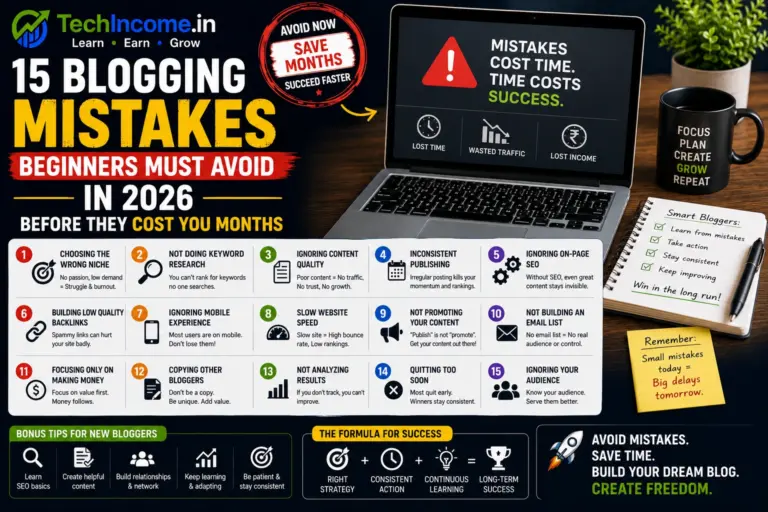
Mistakes That Will Cost You Months of Work
Picking a topic you’re interested in without checking if anyone searches for it. Interest matters, but traffic matters more for a monetized blog. Validate first.
Going broad because it “feels safer.” A narrow niche with 30 strong articles will outrank a broad blog with 100 random posts. Every time.
Choosing a niche with no monetization angle. If there are no affiliate programs, no ads paying well, and no audience willing to spend money, you’ll have traffic with nothing to show for it.
Mixing unrelated topics. A blog about fitness, personal finance, and travel tips confuses both Google and your readers. Pick one direction and go deep.
Recommended Next Reads:
- https://techincome.in/how-to-start-a-blog-in-2026-step-by-step-guide/
- https://techincome.in/is-blogging-a-good-side-hustle-in-2026/
- https://techincome.in/how-much-can-you-earn-from-blogging-india/
- https://techincome.in/blogging-skills-needed-to-succeed-2026/
FAQs
-
How do I know if a niche is too competitive?
Search your main keywords in Ahrefs and check the Keyword Difficulty score. If most relevant keywords are KD 40+, and the top-ranking pages are from large media brands, the niche is too broad. Narrow it down until you find keywords in the KD 0–25 range.
-
Can I start a blog in a niche I’m not an expert in?
Yes — with a condition. You need to research thoroughly and be honest in your content. Many successful bloggers document their learning journey rather than positioning themselves as experts. Beginner-to-beginner content often ranks well because it’s relatable and addresses the exact questions new learners have.
-
How many articles do I need before my blog gains traction?
There’s no magic number, but 30–50 well-researched, keyword-targeted articles in a focused niche is a reasonable threshold before expecting meaningful organic traffic. Consistency across those 30–50 posts matters more than hitting a number quickly.
-
Is the blogging-about-blogging niche too saturated?
At a broad level, yes. But beginner-focused, India-specific blogging content is not. If you’re targeting queries like “how to start a blog in India with no money” or “Rank Math setup for beginners,” you’re competing in a much smaller pool.
-
Should I choose a niche I’m passionate about or one that’s profitable?
Both matter, but for different reasons. Passion keeps you going during the first 6–12 months when results are slow. Profitability determines whether it’s worth the effort long-term. Find the overlap — a topic you can write about consistently that also has monetization potential.
-
How specific is too specific for a niche?
If your niche produces fewer than 20–30 keyword ideas with at least 100 monthly searches each, it may be too narrow to build a full blog around. The goal is a niche specific enough to avoid big competition but broad enough to have a content library of 50+ articles.
-
Can I change my niche after starting?
You can, but it’s costly — you lose topical authority, some rankings, and have to rebuild your content strategy. It’s better to spend 1–2 weeks validating your niche before you start than to pivot after 6 months of publishing.