Stop Guessing. Start Ranking.
If you’ve been writing blog posts and watching them sit at page 5 on Google, keyword research is probably the missing piece. Specifically, how you’re picking your keywords matters more than how well you write.
Ahrefs is one of the best tools for this — but only if you know what to look for. Let me walk you through a workflow that actually works, even if you’re just starting out.
Start With a Seed Keyword
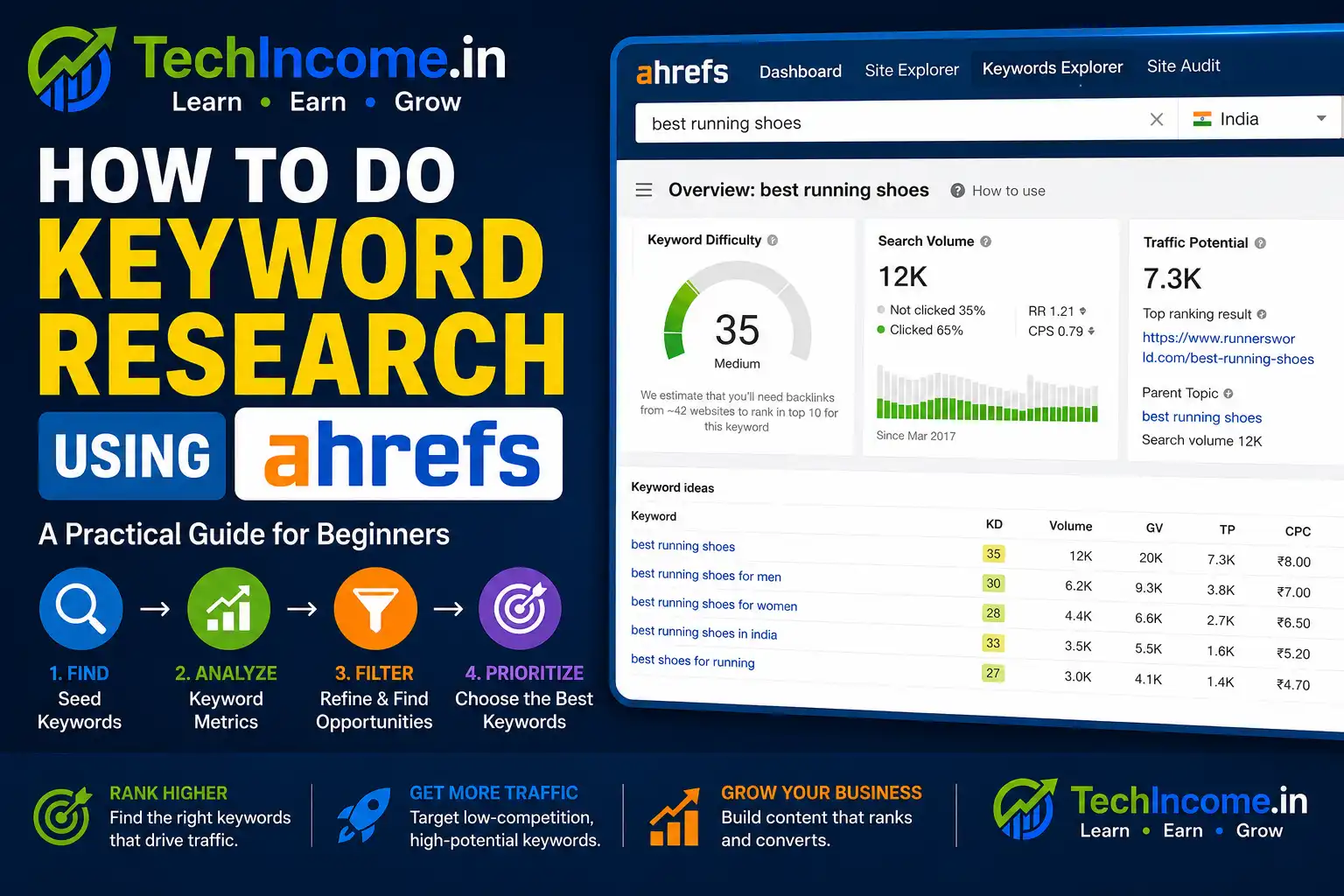
Open Ahrefs’ Keywords Explorer and type in a broad topic related to your niche. This is your seed keyword — something like blogging, freelancing, or digital products.
Don’t overthink this step. You’re not picking your final keyword here. You’re telling Ahrefs what world you’re operating in.
Use “Matching Terms” and “Questions”
Once you enter your seed keyword, Ahrefs gives you hundreds of variations. Two tabs matter the most:
Matching Terms — related keywords with actual search data Questions — what people are literally typing as questions
For example, a seed like “blogging” might surface queries like how to start blogging in India or is blogging worth it in 2026. Those are real, specific queries. Way more useful than the seed itself.
Filter for Low Competition Keywords

This is where most beginners go wrong. They see a keyword with 50,000 monthly searches and immediately want to rank for it — without checking how hard it is.
Set these filters in Ahrefs:
- Keyword Difficulty (KD): 0–20 — these are keywords where newer websites can realistically rank
- Word count: 3+ words — longer keywords (called long-tail) are more targeted and easier to rank
The goal isn’t to find the most popular keyword. It’s to find keywords where you actually have a shot.
Check Volume — But Don’t Be a Slave to It
Search volume tells you how many people are searching for something each month. But high volume almost always means high competition.
For a new blog, aim for keywords in the 100–1,000 searches/month range. A keyword getting 300 searches with KD of 8 will do more for you than one with 20,000 searches and KD of 70.
Low volume + low competition beats high volume + impossible competition. Every time.
Analyze the Top Results Before You Commit
Before you write anything, click on a keyword in Ahrefs and look at the pages currently ranking for it. Ask yourself:
- Are these from weak, outdated websites?
- Is the content thin or incomplete?
- Could you write something more useful?
If the answer is yes, that’s a green light. If the top results are from Forbes and HubSpot with 300 backlinks each, move on.
Match Search Intent — Or You’ll Fail Regardless
Search intent is the why behind a search. Google’s job is to match content to what someone actually wants, and if your content doesn’t match that intent, you won’t rank — even with perfect SEO.
Two main types to know:
- Informational — the person wants to learn something (“how to start a blog”)
- Commercial — the person is comparing options or about to buy (“best hosting for beginners”)
Your article’s format, depth, and angle need to match what the searcher expects to find.
Build a List, Not Just One Keyword
Don’t research one keyword at a time and then start writing. That’s slow and creates random content with no direction.
Instead, build a list of 20–30 keywords in your niche before you write anything. For a blogging niche, that might look like:
- how to start a blog in 2026
- best blogging niches in India
- how much can you earn from blogging
- blogging vs freelancing
This list becomes your content calendar. Now you’re building something, not just writing posts.
Group Keywords Into Clusters
Once you have your list, group related keywords together. This is called topical clustering, and it’s one of the fastest ways to build authority in Google’s eyes.
For example:
- Pillar article: Is blogging a good side hustle in 2026?
- Supporting articles: how to start a blog, how much you can earn, common blogging mistakes
When these articles link to each other and cover a topic from multiple angles, Google treats your site as an authority on that topic.
One Primary Keyword Per Post
Each article should target one main keyword, with a few natural variations woven in. Don’t try to rank for five different things in one post — you’ll end up ranking for none.
Pick your primary keyword, build the article around answering that specific query, and let the related variations appear naturally.
Do a Quick Google Check Before Writing
Before you finalize a keyword, search it on Google yourself. Look at the top 5 results and ask: can I write something more useful, clearer, or more complete than this?
If yes — write it. If not — find a better keyword.
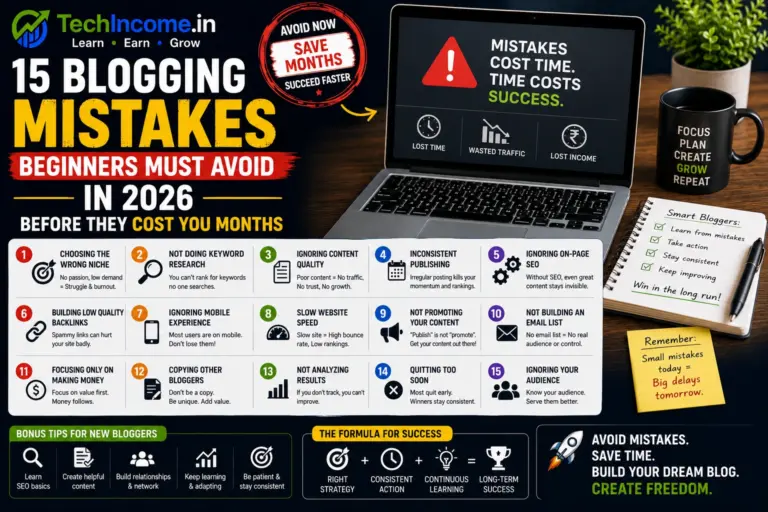
Common Mistakes to Avoid
Going after high-difficulty keywords too early. Your site doesn’t have enough authority yet. Stick to KD 0–20 until you have some wins.
Ignoring search intent. A great article on the wrong angle won’t rank.
Obsessing over volume. 200 searches/month with zero competition beats 10,000 searches/month with 50 competitors.
No content plan. Writing random posts without a keyword strategy builds nothing. You’ll have traffic from nowhere and authority from nothing.
The Beginner’s Action Plan
Here’s a simple workflow to get started:
- Find a seed keyword in your niche
- Use Ahrefs to pull matching terms and questions
- Filter for KD 0–20 and 3+ word keywords
- Check the SERP — can you compete?
- Confirm search intent
- Add to your content list
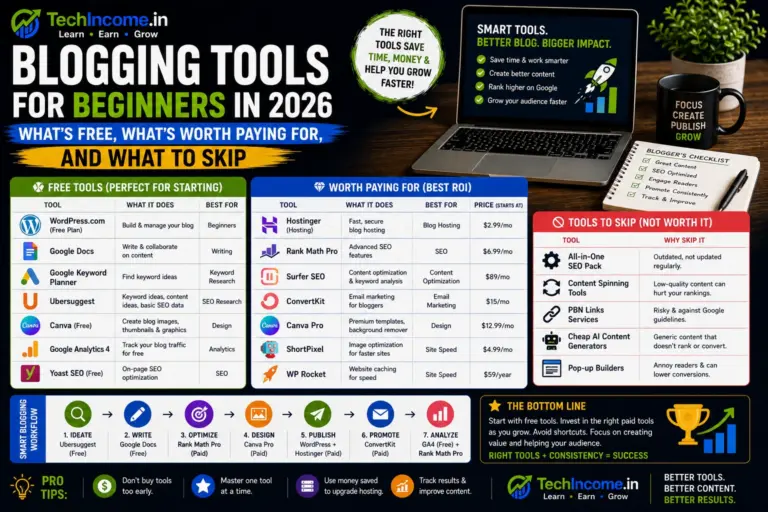
- Write the article, then optimize it with Rank Math or Yoast
Do this for 30 keywords before you start writing anything. Then build your content cluster.
Recommended Next Reads:
- https://techincome.in/write-seo-blog-posts-that-rank-2026/
- https://techincome.in/on-page-seo-checklist-beginners-2026/
- https://techincome.in/get-blog-traffic-without-backlinks-2026/
- https://techincome.in/best-blogging-niches-2026-low-competition/
FAQs
-
What’s a good Keyword Difficulty score for beginners?
Aim for KD 0–20. Once your site has some backlinks and traffic history, you can start going after KD 20–40.
-
How much search volume is enough for a beginner blog?
100–1,000 searches/month is a solid range. Don’t ignore keywords under 100 either — they’re often very specific and convert well.
-
Is Ahrefs worth it if I’m just starting out?
It’s one of the more expensive tools, but the data quality is excellent. If budget is a concern, start with Ahrefs’ free tools or try a short trial period to build your initial keyword list.
-
How many keywords should I target per article?
One primary keyword, and 3–5 natural variations. Don’t force it — if variations fit naturally into the content, include them. If they don’t, skip them.
-
What’s the difference between matching terms and questions in Ahrefs?
Matching terms shows keyword variations based on your seed. Questions shows queries phrased as questions — these are great for FAQ sections and “how to” articles, and they often have clear search intent.
-
How long should I wait before checking if my article is ranking?
Give it at least 2–3 months before drawing conclusions. SEO takes time, especially for newer sites.