
The Backlink Trap That Keeps New Blogs Stuck
Here’s the advice most SEO guides give beginners: build backlinks to rank. Get other websites to link to you. Do outreach. Guest post. Build your domain authority.
All of that is true — eventually. But it completely ignores the reality of a brand new blog with zero traffic, zero audience, and zero connections in their niche. You can’t get backlinks without first having content worth linking to. And you can’t easily get content worth linking to if nobody knows you exist yet.
The good news is that backlinks, while useful, are not what you need in the first 3 to 6 months. What you need is a keyword strategy that puts you in front of searches where you can actually compete. This guide shows you exactly how to do that.
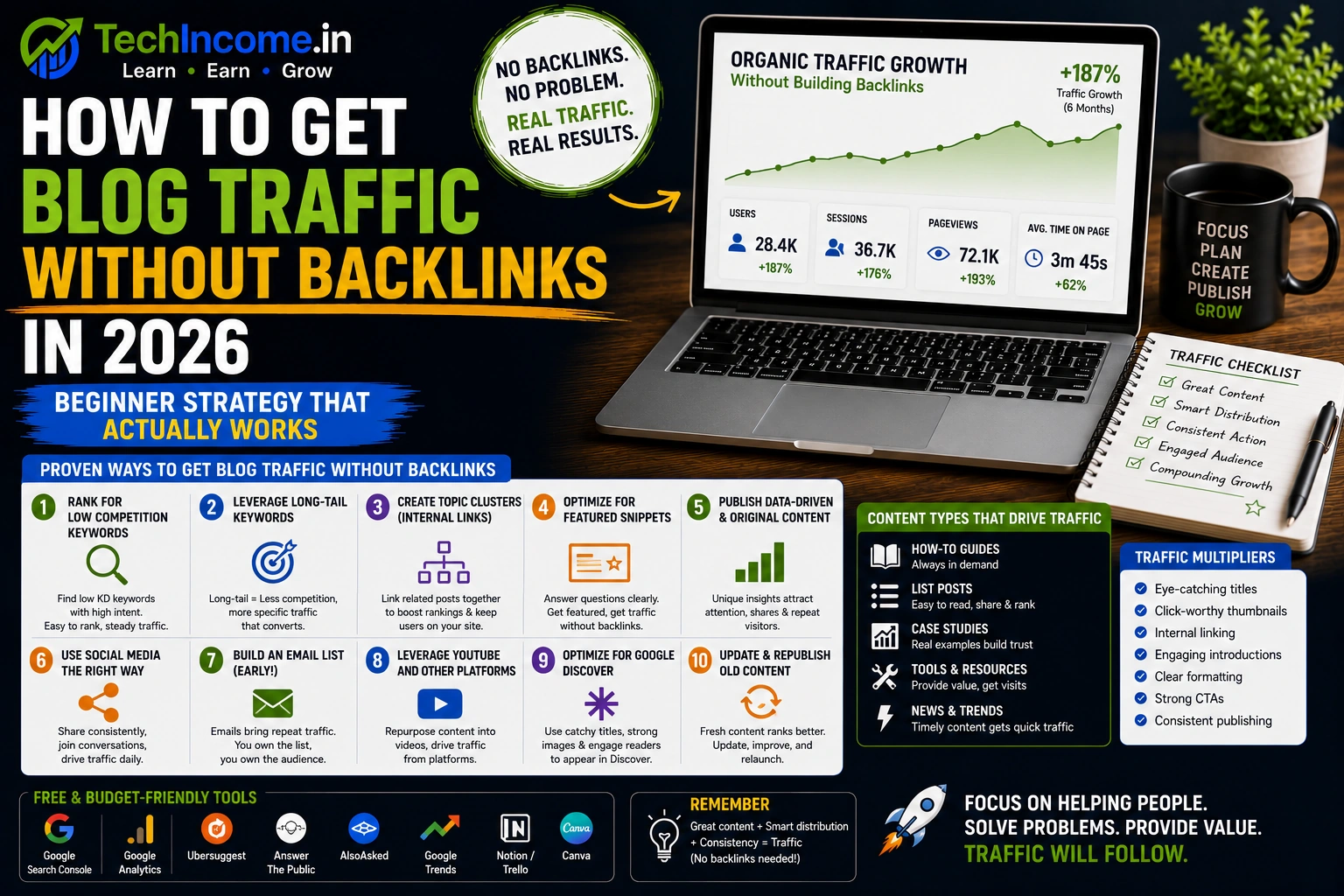
Why You Can Rank Without Backlinks (At Least Early On)
Google doesn’t rank pages based on backlinks alone. Backlinks are one signal among many, and for low-competition keywords, they’re often not the deciding factor at all.
What Google actually evaluates for every search result:
- How well does the content match what the person searched for?
- Does the page fully answer the query?
- Is the site structured in a way that signals topical expertise?
- Do users engage with the content when they land on it?
When competition is low — meaning the other pages ranking for a keyword are thin, outdated, or weakly optimized — a new blog with well-written, well-structured content can rank on its own merits. This is the gap most beginners don’t look for, and the one this strategy is built around.
Step 1: Target Keywords Where You Can Actually Win
This is the most important decision you’ll make. Everything else in this strategy depends on choosing the right keywords — the ones where you have a realistic shot without an established domain or backlink profile.
The filter you’re looking for:
- Keyword Difficulty (KD) of 0 to 20 in Ahrefs — these are keywords where smaller, newer sites can compete
- Long-tail keywords of 3 to 6 words — more specific phrases with clearer intent and lower competition
- 100 to 1,000 monthly searches — enough demand to be worth writing about, low enough that the big players haven’t fully saturated it
The difference in practice:
High competition: blogging — KD 80+, dominated by media companies with millions of backlinks
Winnable: how to start a blog in India with no money — KD under 15, specific audience, clear intent, real search volume
You’re not competing for the big keywords yet. You’re building traffic in the spaces where you can rank, and using that momentum to eventually go after harder targets.
Step 2: Match Search Intent Before You Write a Single Word
Low competition doesn’t automatically mean easy ranking. The other way beginners fail is by writing the wrong type of content for a keyword — even a keyword they could theoretically rank for.
Every search query has an intent behind it. The person typing “best blogging tools for beginners” wants a comparison with recommendations. They don’t want a history of blogging tools or a philosophical essay on why tools matter. If your content doesn’t match what they want, Google won’t show it to them — regardless of how well-written it is.
Before writing any post, search your target keyword on Google and study the top 5 results. Look at:
- Format — is it a list, a how-to guide, a comparison, a definition?
- Depth — how much ground do they cover?
- Angle — who is the content written for and what does it assume the reader already knows?
Your post needs to fit that same format, match or exceed that depth, and speak to the same reader. Then it needs to be better — more complete, clearer, more useful. That’s your path to ranking without backlinks.
Step 3: Write Content That’s Better Than What’s Already Ranking
In competitive niches, backlinks often decide rankings between two equally good pieces of content. In low-competition niches, the content quality itself becomes the differentiator — because the bar is often genuinely low.
Look at what’s ranking for your target keyword right now. Is it a 500-word surface-level overview? An outdated post from 2019 that hasn’t been updated? A forum thread with 12 replies? These are the kinds of results a new blog can displace — not with backlinks, but with content that’s simply more useful.
What “better content” means in practice:
- It fully answers the query without leaving the reader with follow-up questions
- It includes real examples, not just general advice
- It’s structured so it’s easy to read and navigate
- It’s long enough to be complete, not padded to hit a word count
A 1,500-word post that comprehensively solves a specific problem will outrank a 500-word overview every time, in a low-competition space. That’s the advantage available to you right now, before you’ve built any domain authority.
Step 4: Use Internal Linking as Your Authority System
When you don’t have backlinks from other websites, your internal links become the primary way you signal to Google how your content is connected and which posts are most important.
Every time you publish a post, link it to 2 to 5 other relevant posts on your site. And every time you publish something new, go back to older related posts and add a link to the new one. This keeps your site from looking like a collection of isolated articles and instead builds the kind of connected content network that helps Google understand your site’s topical focus.
Use descriptive anchor text — the words you hyperlink should tell both the reader and Google what the linked post is about.
Good: If you haven’t decided on your niche yet, this breakdown of the best blogging niches in 2026 is worth reading first.
Weak: Click here to learn more.
The first version is useful to the reader and informative to search engines. The second tells nobody anything. Every internal link is an opportunity — use it properly.
Step 5: Build Topic Clusters Instead of Random Posts
Publishing 30 posts across 30 unrelated topics builds nothing. Publishing 30 posts that all connect around a core theme builds topical authority — and topical authority is one of the strongest signals Google uses to decide which sites deserve to rank for a given category of keywords.
A topic cluster has one central pillar post and multiple supporting posts that each cover a specific aspect of the main topic. They all link to each other.
For a blogging niche, it looks like this:
Pillar: Complete Guide to Starting a Blog in India in 2026
Supporting posts:
- How to choose a blogging niche in India
- Best WordPress setup for beginner bloggers
- How to do keyword research with Ahrefs
- On-page SEO checklist for beginners
- How to write blog posts that rank
- Top blogging mistakes beginners make
- How to get blog traffic without backlinks
Every supporting post links to the pillar and to related supporting posts. The pillar links to all of them. This creates a web of connected, topically consistent content — and Google reads that as expertise in the subject.
A blog with 30 posts built this way will outrank a blog with 100 random posts almost every time.
Step 6: Nail the On-Page SEO Basics for Every Post
You don’t need advanced technical SEO. You need the fundamentals applied consistently to every post you publish.
For each article:
- Primary keyword in the title, first paragraph, and at least one H2 heading
- A manually written meta description that includes the keyword and gives the reader a reason to click
- A clean URL slug — short, keyword-focused, no unnecessary words
- Proper heading structure (one H1, H2s for main sections, H3s for sub-points)
- Images compressed and with alt text added
- Post tested on mobile before publishing
Install Rank Math and use it as your checklist before every publish. It’ll flag the things you missed. Don’t chase a perfect score — aim for 75 to 85 and make sure the actual content is the best version of itself. A post that reads naturally and covers the topic fully will always outperform a post that’s been over-optimized at the expense of readability.
Step 7: Publish Consistently Over a Long Enough Period
Google favors active sites over dormant ones. A blog that publishes two or three posts a week signals that it’s maintained, current, and worth crawling regularly. A blog that published 10 posts and then went quiet for two months sends the opposite signal.
Consistency also compounds. Post number 30 benefits from the authority built by posts 1 through 29. The internal links, the topical depth, the crawl signals — all of it accumulates. But only if you keep going long enough for it to accumulate.
Set a publishing pace you can genuinely maintain. One solid, well-researched post a week is better than three rushed ones. Two well-optimized posts a week, published consistently for six months, will build something real.
The target is 30 posts in a focused niche before you evaluate whether the strategy is working. Most blogs give up at 10 posts, which is long before any meaningful SEO signal has had time to develop.
Step 8: Go Back and Improve What You’ve Already Published
New posts aren’t the only way to improve your rankings. Updating existing posts — adding depth to thin sections, refreshing outdated information, improving the structure — can push posts that are sitting on pages 2 or 3 onto page 1.
This is one of the highest-leverage activities available to you once you have a few months of content published. Look at which posts are ranking in positions 11 to 20 (page 2 or the bottom of page 1) and start there. These posts are already showing Google relevance — they just need more completeness to break through.
Common improvements that move the needle:
- Adding a real-world example to a section that was previously abstract
- Expanding a section that glosses over a step readers actually need
- Adding a FAQ section that answers the follow-up questions people have after reading
- Improving the introduction so it hooks the reader faster
You don’t always need to write something new to grow. Sometimes improving what already exists is the faster path.
Step 9: Keep Readers on the Page Longer
User engagement is a ranking signal. When someone lands on your post and stays for 4 minutes reading through it, that tells Google the content satisfied their search. When someone lands and immediately hits back, it tells Google the opposite.
The things that actually improve time on page:
- A strong opening that earns the reader’s attention in the first 5 lines
- Short paragraphs that are easy to scan and read
- Clear section headings that guide the reader through the post
- Examples and concrete details that make the content feel grounded
- Internal links that naturally lead the reader to related content
None of this requires backlinks. It requires writing and structuring content well. Which is entirely within your control from day one.
Step 10: Use Alternative Traffic Sources to Kickstart Early Visits
In the first few months before Google has fully indexed and trusted your site, you can supplement organic traffic with a few other channels — not as a permanent strategy, but as a way to get your content in front of real readers early.
Relevant forums and communities: Quora, Reddit, and niche Facebook groups are places where people are actively asking the exact questions your posts answer. Participate genuinely, add value to conversations, and link to your post where it’s actually useful — not as spam.
Pinterest: For certain niches (personal finance, blogging, health, productivity), Pinterest drives significant traffic to blog posts. It functions more like a search engine than a social platform and can send consistent traffic to the right content.
Social sharing: Share new posts in relevant communities where you’re already an active member. The traffic may be small, but engagement from real readers sends positive signals to Google during the critical early indexing period.
These are supplements, not substitutes. The core of this strategy is still keyword-targeted content and internal structure. But early traffic from these sources can speed up the point at which Google starts giving your posts organic visibility.
What to Expect — Honest Timeline
Without backlinks, growth is slower than a site actively building them. That’s just true. But “slower” doesn’t mean “doesn’t work” — it means the timeline looks like this:
Months 1 to 3: Little to no organic traffic. Google is crawling and indexing your content, but hasn’t established trust in your site yet. Keep publishing.
Months 3 to 6: Some posts start appearing on pages 2 to 4 for your target keywords. A few long-tail keywords may crack page 1. Traffic is small but real.
Months 6 to 12: If you’ve been consistent and strategic, posts begin ranking on page 1 for low-competition keywords. Traffic compounds. The cluster structure starts paying off.
The blogs that fail aren’t the ones with bad content. They’re the ones that quit during months 1 to 3 when nothing is visible yet. The mechanism is working — the results just come later.
When Do Backlinks Actually Become Important?
Once your blog has momentum — traffic from low-competition keywords, 30+ posts published, a clear topical structure — backlinks become the lever for the next level of growth.
To rank for keywords with KD above 30, you’ll eventually need sites linking to you. But you won’t be starting from zero at that point. You’ll have real content, real traffic, and real authority in your niche — which makes earning backlinks through natural discovery, guest posts, or outreach significantly more achievable.
Backlinks aren’t the starting point. They’re the accelerant you add once the fire is already burning.
Recommended Next Reads:
- https://techincome.in/write-seo-blog-posts-that-rank-2026/
- https://techincome.in/on-page-seo-checklist-beginners-2026/
- https://techincome.in/blog-post-structure-increase-time-on-page-2026/
- https://techincome.in/how-long-does-it-take-to-make-money-blogging/
FAQs
-
Can a brand new blog realistically rank without any backlinks?
Yes — for the right keywords. If you’re targeting long-tail queries with keyword difficulty under 20 and the top results are weak or outdated, a well-written, properly structured post can rank within 3 to 6 months on its own. The strategy only falls apart when you target keywords that are genuinely competitive, where backlinks are the deciding factor between two equally strong pages.
-
How long does it take to get traffic without backlinks?
Realistically, 3 to 6 months before you see meaningful organic traffic from low-competition keywords. Some posts may rank faster, some slower. The compounding effect of consistent publishing means that month 8 looks very different from month 2 — even if nothing dramatic changed in between.
-
How many posts do I need before I start seeing traffic?
There’s no magic number, but 20 to 30 well-targeted posts in a focused niche is the threshold where most blogs start seeing consistent organic traffic. The posts need to be part of a cohesive topical cluster — 30 random posts across unrelated topics won’t build the same authority as 30 connected posts around one niche.
-
Is internal linking really that important for a new blog?
More than most beginners realize. When you have no backlinks, your internal link structure is the primary signal Google uses to understand how your site is organized and which pages matter most. Every post you leave isolated is a missed opportunity. Link everything that’s genuinely related.
-
Should I be on social media to get traffic to my blog?
Social media can supplement early traffic, but it’s not a substitute for organic SEO. The problem with social-only traffic is that it stops when you stop posting. Organic search traffic compounds — a post that ranks on page 1 six months from now keeps sending traffic without ongoing effort. Use social media to support your SEO strategy, not replace it.
-
What’s the biggest mistake beginners make with this strategy?
Targeting keywords that are too competitive. It’s easy to underestimate how hard it is for a new site to rank for broad or popular terms. If every keyword you’re targeting has a KD above 30 and the top results are from established publications, no amount of good writing will overcome that gap in the short term. Stay disciplined about targeting KD 0 to 20 until your site has real authority behind it.
-
When should I start trying to build backlinks?
Once you have 20 to 30 published posts, some organic traffic, and a clear content cluster established. At that point, you have something worth linking to, which makes outreach and guest posting significantly more productive. Trying to build backlinks before you have solid content is like trying to sell a product before you’ve built it.