
The Question Everyone Asks, and the Answer Nobody Gives Properly
When you’re starting a blog, the post count question feels urgent. If you just knew the number — the threshold where income becomes possible — you could work toward it with a clear target.
The problem is that the number alone is misleading. Two blogs with identical post counts can have completely different results. One generates consistent traffic and income. The other gets barely any visitors. The difference isn’t the number of posts — it’s what’s in them, what keywords they target, and how they’re structured.
So here’s the honest answer: post count matters, but it’s a proxy for the things that actually drive income. Understanding what those things are makes the number a useful milestone rather than an arbitrary target to chase.
Why “Just Publish More Posts” Isn’t the Answer
Consider two blogs in the same niche, both about freelancing for beginners in India:
Blog A publishes 100 posts. They’re 600 to 800 words each, written quickly, targeting broad keywords like “freelancing tips” and “how to freelance.” They have no internal linking structure and were published in random order with no content plan.
Blog B publishes 30 posts. Each one is 1,500 to 2,000 words, targets a specific low-competition keyword, answers the search query completely, and is connected to related posts through internal links. They’re built as a topic cluster — a pillar post on starting as a freelancer, supported by posts on finding clients, setting rates, managing clients, tools, and income expectations.
Blog B will rank faster, earn sooner, and grow more consistently — despite having less than a third of the posts. Because ranking and earning come from relevance, depth, and structure — not volume.
Post count is the visible output. What creates results is the quality of what’s inside each post and the strategy connecting them.
Realistic Milestones — What to Expect at Each Stage
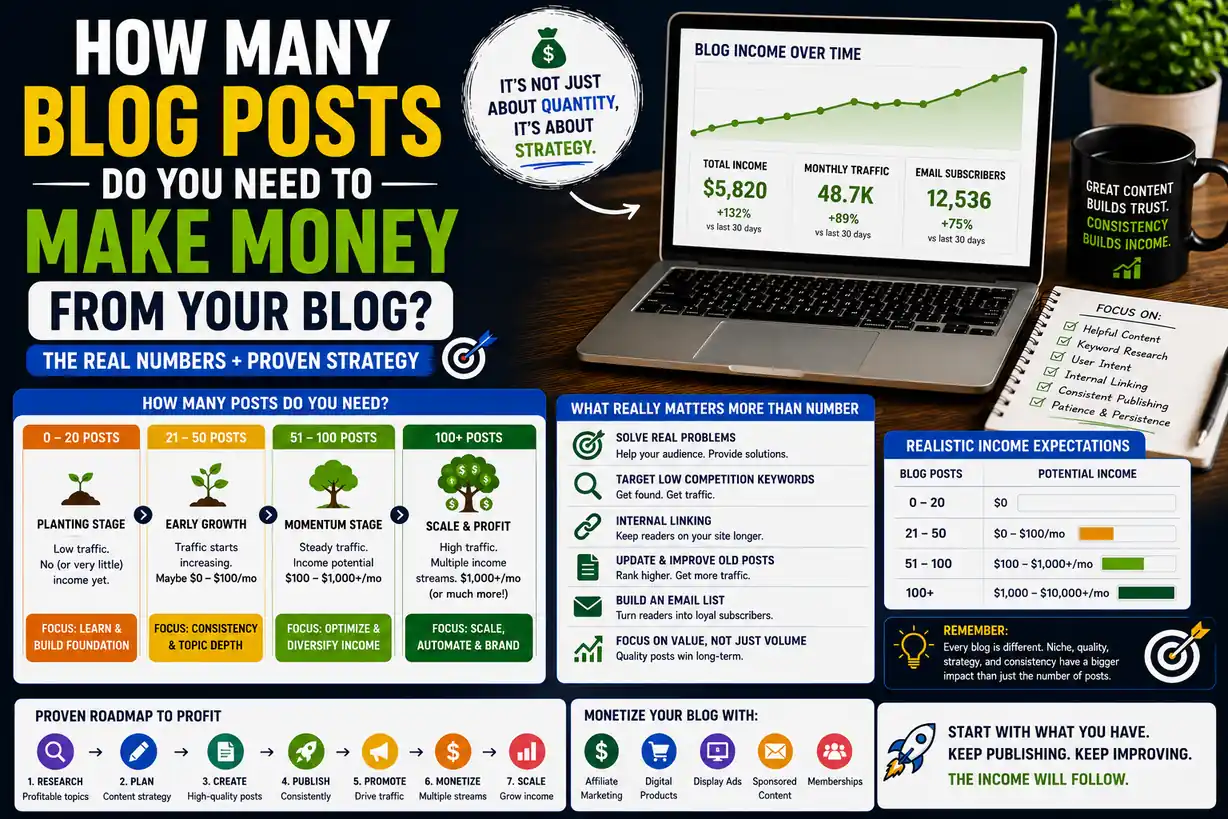
That said, post count does correlate with results in a useful way because more well-optimized posts means more keywords indexed, more internal linking opportunities, and more topical depth. Here’s what the typical trajectory looks like for a beginner blog with a focused niche and solid execution:
Stage 1: 0 to 20 Posts
Traffic: Very low. Earnings: ₹0.
This is the foundation stage. Google is still crawling and building a picture of what your site is about. You don’t have enough content for topical authority to develop, and most of your posts haven’t been indexed long enough to rank for anything meaningful.
This stage feels discouraging, but it’s necessary. The work you do here — getting your content strategy right, building your writing workflow, making sure every post is properly structured and optimized — determines how fast things move in the next stage.
What to focus on: publishing consistently, getting your on-page SEO basics right for every post, and building your internal link structure from the beginning rather than retrofitting it later.
Stage 2: 20 to 30 Posts
Traffic: Starting to appear. Earnings: ₹0 to ₹5,000/month.
This is where things start to become visible. A handful of your posts will begin ranking on pages 2 and 3 for their target keywords. Some of your longest-tail, lowest-competition posts may crack page 1. Your Google Search Console will start showing impressions — people are seeing your content in search results, even if click-through rates are still low.
This is also the threshold where Google AdSense approval becomes realistic. AdSense doesn’t have a published minimum post count, but they evaluate content quality, site completeness (About, Contact, Privacy Policy pages), and whether your site appears to be a legitimate, maintained property. Around 20 to 25 well-written, properly structured posts is generally where approvals start happening consistently.
Affiliate income at this stage is possible but small — you need traffic to generate clicks, and your traffic is still building. Don’t optimize for monetization yet. Optimize for ranking.
Stage 3: 30 to 60 Posts
Traffic: Growing consistently. Earnings: ₹5,000 to ₹30,000/month.
This is where the compounding effect of your earlier work starts showing up. Multiple posts are ranking on page 1. Your topic cluster structure means that as one post builds authority, it passes some of that to related posts through internal links. Traffic grows week over week rather than sitting flat.
Affiliate income becomes meaningful at this stage because you have enough traffic reaching commercial-intent posts — the comparisons, the recommendations, the “best tools for X” type content. If those posts are targeting the right keywords and recommending products with real affiliate programs, the commissions start adding up.
This is also the stage where your AdSense earnings become noticeable rather than negligible — not life-changing, but real validation that the model is working.
Stage 4: 60+ Posts
Traffic: Consistent and compounding. Earnings: ₹30,000 to ₹1 lakh+ per month.
At 60+ posts in a focused niche with proper structure, you’ve built genuine topical authority. Google treats your site as a reliable source on your subject area. New posts rank faster because your domain has established credibility in that space. Old posts continue ranking and sending traffic without requiring ongoing work.
Multiple income streams work together here — AdSense revenue from traffic volume, affiliate commissions from commercial-intent posts, and potentially digital product income if you’ve built an audience that trusts your recommendations.
This isn’t guaranteed at 60 posts. It depends heavily on keyword selection, content quality, and niche competitiveness. But for a blogger who has executed consistently on a focused strategy, 60+ posts is typically where income becomes meaningful enough to call it a real revenue stream.
Why 30 Posts Has Become the Common Benchmark
The “30 posts” number gets repeated because it tends to represent something real — not a magic threshold, but a practical milestone where several things align:
Enough content for topical coverage. A focused 30-post cluster can cover a niche comprehensively — the beginner guide, the how-to posts, the comparison articles, the income expectations, the tools, the mistakes. That breadth signals to Google that your site has real expertise in the area.
Enough internal linking to create structure. With 30 connected posts, you have the internal link density needed for Google to understand your content hierarchy — which posts are central (pillars) and which are supporting.
Enough indexed content for patterns to emerge. After 30 posts, you start having data from Google Search Console that’s actually actionable — you can see which posts are getting impressions, which keywords you’re ranking for, and where to focus improvement efforts.
But the 30-post benchmark only holds if those posts are high-quality, properly optimized, and part of a coherent content plan. Thirty unrelated, thin posts on random keywords won’t produce the same results as 30 well-structured posts in a focused cluster.
What Actually Determines When You Start Earning
Post count is the visible metric, but these are the actual variables:
Keyword selection. Posts that target keywords your site can realistically rank for will generate traffic. Posts chasing keywords that are too competitive will sit on page 4 indefinitely. The gap between the two is entirely in the keyword research step that happens before writing.
Content depth and completeness. A post that fully answers the search query — including the follow-up questions a reader would naturally have — ranks better and holds readers longer than one that covers the surface and stops. Depth is what separates ranking content from invisible content in 2026.
Search intent match. If your post format doesn’t match what the searcher wants — an opinion piece when they wanted a how-to guide, a product review when they wanted a comparison — it won’t rank even if the keyword is right and the content is well-written.
Internal linking structure. Posts connected through relevant internal links build collective authority faster than isolated posts. A new post linked from three established posts on your site will rank faster than an identical post with no internal links pointing to it.
Consistency. A blog that published 40 posts over 5 months will dramatically outperform one that published 40 posts over 18 months. Not just because Google favors active sites, but because the compounding of consistent publication creates momentum that sporadic publishing doesn’t.
Can You Earn With Fewer Than 30 Posts?
Yes — under specific conditions. If you’re in a very low-competition niche, targeting keywords with strong commercial intent, and your content is genuinely among the best answers to those searches, you can see meaningful affiliate income with 10 to 15 well-optimized posts.
Some bloggers make their first affiliate sales from a 10-post niche site focused entirely on product comparisons and buyer-intent content. This works because every post is targeting someone who’s ready to make a purchase decision, not someone who’s just learning.
For most beginner bloggers in broader niches though — blogging, freelancing, personal finance, career development — this is the exception rather than the norm. The 20 to 30 post threshold is more realistic for seeing initial traction in those spaces.
The Mistakes That Make Post Count Irrelevant
Chasing quantity without quality. Publishing two posts a day of 500-word surface-level articles will produce a blog with many posts and minimal traffic. Volume without depth doesn’t build anything in 2026.
Publishing random topics with no cluster structure. If your first 30 posts cover 30 completely different areas of your niche with no internal links connecting them, you’ve built 30 isolated articles rather than a coherent content ecosystem. Google can’t establish topical authority from disconnected content.
Stopping at 10 to 15 posts. This is the most common failure pattern. The blogger publishes 12 posts, checks their analytics after 6 weeks, sees minimal traffic, and concludes it doesn’t work. They quit right at the point where most blogs are still too new to have meaningful ranking signals. The work they did wasn’t wasted — they just stopped before the compound effect had time to develop.
Ignoring keyword difficulty. Writing excellent content for keywords your site can’t realistically rank for is the most invisible way to waste blogging effort. No matter how good the post is, if you’re targeting KD 60+ keywords as a new site, it won’t rank — and won’t earn.
A Realistic Path From Zero to Income
Here’s what a typical trajectory looks like for a blogger executing correctly — focused niche, keyword research before each post, 1,500+ word posts, proper on-page SEO, consistent internal linking:
Month 1 to 2 (posts 1 to 15): No meaningful traffic. Google is indexing your content but hasn’t established trust in your site. Keep publishing.
Month 3 (posts 16 to 25): Search Console starts showing impressions. A few long-tail posts appear on pages 3 to 5. Traffic is real but small. Apply for AdSense if you haven’t.
Month 4 to 5 (posts 26 to 40): First page 1 rankings for low-competition keywords. Traffic starts growing week over week. AdSense earnings are visible but modest. First affiliate clicks.
Month 6 to 9 (posts 41 to 60): Consistent traffic from multiple posts. Monthly earnings in the ₹5,000 to ₹20,000 range depending on niche monetization potential. Topic cluster structure paying off — new posts rank faster.
Month 10 to 12 (posts 60+): Multiple income streams active. Monthly earnings becoming meaningful. Blog is a real asset generating consistent passive income.
That’s not a guarantee — it’s a realistic outcome for someone who executes consistently on a focused strategy. The bloggers who reach month 12 without abandoning the process are the ones who understood early that the first few months are investment months, not evaluation months.
FAQs
-
How many posts do I need for Google AdSense approval?
AdSense doesn’t publish a minimum post count, but in practice, 20 to 25 well-written posts on a custom domain with your essential pages (About, Contact, Privacy Policy, Disclaimer) is where approvals become consistent. The quality and structure of your content matters as much as the quantity — a site with 15 thorough, properly formatted posts is more likely to be approved than one with 30 thin, poorly structured ones.
-
Does publishing more posts faster help you earn sooner?
Publishing consistently faster helps — but only up to the point where quality is maintained. Two solid, well-researched posts a week is better than five rushed ones. Publishing faster without maintaining content quality produces a blog with more posts and similar traffic, because thin content doesn’t rank regardless of how quickly it was published.
-
Can a 10-post blog make money?
In specific situations, yes. A tightly focused affiliate site targeting high commercial-intent, low-competition keywords can generate income with 10 to 15 posts. But this is more common with very narrow micro-niche sites than with broader beginner blogs. For most bloggers in competitive-adjacent niches, 20 to 30 posts is the more realistic minimum for early traction.
-
What matters more — the number of posts or the quality of each post?
Quality, definitively. A blog with 30 detailed, keyword-targeted, properly structured posts will consistently outperform a blog with 100 generic, shallow ones. That said, you need enough posts to build topical authority — so it’s not either/or. The goal is both: enough posts AND high quality on each one.
-
How long does it take to publish 30 posts at a realistic pace?
At two posts per week — a sustainable pace for most bloggers with other commitments — you’ll hit 30 posts in about 15 weeks, roughly 3.5 months. At three posts per week, you’re there in 10 weeks. The pace matters less than the consistency — 30 posts published evenly over 4 months will perform better than 30 posts published in a chaotic burst over 6 weeks.
-
Should I focus on writing new posts or improving old ones to earn faster?
In the first three to four months, focus on publishing new posts — you need volume to build topical authority. After that, shift some of your time to improving posts that are ranking in positions 11 to 30. These posts are already being seen in search results — improving them is often the fastest way to push them onto page 1 and start generating meaningful traffic without starting from scratch.
-
Is it possible to earn from blogging in India with a small number of posts if the niche is right?
Yes. In India-specific niches with genuinely underserved audiences — localized finance content, India-specific career guides, regional language content, niche tool reviews for Indian audiences — well-targeted posts can rank faster and generate income sooner because the competition is lower. The fundamentals still apply: keyword research, content depth, search intent — but the threshold for early traction can be lower when you’re not competing with globally established sites.