
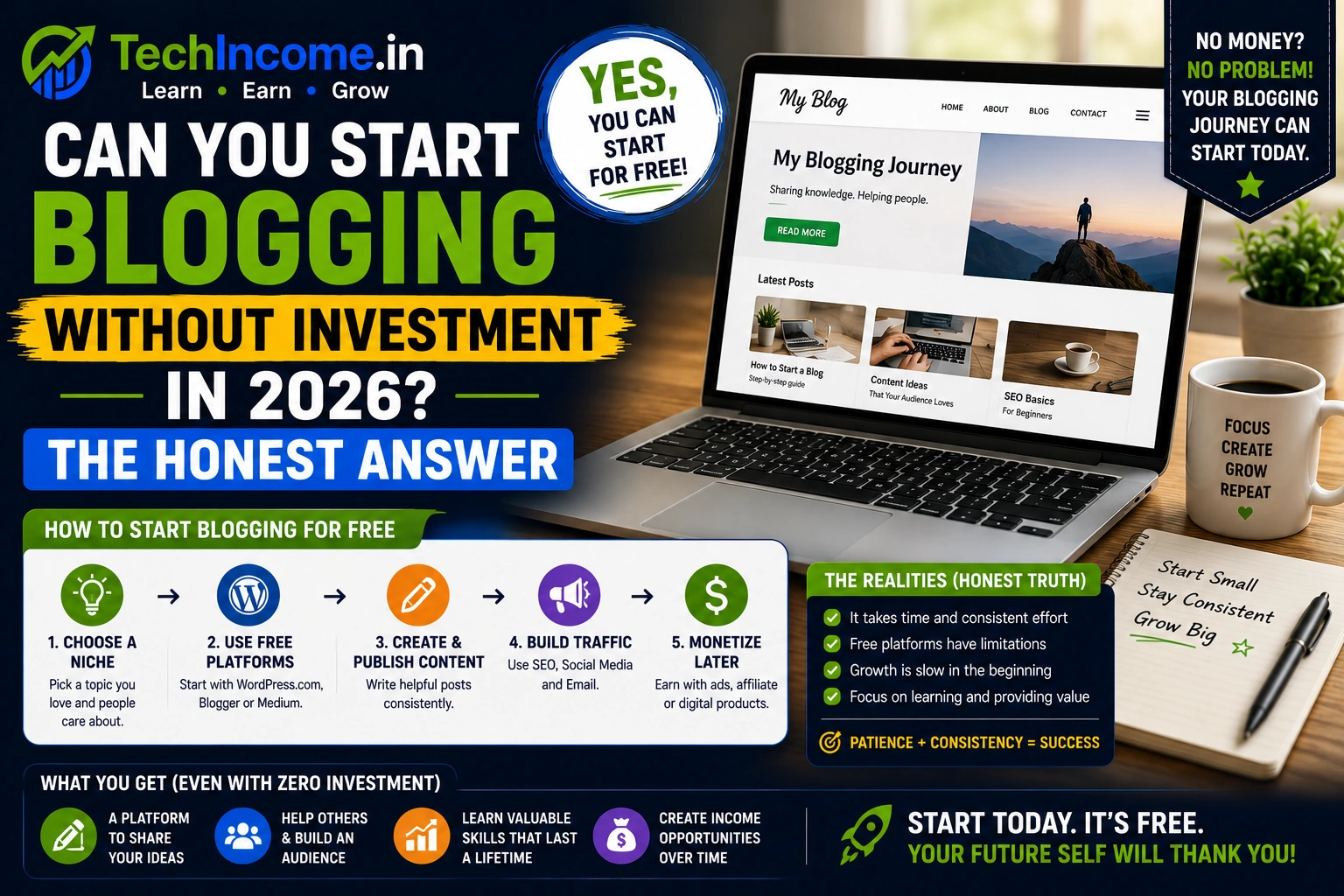
The Honest Version of This Answer
Most articles on this topic either oversell free blogging (“start earning from day one with zero investment!”) or dismiss it entirely (“you need a proper setup or don’t bother”). Neither is accurate.
The truthful answer is this: free blogging is a legitimate way to start, learn, and test whether you actually want to do this. It’s not a legitimate long-term strategy if your goal is to build something that earns real income and grows your authority over time.
Understanding exactly where free blogging works and where it breaks down will help you make a smarter decision — whether you’re deciding to start free for now, or figuring out if the ₹3,000 to ₹5,000 annual investment in a proper setup is worth it.
What “Starting for Free” Actually Looks Like
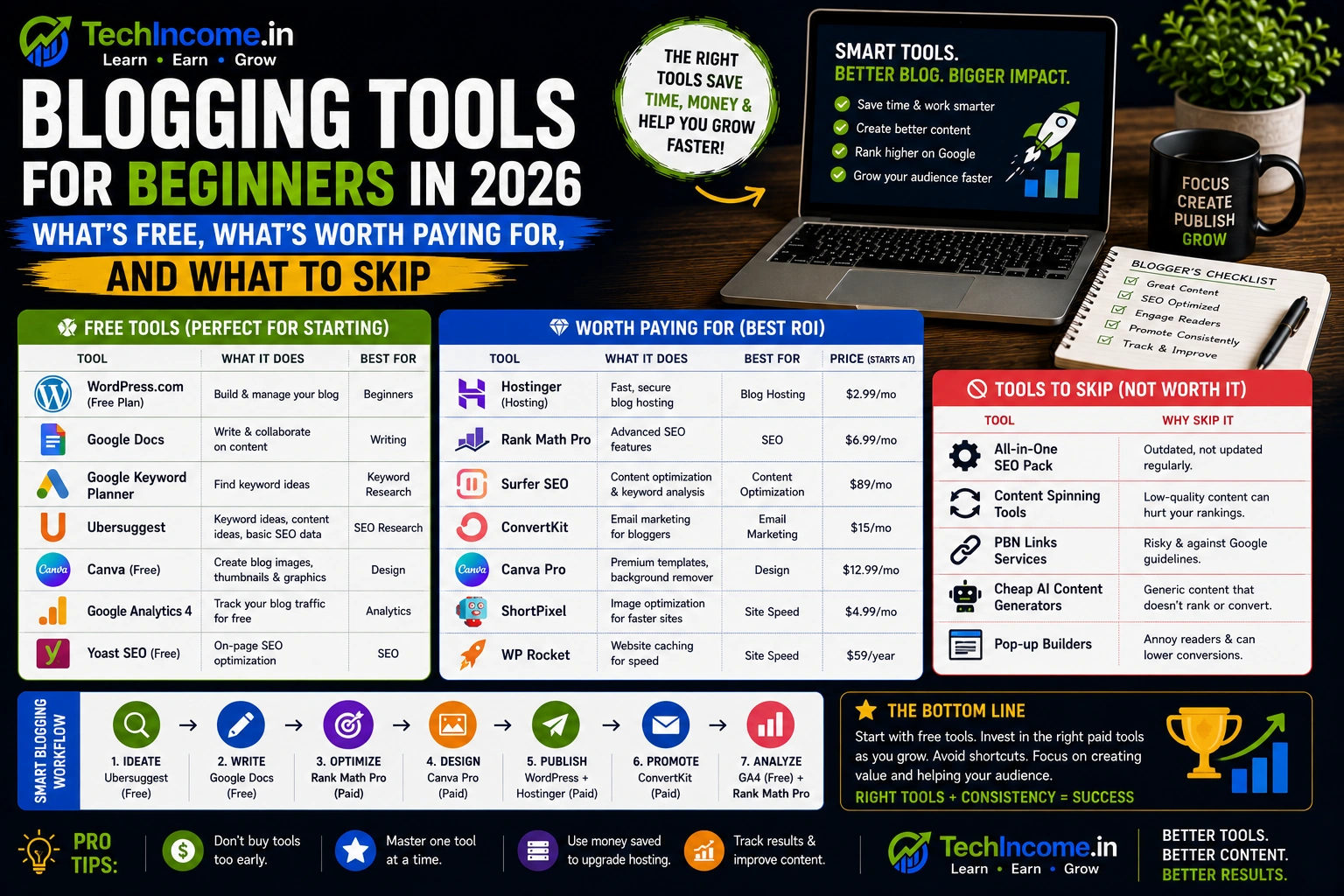
Two platforms make free blogging genuinely usable in 2026:
Blogger (by Google): The older of the two, owned by Google, and completely free. You get a subdomain (yoursite.blogspot.com), basic customization, and Google-native integration with AdSense and Analytics. It’s barebones, but functional.
WordPress.com (free plan): Not to be confused with WordPress.org (the self-hosted version). The free plan on WordPress.com gives you a subdomain (yoursite.wordpress.com), limited theme options, and basic publishing tools.
Both platforms let you write and publish content without spending a single rupee. No hosting fees, no domain registration, no plugin costs.
If you’re trying to understand what blogging involves — the writing workflow, the publishing process, the basics of structuring content — either of these will let you do that at zero cost.
What You Can Actually Do on Free Platforms
Free platforms aren’t useless. For a specific type of beginner, they’re the right starting point.
You can write and publish posts — the core skill of blogging. Getting comfortable with putting content out regularly, finding your voice, learning how to structure an article — all of that is learnable on a free platform.
You can learn basic SEO — understanding how to write a title, use headings, and structure content for search intent doesn’t require a paid setup. You can practice these fundamentals on Blogger or WordPress.com.
You can test your consistency — before investing money, the more important question is whether you’ll actually publish regularly. A free platform lets you test that without financial risk. If you can publish 10 posts over a month without losing interest, you’ve confirmed something important about yourself.
You can build early writing skills — the gap between your first post and your tenth post is significant for most bloggers. Getting through that gap on a free platform before moving to a paid setup means your paid setup starts with a more experienced version of you running it.
Where Free Blogging Actually Falls Short
This is the part that most “start for free” articles skip over. The limitations of free platforms aren’t minor inconveniences — they’re fundamental constraints that cap how far your blog can go.
You don’t fully own your platform.
When your blog lives on Blogger or WordPress.com’s free plan, the platform owns the infrastructure. They set the rules. If they change their policies, restrict certain content types, or decide to shut down a feature — your blog is affected and you have limited recourse. This has happened before, and it will happen again.
With a self-hosted WordPress site on your own domain, you own everything. The content, the design, the data, the monetization method. No platform can change the rules on you because you’re running the show.
Monetization is restricted in ways that matter.
Google AdSense has specific approval requirements, and free subdomains (yoursite.blogspot.com) are significantly harder to get approved compared to custom domains. Some ad networks won’t work with free platforms at all.
Affiliate marketing technically works on free platforms, but many affiliate programs have requirements around domain ownership and professional appearance. Brands and affiliate managers look at subdomains as a signal that the site isn’t a serious operation — which it might not be, and they know it.
The subdomain hurts your credibility.
This is easy to underestimate until you see it from the reader’s perspective. yoursite.blogspot.com signals “free hobby project.” yoursite.in or yoursite.com signals “this person is serious about what they’re building.”
For an Indian audience specifically, a .in domain with your own brand name costs roughly ₹500 to ₹700 per year. The credibility difference for that price is significant — both with readers and with brands you might eventually want to work with.
SEO potential is lower and harder to scale.
Free platforms offer limited control over technical SEO elements — site speed optimization, custom permalink structures, advanced schema markup, plugin-driven improvements. On Blogger specifically, the customization ceiling is low enough that you’ll hit it quickly once you start thinking seriously about ranking.
WordPress.org with Rank Math, a lightweight theme like Kadence, and basic caching gives you a technical SEO baseline that free platforms simply can’t match.
What a Basic Paid Setup Costs in India
The barrier to a proper blogging setup is lower than most beginners assume. Here’s what a functional, professional setup costs in India annually:
Domain name: ₹700 to ₹1,200/year for a .com, or ₹500 to ₹700 for a .in
Shared hosting (Hostinger or similar): ₹1,500 to ₹3,000/year on an annual plan
WordPress: Free (open source, always)
Kadence theme: Free version is sufficient to start
Rank Math: Free version covers everything you need as a beginner
Total annual cost: Approximately ₹2,200 to ₹4,200 per year — roughly ₹180 to ₹350 per month
That’s the cost of a cup of coffee every few days. For that amount, you get full ownership, full monetization capability, full SEO control, and a professional-looking property you can actually build into something.
If even that feels too much right now, start free — but treat it explicitly as a temporary learning phase, not a permanent setup.
Free vs Paid Blogging — The Real Comparison
Here’s what the difference actually looks like across the factors that matter:
Ownership: Free platforms own your infrastructure. Paid setup — you own everything.
Cost: Free is ₹0. Paid is ₹2,200 to ₹4,200 per year.
Custom domain: Not available on free plans (or costs extra). Paid setup includes it.
Monetization: Limited on free platforms — AdSense approval harder, affiliate restrictions apply. Paid setup has full monetization options.
SEO control: Basic on free platforms. Full control on self-hosted WordPress.
Credibility: Subdomain signals a hobby project. Custom domain signals a real site.
Scalability: Free platforms hit a ceiling quickly. Self-hosted WordPress scales without limits.
The gap isn’t marginal. For anyone serious about building a blog that earns money, the paid setup isn’t a luxury — it’s the infrastructure that makes the goal achievable.
The Right Strategy Based on Your Situation
There’s no single right answer — it depends on where you are and what you’re trying to accomplish.
Start free if:
You’re genuinely unsure whether blogging is for you. If you’ve never written consistently, don’t know whether you can maintain a publishing schedule, or haven’t yet identified a niche you’re confident about — a free platform lets you test all of those things without financial commitment. Publish 10 posts. See if you can sustain it. See if you enjoy it. Then invest.
You have zero budget right now. Financial constraints are real. If ₹3,000 is genuinely not accessible right now, starting on Blogger is far better than not starting at all. The skills you build on a free platform transfer completely to a paid setup.
Move to a paid setup if:
You’ve tested on a free platform and confirmed you can publish consistently. Now you know this is something you’ll stick with — invest in the proper foundation.
You’re starting with clarity about your niche and a real plan. If you’ve done your keyword research, have a content plan, and you’re treating this as a serious income-building project from day one — skip the free phase and set up properly from the start.
You want to monetize within 6 to 12 months. If income is a goal and timeline matters, a paid setup is the only path that keeps that timeline realistic.
What Matters More Than Money
Here’s the thing that’s worth saying clearly: the difference between a free blog and a paid blog is real, but it’s not the main variable that determines whether your blog succeeds.
Bloggers with custom domains and premium hosting fail all the time — because they publish inconsistently, target the wrong keywords, or produce content that doesn’t help anyone.
Bloggers who start on free platforms and treat the limitations as temporary while building real writing discipline and SEO understanding are already ahead of most people who spend ₹10,000 on tools and templates and then don’t know what to write.
The investment in a domain and hosting matters. But the investment in learning keyword research, writing clearly, building internal links, and publishing consistently matters more. None of that costs money — it costs time and discipline, which are the actual constraints for most bloggers.
Start wherever your situation allows. But build the habits that will carry your blog forward regardless of platform.
How to Transition From Free to Paid
If you start free and decide to move to a proper setup, the transition is manageable — but there are a few things to do carefully.
Export your content before you leave. Both Blogger and WordPress.com allow you to export your posts. Download that export file before you cancel or abandon the free site.
Set up your new site first, then import. Get WordPress installed on your new hosting, configure your theme and plugins, then import your existing posts. Don’t rush this — set up the new site properly before migrating anything.
Redirect your old URL if possible. If your free blog was getting any traffic, a redirect from the old subdomain to your new domain preserves some of that. Blogger allows custom domain redirects. WordPress.com’s free plan has limited redirect options.
Update your content during the transition. Moving platforms is a good opportunity to review your existing posts — improve the weaker ones, update any outdated information, and make sure everything is properly optimized before it goes live on your new site.
Common Mistakes to Avoid
Staying on a free platform too long. The right time to move to a paid setup is when you’ve confirmed you’re going to stick with blogging — not when you’ve been stuck on a free platform for two years and wonder why your site isn’t growing.
Expecting serious income from a free platform. If earning money is your goal, a free subdomain is not the foundation for it. AdSense approval on a subdomain is inconsistent, and most serious affiliate programs expect a professional-looking site with a custom domain.
Treating the platform as the problem when execution is the problem. If you’re not publishing consistently, not doing keyword research, and not writing content that answers real search queries — moving from Blogger to WordPress won’t fix any of that. Fix the execution first, then optimize the platform.
FAQs
-
Can I actually earn money from a free blog on Blogger or WordPress.com?
Technically possible, but significantly harder. Google AdSense approval on a free subdomain is inconsistent — many applications get rejected specifically because the site doesn’t have a custom domain. Affiliate programs also often require a custom domain. You can earn small amounts, but the monetization ceiling on free platforms is low compared to a self-hosted site.
-
How much does it actually cost to start a proper blog in India?
A domain (.in or .com) costs ₹500 to ₹1,200 per year. Shared hosting from a provider like Hostinger costs ₹1,500 to ₹3,000 per year on an annual plan. WordPress, the Kadence theme (free version), and Rank Math (free version) cost nothing. Total: roughly ₹2,000 to ₹4,200 per year — around ₹200 to ₹350 per month.
-
Is Blogger still worth using in 2026?
As a learning tool for complete beginners, yes — it’s free, stable, and simple enough to get started without any setup friction. As a long-term platform for a serious blog, no — the SEO limitations, subdomain credibility issues, and monetization restrictions make it unsuitable for anyone with real income goals.
-
Can I transfer my Blogger posts to WordPress later?
Yes. Blogger lets you export your content as an XML file, which WordPress can import directly. The transition isn’t perfect — images and formatting sometimes need manual fixing — but the core content transfers cleanly. Plan the migration carefully and redirect your old URLs to your new domain to preserve any existing traffic.
-
What’s the minimum investment required to start a blog that can earn money?
A custom domain and basic shared hosting — roughly ₹2,000 to ₹3,500 for the first year in India. WordPress, the Kadence theme, Rank Math, Google Analytics, and Google Search Console are all free. You don’t need anything beyond hosting and a domain to build a fully functional, monetizable blog.
-
Should I start free to test myself, or just invest from the beginning?
If you have any doubt about whether you’ll stick with blogging — start free. Publish 10 posts over a month or two. If you’re still going, you’ve confirmed consistency, which is the main thing the money won’t buy you. If you’re already confident you’re committed and you have the budget, skip the free phase and set up properly from day one.
-
Does having a .com domain matter compared to a .in domain in India?
For an Indian audience, a .in domain is perfectly credible and often slightly cheaper. If you’re planning to target a global audience eventually, .com has broader recognition. Either is infinitely better than a blogspot or wordpress.com subdomain. Choose based on your target audience — for India-focused content, .in works well.